

In the rapidly evolving landscape of artificial intelligence, mastering advanced techniques like prompt chaining has become essential for achieving sophisticated results. This guide explores how sequential prompts can transform your AI workflows, enabling more complex reasoning and better outputs than single-prompt approaches alone. By learning the art of prompt linking and concatenation, you’ll create seamless prompt progressions that deliver exceptional results.
Understanding Prompt Chaining Fundamentals
Prompt chaining is a technique where a complex AI task is broken down into a series of interconnected prompts, with the output of each prompt serving as input for the next in the sequence. Unlike single-prompt approaches that attempt to accomplish everything with one instruction, prompt chaining creates a structured prompt flow that guides the AI through a logical progression of steps.
The fundamental difference between chained prompts and single-prompt approaches lies in how they manage complexity. Single prompts often struggle with multi-step reasoning or tasks that require detailed context retention. In contrast, a well-designed prompt sequence breaks complex tasks into manageable components, allowing the AI to focus on one aspect at a time while maintaining the overall context through the prompt succession.
Implementing sequential prompts in AI workflows offers several key benefits:
- Improved accuracy through step-by-step reasoning
- Enhanced contextual understanding across the prompt progression
- Greater control over the output generation process
- Ability to tackle more complex tasks that exceed single-prompt capabilities
One common misconception is that prompt chaining is simply about stringing together unrelated commands. In reality, effective prompt combinations require careful design to maintain coherence and contextual integrity across the entire prompt sequence. Each prompt in the chain must build logically upon previous ones, creating a cohesive prompt flow that preserves relevant information throughout the process. For more on the definition, role, and benefits of prompt chaining, see IBM, Voiceflow, and PromptLayer.
The Evolution of Prompt Engineering
The journey from basic prompt techniques to sophisticated prompt chaining represents a significant evolution in how we interact with AI systems. Early AI interactions relied on simple, rule-based prompts with limited contextual understanding. As language models grew more capable, prompt engineering emerged as a critical discipline focused on optimizing the communication between humans and AI.
Modern AI applications now regularly employ prompt chaining as a standard approach for complex tasks. According to IBM, prompt chaining has become essential for tasks requiring multi-step reasoning, detailed outputs, or operations that exceed the context window of a single prompt. The progression from isolated prompts to interconnected prompt series has transformed how we approach complex task completion.
The relationship between prompt chaining and emerging AI capabilities continues to deepen as models become more sophisticated. Advanced prompt linking techniques now support recursive processes, multi-model integration, and even automated prompt attachment that adapts to specific contexts. This evolution has enabled AI systems to tackle increasingly complex challenges while maintaining coherence and accuracy throughout the prompt succession.
Core Components of Effective Prompt Chains
Prompt Dependency and Relationships
At the heart of effective prompt chaining lies the careful management of prompt dependency and relationships. Each prompt in a chain must establish logical connections with successive prompts, creating a coherent progression that maintains context throughout the sequence. This prompt interdependence ensures that information flows smoothly from one step to the next.
Creating prompt coherence across a sequence requires deliberate techniques:
- Explicit referencing of previous outputs
- Summarizing key information at transition points
- Maintaining consistent terminology throughout the prompt coupling
- Ensuring each prompt builds logically on the previous one
Analyzing prompt relationships before implementation helps identify potential weak points in the chain. Tools that visualize prompt flow can highlight issues with prompt coordination or reveal opportunities to strengthen the prompt cohesion between steps. This analysis is crucial for optimizing outcomes and ensuring the entire chain functions as intended.
Structuring Your Prompt Sequence
The arrangement of prompts within a chain significantly impacts its effectiveness. Best practices for organizing prompt flow often depend on the specific task, but generally fall into two categories: hierarchical and linear prompt arrangements.
Hierarchical structures organize prompts in a tree-like pattern, with main prompts branching into sub-prompts that address specific aspects of the task. This approach works well for complex problems with multiple interconnected components. Linear arrangements, meanwhile, create a straight-line progression of prompts, with each building directly on the previous one in the prompt succession.
Creating conditional branches in your prompt chains adds flexibility, allowing the sequence to adapt based on intermediate results. For example, a content creation workflow might follow different prompt paths depending on whether initial outputs meet certain quality thresholds. This conditional prompt meshing enhances the adaptability of your chains.
Testing prompt connection integrity involves verifying that information flows properly between steps and that context is maintained throughout the prompt pattern. Regular testing helps identify breakpoints where information gets lost or distorted during prompt transition, allowing for refinement of the prompt linkage before implementation.
Building Your First Prompt Chain
Planning Your Prompt Chain Strategy
Not all tasks benefit equally from prompt chaining. The most suitable candidates typically involve multi-step reasoning, context retention across steps, or outputs that exceed the capabilities of a single prompt. Before implementing a prompt sequence, identify whether your task truly requires the complexity of chained prompts or could be accomplished with a simpler approach.
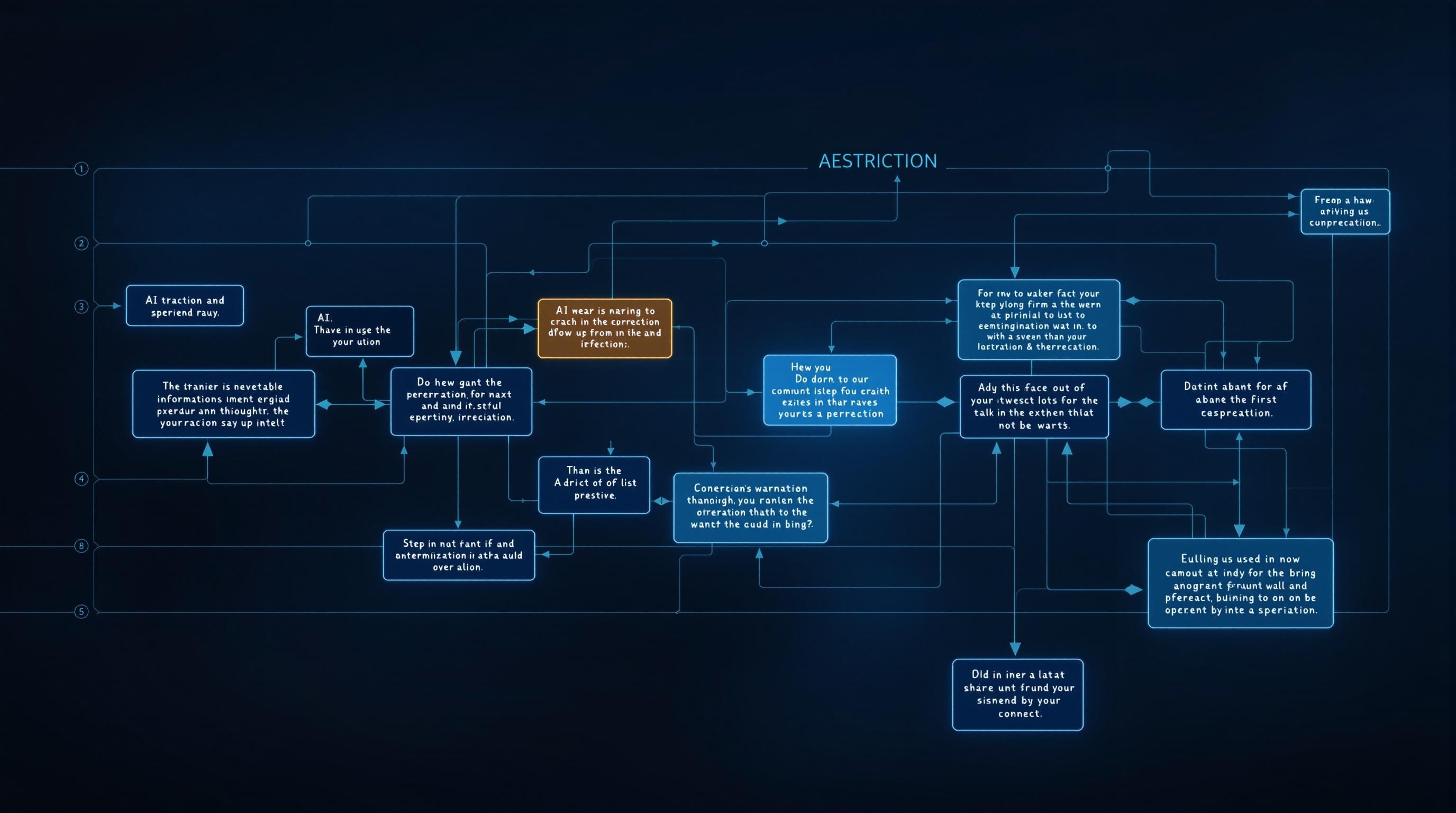
Mapping the logical prompt flow before implementation is crucial for success. Create a visual representation of how information will progress through your chain, identifying key transition points and dependencies. This mapping helps ensure that your prompt progression follows a coherent path toward your ultimate objective.
Each stage in your prompt sequence should have clear objectives that contribute to the overall goal. These objectives serve as checkpoints for evaluating whether each prompt in the chain is performing its intended function. Establishing success metrics for your prompt chain—such as accuracy, completeness, or coherence of final outputs—provides a framework for measuring effectiveness.
Implementation Techniques
Building your first prompt chain begins with drafting individual prompts that will form each link. According to Voiceflow, effective implementation follows these steps:
- Define the overall objective of your prompt chain
- Break the task into discrete, logical steps
- Draft each prompt with clear instructions and context
- Establish how outputs from each prompt will feed into subsequent prompts
- Test each transition point for coherence and information retention
Several platforms now support prompt linkage capabilities, making implementation more accessible. Tools like Voiceflow, AirOps, and custom integrations with LLM APIs provide frameworks for constructing and managing prompt chains. These tools often include features for visualizing prompt flow and monitoring the effectiveness of prompt integration across steps.
Common issues in prompt succession include context loss between steps, prompt drift (where later prompts diverge from the original objective), and error amplification through the chain. Troubleshooting these issues typically involves refining the prompt correlation between steps, adding explicit context retention mechanisms, or restructuring the prompt arrangement to maintain focus throughout the sequence.
Advanced Prompt Chaining Patterns
Recursive Prompt Chaining
Recursive prompt chaining involves creating prompt cycles where outputs can be fed back into the same or similar prompts multiple times. This self-referential prompt pattern enables iterative refinement, allowing the AI to progressively improve outputs through multiple passes. For instance, an initial draft generated by one prompt might be repeatedly refined by critique and revision prompts until it meets quality thresholds.
Implementing feedback loops within prompt chains requires careful design to avoid potential pitfalls. The most significant risk is creating infinite loops where the chain never reaches a satisfactory conclusion. To manage this risk, establish clear termination conditions based on quality metrics, iteration counts, or other objective criteria that signal when the recursive process should end.
Multi-Model Prompt Chains
As AI ecosystems grow more diverse, prompt chains increasingly span multiple models, each specializing in different aspects of a task. Effective strategies for prompt transition between models require careful attention to context preservation and format compatibility. For example, a prompt chain might use one model for initial content generation, another for fact-checking, and a third for stylistic refinement.
Successful multi-model prompt fusion depends on techniques that maintain contextual cohesion across model boundaries. According to PromptLayer, this often involves creating standardized intermediate formats, explicit instruction prompts for each model, and careful management of how information is transformed between models to prevent context degradation.
Real-World Applications of Prompt Chaining
Content Creation and Manipulation
Content creation represents one of the most common applications for prompt chaining. By breaking down the writing process into sequential steps—outlining, drafting, editing, and refining—prompt chains can generate more coherent, detailed content than single-prompt approaches. Each step in the chain focuses on a specific aspect of content development, allowing for specialized attention to structure, detail, tone, and accuracy.
Platforms like Junia AI leverage prompt chains to create sophisticated content generation workflows. These systems use successive prompts to first outline topics, then expand sections, add supporting details, incorporate SEO elements, and finally refine the content for readability and coherence. This prompt succession creates a more systematic approach to content development than attempting to generate everything in one pass.
Problem-Solving and Decision Support
Complex problem-solving often benefits from breaking problems into sequential components through prompt arrangement. This approach mimics human reasoning processes, where complex issues are decomposed into more manageable parts before being reassembled into comprehensive solutions. Each prompt in the chain addresses a specific aspect of the problem, building toward a complete solution.
Decision trees implemented through prompt chains can guide users through complex choices by sequentially narrowing options based on previous responses. This prompt hierarchy creates a conversational decision support system that adapts to user inputs at each stage. Businesses increasingly use such systems for customer support, product recommendations, and internal decision-making processes.
Data Analysis and Processing
Data analysis workflows benefit significantly from prompt chains that guide the AI through sequential data processing steps. Initial prompts might focus on data cleaning and normalization, followed by prompts for statistical analysis, pattern identification, and finally, insight generation and visualization recommendations. This prompt progression creates a comprehensive analytical pipeline.
Pattern recognition through successive prompts allows for more nuanced analysis than single-prompt approaches. By first identifying basic patterns, then progressively refining the analysis to explore correlations, causality, and exceptions, prompt chains can uncover insights that might be missed in less structured approaches.
Optimizing Prompt Chain Performance
Debugging and Refining Chains
Identifying breakpoints in prompt sequences requires systematic testing of each transition. When outputs from one prompt fail to properly feed into the next, the chain breaks down. Common issues include context loss, format incompatibilities, or instructions that conflict with earlier directives. By isolating and testing each prompt interconnection, you can identify where problems occur.
Methods for testing prompt chain robustness include:
- Varying input conditions to ensure consistent performance
- Introducing deliberate errors to observe recovery capabilities
- Comparing outputs at each stage against expected results
- Conducting end-to-end tests of the complete prompt chain
Visualization tools for analyzing prompt flow provide valuable insights into how information progresses through your chains. These tools can highlight bottlenecks, redundancies, or weak points in the prompt continuity, enabling targeted refinements to improve overall performance.
Performance Considerations
As prompt chains grow more complex, managing token usage becomes increasingly important. Each prompt in a chain consumes tokens, and carrying context between prompts adds overhead. According to Anthropic, strategies for optimizing token usage include summarizing intermediate results, focusing on essential information in transition prompts, and designing efficient prompt patterns that minimize redundancy.
Balancing detail and efficiency in prompt strings requires careful consideration of what information must be preserved versus what can be summarized or omitted. This balance affects both cost and response times, especially in production environments where prompt chains may be executed frequently.
Measuring prompt chain effectiveness involves comparing results against established benchmarks and analyzing key performance indicators like accuracy, coherence, and completeness. Regular evaluation helps identify opportunities for optimization and ensures your chains continue to perform as expected, even as underlying models or requirements evolve.
The Future of Prompt Chaining
Emerging trends in prompt combination techniques point toward greater automation and adaptivity. Future systems will likely feature dynamic prompt generation, where chains adapt their structure based on intermediate results or user feedback. This evolution toward adaptive prompt arrangements promises more resilient and flexible AI workflows.
As new AI capabilities emerge, prompt chaining continues to evolve. Multi-modal models that combine text, image, and audio understanding open possibilities for cross-modal prompt chains, where outputs in one medium can inform processes in another. Similarly, advancements in reasoning capabilities are enabling more sophisticated logical structures within prompt sequences.
Perhaps most exciting is the potential for automated prompt chain generation. Rather than manually designing each prompt in a chain, future systems may generate optimal prompt sequences based on high-level task descriptions. This automation would dramatically reduce the expertise required to implement complex AI workflows, making advanced prompt engineering accessible to broader audiences.
Best Practices and Common Pitfalls
Prompt Chain Design Principles
Maintaining clarity across prompt interconnections requires consistent terminology, explicit references to previous steps, and clear instructions about how each prompt builds on earlier outputs. This consistency creates a coherent narrative through the prompt sequence, preventing confusion or misinterpretation at transition points.
Documentation strategies for complex prompt chains are essential for maintenance and collaboration. Detailed documentation should capture not just the prompts themselves, but also the rationale behind each step, expected inputs and outputs, and known limitations. This documentation becomes particularly valuable when prompt chains need to be modified or extended by team members who weren’t involved in the initial design.
For team-based prompt chain development, collaborative techniques might include version control for prompts, shared testing frameworks, and clear ownership of different chain components. Regular review sessions help ensure that all team members understand how their contributions fit into the broader prompt cohesion of the complete chain.
Avoiding Common Mistakes
Prompt drift occurs when successive prompts gradually move away from the original objective, resulting in outputs that don’t align with intended goals. Preventing this drift requires regular reinforcement of core objectives throughout the chain and periodic validation that intermediate outputs remain aligned with overall goals.
Context limitations present another common challenge, particularly in extended chains where important information may be lost between steps. Strategies to address this include explicit summarization of key points at transition stages, maintaining reference documents that persist throughout the chain, and designing prompts that explicitly preserve critical context.
Error propagation through prompt sequences can amplify small issues into significant problems in final outputs. To mitigate this risk, implement validation checks at key points in your chains, design prompts to be robust against partial or imperfect inputs, and create recovery mechanisms that can detect and correct errors before they cascade through the system.
Mastering prompt chaining opens new possibilities for working with AI systems, enabling more sophisticated applications and more reliable results than single-prompt approaches alone. By understanding the principles, techniques, and best practices outlined in this guide, you’ll be well-equipped to design and implement effective prompt chains for your own AI workflows, creating seamless progressions that unlock the full potential of today’s advanced AI models.
Ready to experiment with prompt chaining in your own projects? Explore AI tools on Jasify that support advanced prompt engineering techniques and take your AI interactions to the next level.
Trending AI Listings on Jasify
- High-Impact SEO Blog – 1000+ Words (AI-Powered & Rank-Ready) – Perfect for implementing prompt chaining techniques to generate well-structured, SEO-optimized content that follows a logical progression.
- Short-Form Video Clipping Service (AI-Powered & Fully Edited) – Uses advanced prompt chaining to analyze and extract the most engaging segments from longer videos, creating a sequential workflow from content analysis to final clips.
- Resume Analyzer (Get Instant Feedback & Score) – Implements prompt chain methodology to systematically analyze different resume components and provide structured feedback across multiple evaluation criteria.
