

How to Write a Prompt That Gets Immediate, High-Quality AI Responses
This guide shows you how to write a prompt that gets swift, high-quality AI responses on the first try. You’ll learn a simple structure (outcome, context, role, format), see examples and edge cases, add verification without asking for private reasoning, and use a fast iteration method. We’ll also share reusable templates and ways to measure prompt quality—plus where Jasify’s marketplace tools can help you scale.
Map the outcome in one line
Start every prompt with a clear outcome: action + deliverable + audience + success signal. This single line acts as the directive that cues the model to produce the exact thing you want—fast.
Example: “Draft a 120-word product blurb for SMB CFOs that lists 3 benefits in plain English and avoids jargon.”
That sentence motivates a focused, immediate response. It’s a nudge that can spur quality because it limits scope and indicates acceptance criteria up front.
Provide only the context that changes the answer
Over-sharing causes drift. Add only details that affect the output. Think of these as the minimal cues that activate accuracy.
- Audience and channel: who it’s for and where it will appear (email, blog, sales deck).
- Constraints: industry, region, compliance limits, or known data sources (IDs/links).
- Non-negotiables: must/never rules (banned terms, reading level, length caps).
Example add-on: “Audience: healthcare buyers in the EU. Cite source IDs S-101 and S-204 only. Never invent metrics.”
Assign a role with guardrails
A good prompt instructs and constrains. Give the AI a role tied to domain knowledge and insist on a small number of safety rails.
Example: “You are a B2B SaaS product marketer. If specs conflict, ask one clarifying question. Never fabricate data. Provide one-sentence rationale after the answer.”
Role + rules is an inceptive frame that helps the model initiate the right behavior and avoid tangents.
Specify output format and level of detail
Tell the model exactly how to package the answer. Tight formats speed review and reduce rework.
Example: “Output: numbered steps (max 5). 110–130 words. Tone: practical and calm. Include 1 source link by ID.”
Clear format is an imperative cue. It can propel a quicker time-to-first-token and a cleaner, more usable response.
Show one good example and one edge case
Models learn from pattern cues. Include a brief exemplar plus a tricky variant so the system can generalize without guessing.
Good example: “Blurb for SMB CFOs, 120 words, 3 crisp benefits, no acronyms.”
Edge case: “If benefits are speculative, replace the third benefit with ‘Risk: what to verify’ and add a limitations line.”
Require verification without exposing internal reasoning
You don’t need a chain-of-thought. Ask for compact checks that improve trust and speed.
- A one-sentence rationale (“Why this answer should work”).
- A limitations line (what might be missing or uncertain).
- Source grounding via IDs/links and a simple confidence note.
For safety and resilience, pair this with guardrails and prompt-injection awareness. Our post on prompt injection defense covers immediate, practical countermeasures. Lakera AI has similar guidance on injection risks and mitigations (external).
Optimize for speed
Slow prompts usually try to do too much. Narrow the task, cap tokens, and prefer lists over long prose. If the job is big, ask for an outline first—then say “GO” to expand. Incremental delivery reduces latency and edit effort.
Tip: For SEO or content ops, compact formats consistently cut rework. See our guide on prompt optimization for SEO for practical structures you can reuse.
Iterate fast: the 3‑pass prompt sprint
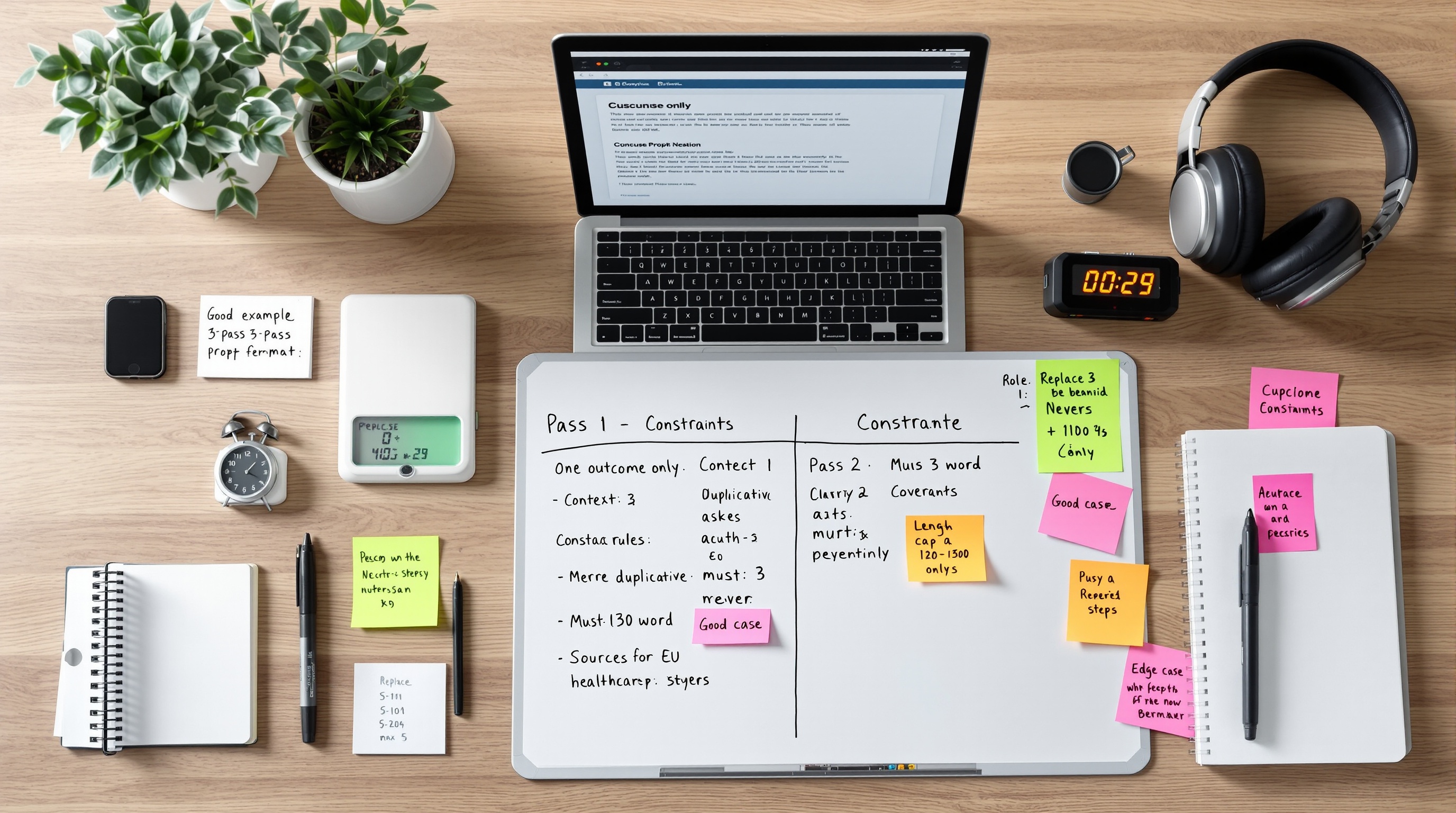
- Pass 1 — Clarity: Remove vagueness. Merge duplicative asks. One outcome only.
- Pass 2 — Constraints: Add must/never rules, length caps, and format.
- Pass 3 — Coverage: Add only context that changes the answer (audience, region, sources).
Ship, test on 3–5 samples, then A/B a small change. Keep what reduces edits and increases correctness.
Reusable prompt templates you can adapt
Vendor outreach email (Jasify leads)
Goal: Invite AI vendors to list on Jasify. “You are a B2B partnerships manager. Draft a 120–150 word outreach email to [ICP] introducing Jasify, ‘The AI Marketplace.’ Include 2 value props ([value1], [value2]), one clear CTA (‘Book a listing consult’), and a compliance note (‘We respect data-use policies’). Tone: warm and professional. Output: subject line + preview line + body. One-sentence rationale. Limitations: what info would improve this.”
Product comparison brief
Goal: Compare 3 AI tools. “You are an analyst. Compare [toolA], [toolB], [toolC] for [use case]. Criteria: [list]. Data sources: [IDs/links]. Output: 5-bullet summary, simple scoring table spec (criteria, weights, scores 1–5), 1-line recommendation. Never invent benchmarks; if unknown, mark ‘unknown’ with a source to verify. Include one-sentence rationale + limitations.”
Transcript → data extraction
Goal: Pull entities and decisions. “You are an operations analyst. Extract from transcript: {‘decision’: string, ‘owners’: array, ‘due_date’: string, ‘risks’: array}. If absent, use ‘unknown’. Output only JSON. After JSON, add one-sentence rationale and a limitations line. Never include PII beyond what’s in the source.”
Jasify vendor discovery prompt
Goal: Shortlist marketplace vendors. “You are a procurement researcher. Budget: [range]. Industry: [industry]. Must-haves: [features]. Output: 5 vendors with 1-sentence fit reason each + source links. Region rules: [constraints]. Tone: neutral. If data is thin, propose 2 clarifying questions instead of guessing.”
Anti‑patterns to avoid
- Vague asks (“Write something about X”).
- Stacked tasks in one prompt (research + draft + format + translate at once).
- Missing constraints (no length, no tone, no banned terms).
- Unlimited outputs (no caps = slow, rambling answers).
- No example or edge case (model guesses your style, often wrong).
- Demanding private chain-of-thought (not needed; ask for a compact rationale instead).
Measure and improve prompt quality
Create a lightweight rubric and track what actually matters: time-to-first-token (speed), completeness vs. your acceptance criteria (quality), citation accuracy (trust), and edit effort (cost). For creative tasks, style match is useful—link to a short example in your prompt. For visual work, we compiled a practical roundup of image prompt generators you can adapt for text-to-image workflows.
Where Jasify fits in your prompt workflow
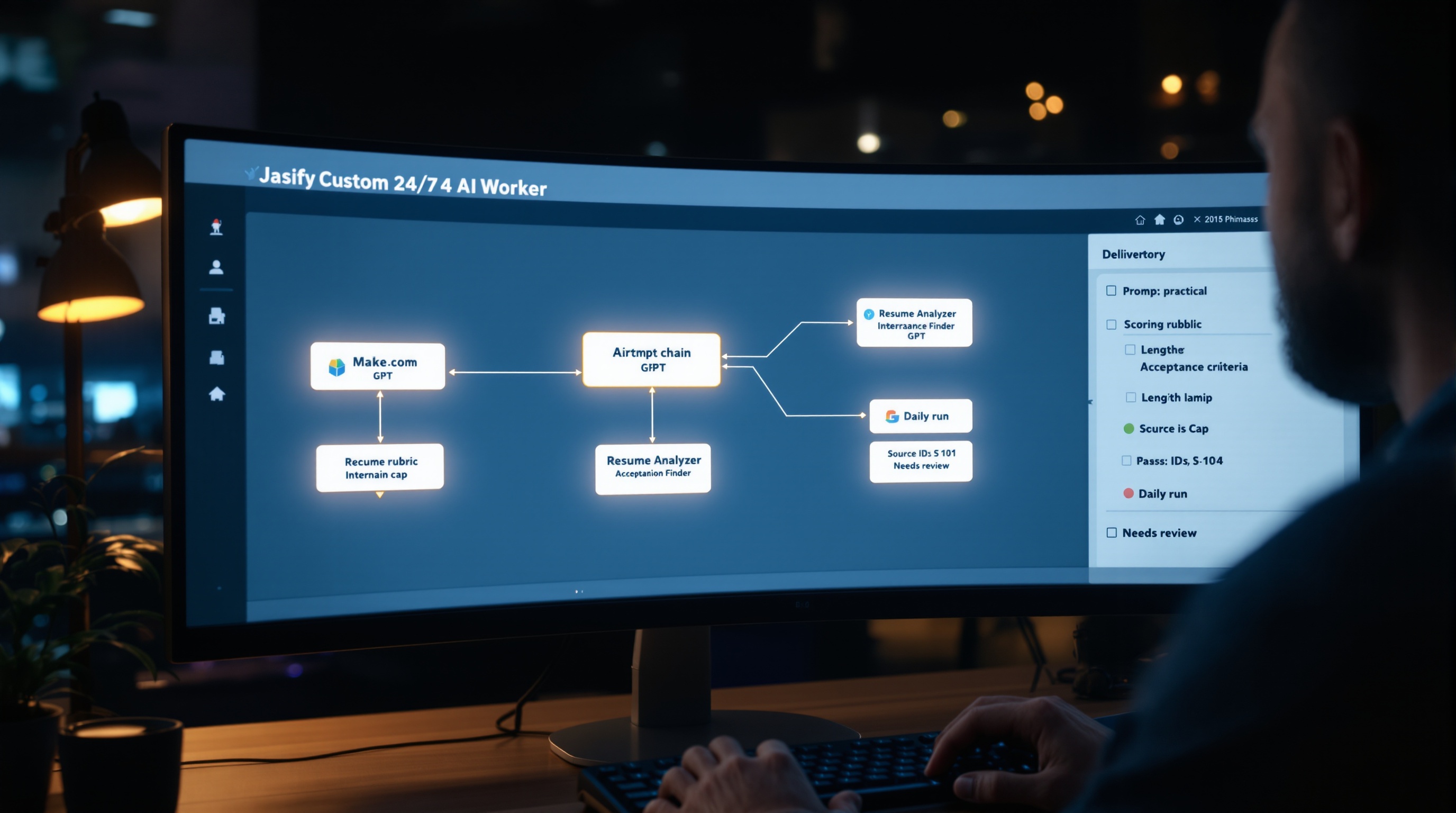
Jasify isn’t just a directory—it’s where prompts turn into systems. If you’re ready to automate consistent, high-quality outputs, the Custom 24/7 AI Worker can implement your prompt chains with Make.com, Airtable, and GPT so an actual workflow runs every day. If you want a live example of structured prompts in the career space, the Resume Analyzer uses scoring rubrics and acceptance criteria to deliver practical feedback quickly. And if you’re job hunting, the Internship Finder blends targeted prompt systems with human curation to shortlist roles and generate tailored applications.
Teams building SEO content or research briefs can reuse the structures above—then standardize them across functions. Atlassian offers straightforward prompting guidance for clarity and structure (external). Put that into practice with Jasify templates, evaluate results, and roll your best prompts into your operating playbook.
Quick reference: a great prompt in one paragraph
“You are a [role]. Task: [action + deliverable] for [audience/channel]. Constraints: [must/never], [region/industry], [length cap], [tone]. Sources: [IDs/links]; never invent data. Output: [exact format/schema]. Include a one-sentence rationale and a limitations line. If specs conflict, ask one clarifying question before answering.”
That single paragraph is the cue—the instructive, inceptive push—that can provoke an immediate, high-quality response. Used consistently, it will enable faster cycles, reduce edits, and lead your team to better outcomes with less effort.
