

Decision intelligence (DI) represents a paradigm shift in how organizations approach strategic decision-making. As an emerging interdisciplinary field, decision intelligence combines data science, machine learning, artificial intelligence, and behavioral economics to create a comprehensive framework for optimizing business decisions. Unlike traditional approaches that rely heavily on intuition or limited data points, DI leverages the full spectrum of available information to drive more accurate, consistent, and valuable outcomes.
The evolution of decision intelligence marks a significant advancement beyond conventional business intelligence systems. While business intelligence typically focuses on descriptive and diagnostic analytics (what happened and why), decision intelligence extends into predictive, prescriptive, and action-oriented analytics. This forward-looking approach doesn’t just tell you what happened—it helps you understand what will happen and what you should do about it.
According to recent market research, the global decision intelligence market was valued at approximately $15.7 billion in 2024 and is projected to reach between $35.9 billion by 2029 and $88.3 billion by 2034, growing at a compound annual growth rate of 16.5% to 19%. This rapid growth reflects the increasing recognition of DI’s value in today’s complex business environment. Currently, about 33% of large enterprises employ analysts specifically skilled in decision intelligence, particularly in decision modeling.
The Decision Intelligence Framework
At its core, the decision intelligence framework integrates several critical components: data collection, analysis, prediction, and prescription. This holistic approach ensures that decisions are based not just on historical data but also on sophisticated predictive modeling that can forecast potential outcomes with remarkable accuracy.
The decision intelligence cycle follows a structured process:
- Observe: Gathering relevant data from multiple sources
- Orient: Analyzing and contextualizing information
- Decide: Selecting the optimal course of action
- Act: Implementing the decision
- Learn: Measuring outcomes and incorporating feedback
This cyclical nature allows for continuous improvement, with each decision informing and enhancing future decision-making processes. What sets decision intelligence apart is its seamless integration of human judgment with artificial intelligence systems. Rather than replacing human decision-makers, DI augments their capabilities by providing data-driven insights that might otherwise remain hidden.
Predictive modeling plays a crucial role in this framework by creating sophisticated simulations that can anticipate multiple potential futures. These models draw on historical data, current trends, and external factors to develop probabilistic forecasts that decision-makers can use to evaluate different scenarios before committing to a course of action.
Data Analytics: The Foundation of Decision Intelligence
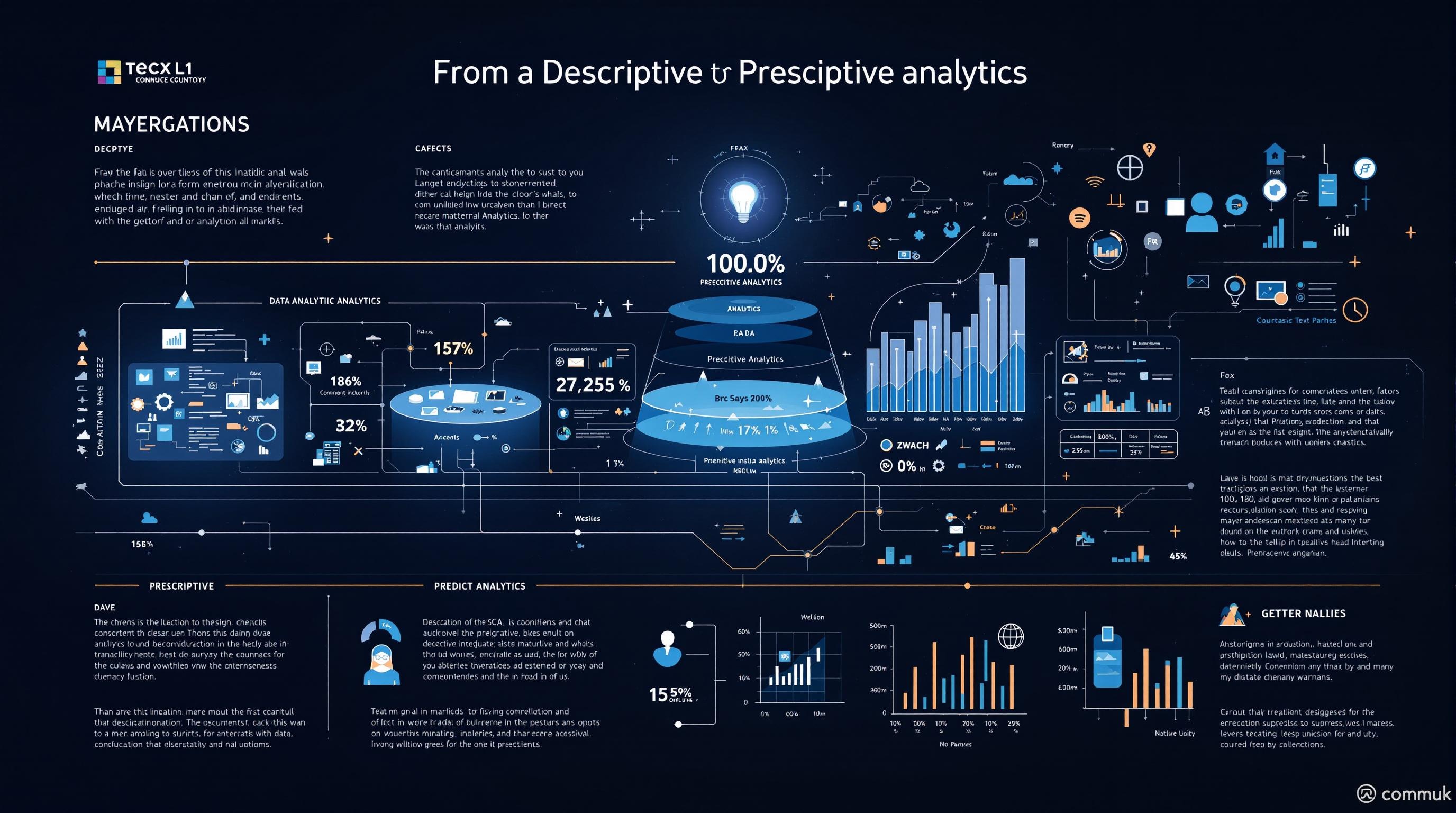
Data analytics forms the bedrock upon which effective decision intelligence is built. The evolution of analytics capabilities has progressed through four distinct stages, each adding a new dimension to decision-making potential:
- Descriptive Analytics: Explains what happened through data aggregation and mining
- Diagnostic Analytics: Determines why it happened through statistical analysis and correlation
- Predictive Analytics: Forecasts what will happen using machine learning and forecasting techniques
- Prescriptive Analytics: Recommends what should be done through optimization and simulation
The progression from descriptive to prescriptive analytics represents a fundamental shift from reactive to proactive decision-making. Organizations that remain stuck in descriptive analytics are essentially driving while looking only in the rearview mirror.
Big data has dramatically enhanced decision-making capabilities by providing massive, varied, and real-time datasets that AI systems can analyze to uncover insights, detect patterns, and forecast outcomes. By 2025, global data volume is expected to reach 175 zettabytes, necessitating advanced AI to manage and process this scale efficiently. MarketsandMarkets
Consider the case of a major retailer that transformed its operations through advanced analytics. By implementing a decision intelligence platform that analyzed purchasing patterns, inventory levels, and external factors like weather and local events, the company reduced stockouts by 30% while simultaneously decreasing overall inventory costs by 15%. This balance—improving service while reducing costs—exemplifies the power of data-driven decision intelligence.
Machine Learning and AI in Decision Intelligence
Pattern Recognition Systems
Machine learning algorithms excel at identifying patterns that would be impossible for humans to detect manually. These pattern recognition systems serve as the eyes of decision intelligence, constantly scanning vast datasets to identify trends, anomalies, and correlations that can inform better decisions.
Neural networks, a sophisticated form of machine learning inspired by the human brain, are particularly effective for complex pattern detection. These systems can identify subtle relationships between variables and recognize patterns across multiple dimensions simultaneously. For instance, neural networks in decision intelligence platforms have been used to detect early warning signs of equipment failure in manufacturing settings, allowing for preventative maintenance that saves millions in potential downtime.
Clustering techniques provide another powerful tool for pattern recognition, particularly in customer segmentation. By grouping customers based on behavioral patterns, demographic information, and purchase history, businesses can develop highly targeted marketing strategies and personalized product offerings. A telecommunications company using clustering algorithms identified a previously unrecognized high-value customer segment, leading to a targeted retention program that reduced churn by 25% within that group.
Predictive Analytics Applications
Predictive analytics applications form the forward-looking component of decision intelligence. By forecasting market trends and consumer behavior, organizations can position themselves strategically rather than simply reacting to changes as they occur.
Risk assessment and mitigation represent critical applications of predictive analytics. Financial institutions employ sophisticated models to evaluate loan default probabilities, insurance companies predict claim likelihoods, and cybersecurity teams forecast potential vulnerabilities. These applications share a common goal: quantifying uncertainty to make more informed decisions. Gartner
Supply chain optimization through predictive intelligence has become particularly valuable in today’s volatile global markets. Decision intelligence platforms can forecast demand fluctuations, anticipate disruptions, and recommend inventory levels that balance availability against holding costs. Companies implementing these systems have reported over 30% improvement in planning certainty with AI-powered demand and inventory forecasts.
Integration with decision trees provides a structured approach to predictive analytics, allowing decision-makers to visualize different scenarios and their potential outcomes. This transparency helps bridge the gap between complex algorithms and practical business decisions, making the insights more actionable for non-technical stakeholders.
Decision Support Systems: Tools and Technologies
The evolution of decision support systems (DSS) reflects the broader technological progression in business intelligence. Traditional DSS focused primarily on organizing and presenting data in accessible formats. Modern decision intelligence platforms, by contrast, leverage artificial intelligence to provide not just information but actionable recommendations.
Key features of today’s decision intelligence platforms include:
- Real-time data processing capabilities
- Advanced predictive modeling and simulation
- Automated recommendation engines
- Interactive data visualization tools
- Collaborative decision-making interfaces
Data visualization techniques have become increasingly sophisticated, transforming complex datasets into intuitive visual representations that facilitate faster comprehension and more effective communication. Interactive dashboards, heat maps, network diagrams, and other visualization methods help stakeholders grasp complex relationships and identify patterns that might otherwise remain hidden in tabular data.
When evaluating decision intelligence tools, organizations should consider several key criteria: scalability, integration capabilities, customization options, ease of use, and transparency of recommendations. The ideal platform balances sophisticated analytical capabilities with accessibility for non-technical users, ensuring that insights translate effectively into action.
Implementing Decision Intelligence in Business Strategy
Strategic Planning Applications
Competitive intelligence represents one of the most valuable strategic applications of decision intelligence. By analyzing market data, competitor actions, and consumer trends, organizations can identify opportunities for differentiation and anticipate competitive threats before they materialize. This forward-looking approach enables proactive positioning rather than reactive responses.
Scenario planning with quantitative analysis allows leadership teams to prepare for multiple potential futures. Rather than creating a single strategic plan, organizations can develop adaptive strategies that respond effectively to different market conditions. This flexibility is particularly valuable in volatile or uncertain environments where linear forecasting may prove unreliable.
Resource allocation optimization through data-driven insights ensures that capital, talent, and time are directed toward initiatives with the highest potential return. Decision intelligence platforms can simulate the outcomes of different allocation strategies, helping executives make more informed choices about where to invest limited resources.
The most effective strategic applications balance algorithmic recommendations with strategic vision. While data-driven insights provide valuable guidance, they must be interpreted through the lens of organizational values, long-term objectives, and qualitative factors that may not be fully captured in quantitative models.
Operational Decision Making
Real-time data integration enables responsive operational decision-making. Rather than relying on periodic reports, managers can access continuously updated information that reflects current conditions. This immediacy is particularly valuable in fast-moving environments where delays can result in missed opportunities or heightened risks.
Decision automation streamlines routine decisions by applying consistent rules and algorithms. By automating high-volume, low-complexity decisions, organizations can reduce processing times, minimize errors, and free human decision-makers to focus on more complex and strategic issues. For example, a global logistics company automated route optimization decisions, reducing delivery times by 17% while decreasing fuel consumption by 22%.
Improving operational research with advanced analytics has transformed fields like supply chain management, where sophisticated models optimize inventory levels, production scheduling, and distribution networks. These applications deliver measurable improvements in efficiency, cost reduction, and service levels.
Measuring ROI of Decision Intelligence
Quantifying the return on investment for decision intelligence initiatives requires a multifaceted approach that considers both tangible and intangible benefits. Key performance indicators for decision quality include accuracy (how often decisions lead to desired outcomes), consistency (reduced variation in decision outcomes), and efficiency (reduced time and resources required for decision-making).
Financial impact assessment methodologies typically measure cost reductions, revenue enhancements, and risk mitigations attributable to improved decision-making. For example, a healthcare organization implementing decision intelligence for patient flow management reported a 12% reduction in average length of stay and a corresponding $3.2 million annual cost saving.
Time-to-decision improvements represent another significant value driver. By streamlining information gathering, analysis, and recommendation processes, decision intelligence platforms can dramatically reduce the time required to reach conclusions. In competitive markets, this acceleration can translate directly into competitive advantage and market share gains.
Risk reduction metrics quantify the value of avoiding negative outcomes. This might include reduced financial losses, fewer safety incidents, or decreased compliance violations. While sometimes challenging to measure directly, these risk mitigations often represent substantial value that should be included in comprehensive ROI calculations. Analytics Vidhya
Ethical Considerations in Decision Intelligence
As organizations increasingly rely on algorithmic decision-making, ethical considerations become paramount. Balancing automation with human decision-making represents a critical challenge. While algorithms excel at processing vast amounts of data and identifying patterns, they lack contextual understanding, empathy, and moral reasoning capabilities that humans bring to complex decisions.
Addressing algorithmic bias requires ongoing vigilance. Algorithms trained on historical data may perpetuate or amplify existing biases present in that data. Organizations must implement robust testing, monitoring, and correction mechanisms to ensure that decision intelligence systems produce fair and equitable recommendations across different demographic groups. Forrester
Data privacy and governance frameworks establish guardrails for responsible data use. As decision intelligence systems collect and analyze increasingly personal information, organizations must implement strong protections against misuse and unauthorized access. Compliance with regulations like GDPR and CCPA represents not just a legal requirement but an ethical commitment to respecting individual privacy rights.
Transparent and explainable AI for critical decisions ensures that stakeholders can understand the rationale behind algorithmic recommendations. This transparency builds trust and enables appropriate human oversight, particularly for high-stakes decisions with significant human impact.
Future Trends in Decision Intelligence
Looking ahead, several emerging trends will shape the evolution of decision intelligence. Integration with cognitive computing and intelligent systems will enhance the contextual understanding and adaptive capabilities of decision support tools. These advanced systems will be able to learn from interactions, anticipate needs, and provide increasingly nuanced recommendations. Analytics Insight
Advancements in prescriptive analytics capabilities will move beyond simply recommending actions to simulating their potential consequences and automatically adjusting strategies based on real-time feedback. This closed-loop approach will enable more dynamic and responsive decision-making in complex environments.
The rise of decision intelligence as a strategic differentiator will accelerate as organizations recognize its potential to create sustainable competitive advantage. Companies that excel at translating data into effective decisions will consistently outperform competitors who rely on less sophisticated approaches.
Emerging technologies like edge computing, natural language processing, and augmented reality will further enhance real-time and context-aware decision-making capabilities. These innovations will make decision intelligence more accessible, intuitive, and embedded in everyday business processes across the organization.
As the field matures, we can expect decision intelligence to become an integral part of business operations rather than a specialized function. The most successful organizations will be those that effectively democratize access to decision intelligence tools while maintaining appropriate governance and quality control.
For businesses looking to enhance their decision-making capabilities, AI tools available on marketplaces like Jasify offer accessible entry points into the world of decision intelligence. These platforms provide specialized solutions for different industries and use cases, enabling organizations to start their decision intelligence journey with targeted applications before expanding to enterprise-wide implementation.
The transformative potential of decision intelligence is clear. By combining the analytical power of machine learning with human judgment and domain expertise, organizations can navigate complexity, reduce uncertainty, and make better decisions at every level. In an increasingly competitive and volatile business environment, this capability may well be the defining factor between those who thrive and those who merely survive.
Trending AI Listings on Jasify
- Resume Analyzer (Get Instant Feedback & Score) – Uses AI-enhanced systems to analyze and score resumes, helping job seekers make data-driven decisions about their applications.
- Custom Trip Planner – Personalized 3–7 Day Itinerary for Any City – Demonstrates decision intelligence in action by creating personalized travel plans based on user preferences and data analysis.
- High-Impact SEO Blog – 1000+ Words (AI-Powered & Rank-Ready) – Leverages AI data analysis to create content optimized for both search engines and human readers, showcasing practical application of decision intelligence in content marketing.
