

API for Artificial Intelligence: What It Is and Why It Matters
The rise of artificial intelligence (AI) has transformed how businesses create value, and APIs make this transformation accessible. An API for artificial intelligence allows teams to integrate machine learning, computer vision, natural language processing, and more into their products without building AI models from scratch. This blog explains what AI APIs are, why they matter, the different types available, and how organizations can integrate them responsibly and effectively.
What is an API for artificial intelligence?
A bridge exposing models via predictable endpoints
An artificial intelligence programming interface connects applications to pre-trained AI models, exposing them through standardized, predictable endpoints. This abstraction enables engineers to work with powerful AI without knowing the complexities of training deep learning models or managing compute resources.
Abstracts training, data, and scaling so teams ship faster
By relying on an API, developers avoid heavy lifting tasks like model training, data preparation, and scaling infrastructure. Whether it’s a machine learning API for predictive tasks, a neural network API for advanced deep learning, or an API for natural language processing, teams can shorten time-to-market dramatically while still delivering advanced capabilities.
Why AI APIs matter for teams and products
Cut time-to-market and total cost of ownership
AI API development helps companies speed up innovation, reduce costs, and deliver new features faster. For example, Netflix’s use of a predictive analytics API for recommendations has reportedly saved the company over $1 billion in customer retention value.
Clear interfaces aid security, governance, and vendor integration
Standardized API interfaces simplify authentication, authorization, documentation, and monitoring. This makes it easier to integrate with multi-vendor ecosystems and ensures compliance with regulations like GDPR and HIPAA when handling sensitive data. Governance practices such as versioning, consistent design guidelines, and thorough observability are vital when deploying AI model hosting APIs and AI model deployment APIs in production environments.
The main types you’ll encounter
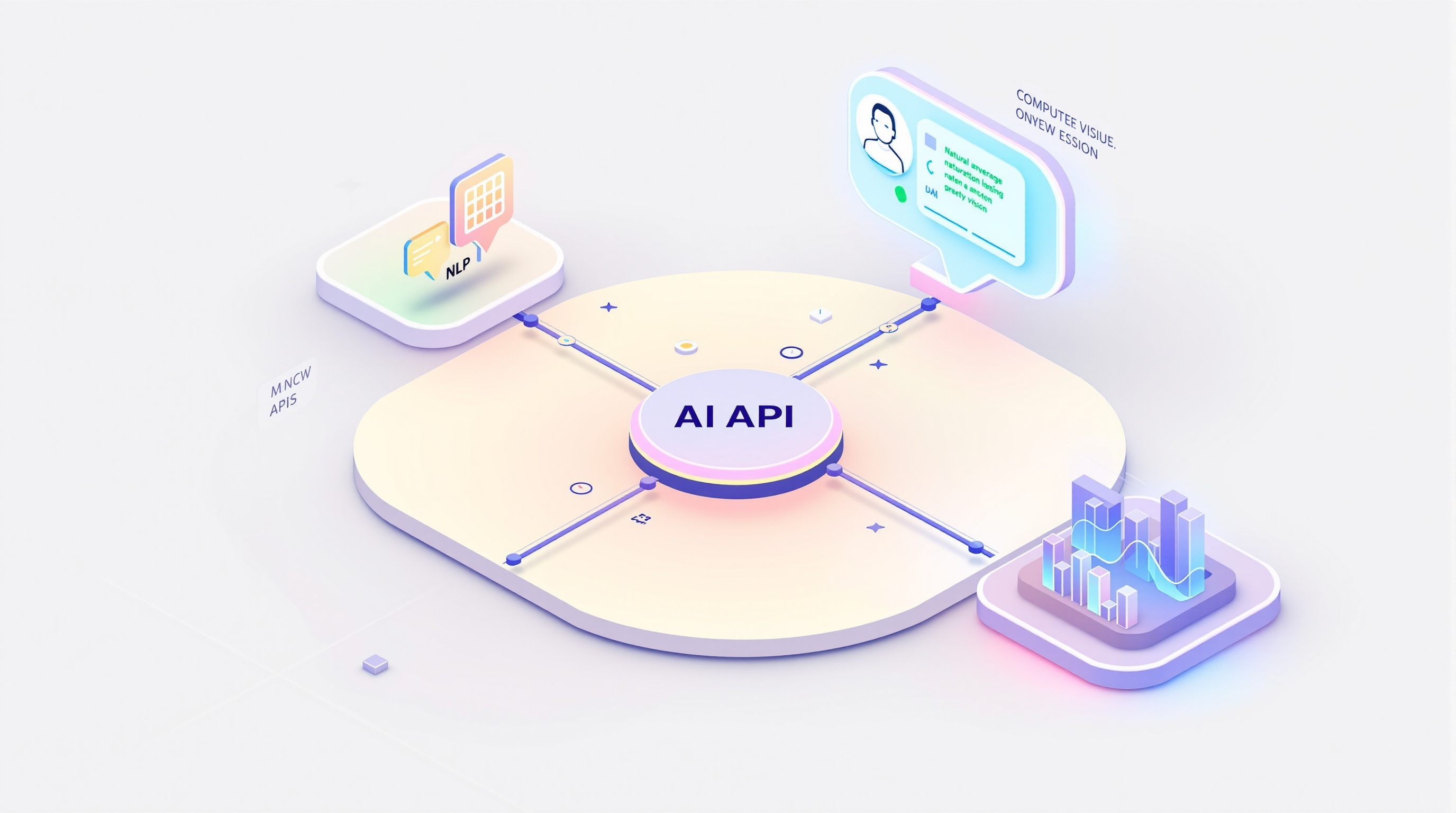
Pick by task; avoid one-model-for-everything
APIs are often optimized for specific AI tasks, making it better to choose purpose-built APIs rather than one general solution. Here are some of the most common categories:
- Machine learning APIs for predictive analytics APIs, API for clustering algorithms, and API for regression algorithms.
- API for natural language processing, covering conversational AI APIs, API for sentiment analysis, API for semantic analysis, APIs for neural machine translation, and API for text classification.
- API for computer vision tasks such as API for image recognition, API for facial recognition, API for object detection, and API for emotion recognition.
- API for speech recognition, API for speech synthesis, and conversational chatbot APIs for voice-driven customer support.
- API for cognitive computing and API for knowledge graphs for reasoning and decision-making support.
- API for anomaly detection, API for fraud detection, API for time series forecasting, and API for generative models used in industries from finance to creative applications.
- Advanced APIs like API for reinforcement learning, API for optimization algorithms, API for decision trees, API for active learning, API for graph analytics, AI model training APIs, and AI model validation APIs support more complex business workflows.
Build vs buy: cloud-based AI API or self-hosted models?
Weigh latency, data sensitivity, cost, and operational overhead
Businesses must consider whether to use a cloud-based AI API or host models in their own environments. Cloud solutions shine for scalability and fast integration, while self-hosted AI model hosting APIs can offer tighter control for data privacy, low-latency deployments, or compliance concerns. Many companies use a hybrid approach where sensitive tasks are run internally while broader functions rely on cloud providers.
Integration essentials for shipping AI features
Plan authentication, rate limits, versioning, and fallback UX
Integrating an AI API is not just about calling endpoints—it requires strong operational practices:
- Cache stable results and batch high-volume calls for performance optimization.
- Implement circuit breakers and tuned retries to stabilize AI algorithms APIs under load.
- Log inputs and outputs for AI model evaluation APIs, tracing results back to users and sessions.
- Use monitoring to detect anomalies in API for sequence prediction or API for time series analysis tasks.
- Design fallback user experiences so that failures in API for recommendation systems or API for recommendation algorithms do not break core functionality.
Reliability, risk, and responsible use

Test for bias, drift, hallucinations, and personal data exposure
APIs are as reliable as the models they expose. Risks include bias, drifting accuracy, data leakage, and AI-generated hallucinations. Best practices include:
- Gate releases with evaluations and controlled canary rollouts when deploying AI model training APIs.
- Monitor ongoing performance with golden datasets to ensure API for sequence classification and other classifiers remain accurate.
- Keep human oversight for sensitive tasks, especially when deploying API for cognitive computing or API for chatbots that handle customer interactions.
- Ensure compliance when training or serving workloads with API for data labeling and API for data analysis.
Conclusion
An API for artificial intelligence democratizes access to advanced machine learning and deep learning capabilities. From AI model evaluation APIs to API for computer vision or API for speech recognition, these tools accelerate development, reduce costs, and improve customer experiences. Responsible deployment—through robust governance, security, monitoring, and human oversight—ensures they deliver long-term value. Whether building or buying, integrating APIs for AI will continue to be central for businesses aiming to remain innovative and competitive in a data-driven world.
As AI adoption grows, organizations using AI APIs not only keep up with market demand but also future-proof their technology stack. Companies that invest today in strong api ai integration strategies will be best positioned to deliver smarter services tomorrow.
Explore more about AI solutions and integrations at Jasify, the trusted AI marketplace where businesses connect with tools, services, and products powered by artificial intelligence.
