


Discover the 7 stages of artificial intelligence from rule-based systems to the theoretical Singularity. Learn where we stand today and how businesses can leverage current AI capabilities for real results.

Discover the real difference between AI vs algorithm with our expert guide. Learn when to use each for your business needs, how they work, and practical examples from automation to ChatGPT.
Agent workflow in customer service environments encompasses the sequence of tasks, processes, and activities that service representatives follow to address customer inquiries and resolve issues. Despite its critical importance to business operations, agent workflow often suffers from significant inefficiencies that hamper productivity and customer satisfaction.
Statistics reveal the magnitude of this problem: inefficient workflows can cause substantial time waste, with agents spending up to 30% of their time switching between different systems and searching for information. Conversely, AI-powered workflow automation can reduce resolution times by up to 50% and first response times by 37%, enabling agents to engage customers faster and more effectively according to Desk365.
The impact of poor workflow management extends beyond operational metrics to affect both agent morale and customer experience. Key pain points in traditional agent workflow include:
These challenges create a compelling case for workflow optimization through automation technologies that streamline processes and eliminate redundancies.
The financial benefits of implementing workflow automation software present a clear business case for organizations. AI agent implementations have demonstrated a 40% reduction in costs and a 50% increase in productivity, with return on investment typically realized within 12 months of deployment. These impressive figures explain why over 78% of mid-to-large enterprises are expected to deploy AI agents by the end of 2025, according to research from Experro.
Beyond direct cost savings, workflow automation delivers substantial benefits across multiple dimensions:
Reduced training time: Automated, guided workflows decrease the learning curve for new agents, cutting onboarding periods by up to 60%.
Lower operational expenses: Streamlined workflow processes reduce error rates and the associated costs of correcting mistakes.
Enhanced agent performance metrics: Organizations implementing workflow automation software report improvements in first-contact resolution rates, average handle time, and customer satisfaction scores.
The global AI agents market, which powers many workflow automation solutions, is projected to reach $7.60 billion in 2025 and escalate to $50.31 billion by 2030, driven by automation demands and the need for personalized, scalable customer service solutions.
Before implementing any workflow optimization strategy, establishing baseline metrics and ongoing measurement protocols is essential. Key performance indicators to track before and after workflow automation include:
These metrics should be benchmarked against industry standards using workforce management software and analytics dashboards to identify areas with the greatest potential for improvement through workflow optimization.
Effective workflow optimization begins with a comprehensive understanding of current processes. Process mapping involves documenting all agent tasks and interactions to create visual representations of workflow patterns, decision points, and handoffs between teams or systems.
Modern workflow analysis tools leverage data and AI to identify bottlenecks, redundancies, and inefficiencies within these mapped processes. This analysis phase reveals opportunities to streamline workflow by:
– Eliminating unnecessary steps that don’t add value
– Consolidating related tasks to reduce context switching
– Identifying candidates for automation among repetitive processes
– Reconfiguring decision pathways to optimize resolution time
Creating detailed workflow diagrams provides a visual foundation for stakeholder discussions about improvement opportunities and serves as documentation for future workflow automation implementation.
Task management systems form the backbone of efficient agent workflow, providing structure and visibility to daily activities. Effective task management platforms for customer service environments include features such as:
Automated task assignment that routes issues to appropriate agents based on predefined rules
Prioritization frameworks that ensure high-impact customer issues receive timely attention
Follow-up automation that eliminates the need for manual tracking of pending tasks
Integration capabilities with existing workflow tools such as CRM systems and knowledge bases
When selecting workflow automation software for task management, organizations should prioritize solutions that offer customizable workflows aligned with their specific business processes and customer service requirements.
AI-powered routing and assignment algorithms represent a significant advancement in workflow optimization. These systems analyze multiple factors—including agent skills, historical performance, current availability, and customer needs—to determine the optimal assignment for each incoming inquiry.
Intelligent workload distribution through workflow automation platforms delivers multiple benefits:
Balanced agent workloads that prevent overallocation to any individual team member
Real-time workforce management that adapts to changing conditions throughout the day
Burnout prevention by ensuring equitable distribution of complex cases
According to Sobot, AI agents can autonomously handle up to 80% of customer service interactions, significantly reducing agent workload while enhancing response speed and quality.
A specialized application of intelligent workload distribution, skills-based routing matches customer inquiries to agents with relevant expertise. This workflow optimization strategy involves:
Mapping detailed agent skill profiles against common customer inquiry types
Implementing dynamic routing logic that considers real-time queue conditions
Deploying workflow automation tools that support specialized distribution paths
Developing targeted training programs that align with specific workflow requirements
Skills-based routing not only improves first-contact resolution rates but also enhances agent confidence and satisfaction by assigning them tasks aligned with their strengths.
Converting paper-based or manual processes into digital workflows represents a foundational step in optimization efforts. Organizations should begin by identifying high-volume, repetitive scenarios that would benefit from standardization, such as account updates, billing inquiries, or product information requests.
Digital workflow creation involves:
Documenting the ideal resolution path for each common scenario
Building step-by-step guided processes within workflow automation software
Standardizing response templates and resource access points
Testing and refining workflows to ensure optimal efficiency
Successful digital workflow implementations have demonstrated reduction in handle times by up to 40% for routine inquiries while simultaneously improving consistency in customer experience.
Integrating knowledge management into agent workflow systems addresses one of the most significant productivity barriers: information retrieval. Workflow automation software can transform this process by:
Automatically surfacing relevant knowledge articles based on customer inquiry context
Embedding knowledge retrieval within the same interface agents use for customer interaction
Providing contextual guidance that anticipates agent information needs
Tracking knowledge usage patterns to identify content gaps
By reducing search time and presenting information contextually, workflow-integrated knowledge management can improve first-contact resolution rates while decreasing average handle time. This integration represents a prime example of how workflow automation technology can directly enhance agent productivity.
The most technically sophisticated workflow automation solution will fail if agents find it difficult or frustrating to use. Human-centered design principles should guide workflow technology implementation:
Minimizing cognitive load by presenting only the most relevant information and options at each step
Creating intuitive interfaces that follow natural problem-solving patterns
Balancing automation with appropriate levels of agent autonomy and decision-making
Offering customization options that accommodate different working styles
The goal of agent-friendly workflow design is to create systems that feel like supportive tools rather than restrictive constraints, enhancing both adoption rates and overall satisfaction with workflow technology solutions.
Continuous improvement in workflow optimization requires systematic collection and implementation of agent feedback. Effective feedback mechanisms include:
Regular surveys targeting specific workflow components
In-application feedback tools that capture insights at the moment of experience
Focus groups to discuss workflow challenges and potential solutions
Agent representation on workflow optimization project teams
Organizations that successfully incorporate agent suggestions into workflow enhancements report higher adoption rates and greater productivity gains from their workflow automation investments.
The average customer service agent navigates between 5-7 different systems during typical interactions. Cross-system workflow integration addresses this fragmentation by creating unified workspaces through API connections and data synchronization.
Benefits of integrated agent workspaces include:
Reduced time spent switching between applications
Elimination of duplicate data entry requirements
Comprehensive customer view across all touchpoints
Seamless handoffs between different functional areas
While integration challenges—including API limitations, data formatting inconsistencies, and security considerations—can present obstacles, the productivity gains justify the investment in robust workflow integration solutions.
Building compliance and quality checkpoints directly into agent workflows represents a proactive approach to ensuring service excellence. Workflow automation software can support quality assurance through:
Embedded compliance verification at critical decision points
Real-time script adherence monitoring during customer interactions
Automated approval workflows for transactions exceeding specified thresholds
Quality scoring based on adherence to defined workflow processes
The integration of quality assurance into workflow design reduces error rates and rework while maintaining high service standards—all without adding separate quality control steps that might decrease overall efficiency.
Traditional training approaches often overwhelm new agents with information that isn’t immediately applicable. Workflow automation software enables a more effective approach through:
Guided workflows that provide step-by-step instruction during actual customer interactions
Just-in-time learning modules that appear when specific scenarios arise
Progressive complexity that adapts as agents demonstrate proficiency
Performance analytics that identify targeted coaching opportunities
This embedded approach to training reduces formal onboarding time while improving knowledge retention and application. According to research from Pragmatic Coders, enterprises deploying AI-driven workflow automation report operational cost savings up to 68% during peak seasons, partly due to reduced training requirements.
Workflow optimization is not a one-time project but an ongoing discipline. Organizations achieving sustained productivity improvements implement methodologies such as:
Kaizen: A philosophy of continuous, incremental improvement applied to workflow processes
Six Sigma: Data-driven approach to eliminating defects and variations in workflow execution
Agile: Iterative testing and refinement of workflow enhancements in short cycles
These methodologies, supported by workflow analysis tools and automation platforms, create a culture of efficiency and adaptation that maintains productivity gains over time.
Successful workflow automation implementation follows a structured approach that typically includes:
Assessment Phase: Documenting current workflows, establishing baseline metrics, and identifying priority improvement areas
Design Phase: Creating optimized workflow models, selecting appropriate automation tools, and developing integration plans
Pilot Implementation: Testing workflow automation in controlled environments with selected agent teams
Phased Rollout: Gradually expanding automation to additional processes and teams
Continuous Optimization: Monitoring performance metrics and refining workflows based on results
This measured approach minimizes disruption while maximizing adoption and return on investment. Organizations should plan for 3-6 months for initial implementation, with ongoing optimization efforts continuing indefinitely.
Organizations should prepare for several common obstacles when implementing workflow automation:
Resistance to change from agents accustomed to existing processes
Technical integration difficulties with legacy systems
Data migration and quality issues affecting workflow functionality
Resource constraints limiting implementation scope or pace
Successful implementations address these challenges through comprehensive change management, thorough technical planning, and realistic resource allocation.
Looking ahead, several emerging technologies promise to further revolutionize agent workflow:
AI and machine learning applications that continuously optimize routing and processing decisions based on outcome data
Predictive analytics that anticipate customer needs and proactively prepare relevant resources
Voice-enabled workflow technologies that allow hands-free navigation through process steps
Multi-agent AI systems where collaborative automated agents handle interconnected tasks
Organizations invested in AI tools for workflow optimization will be well-positioned to leverage these advancements as they mature, maintaining competitive advantages in efficiency and customer experience.
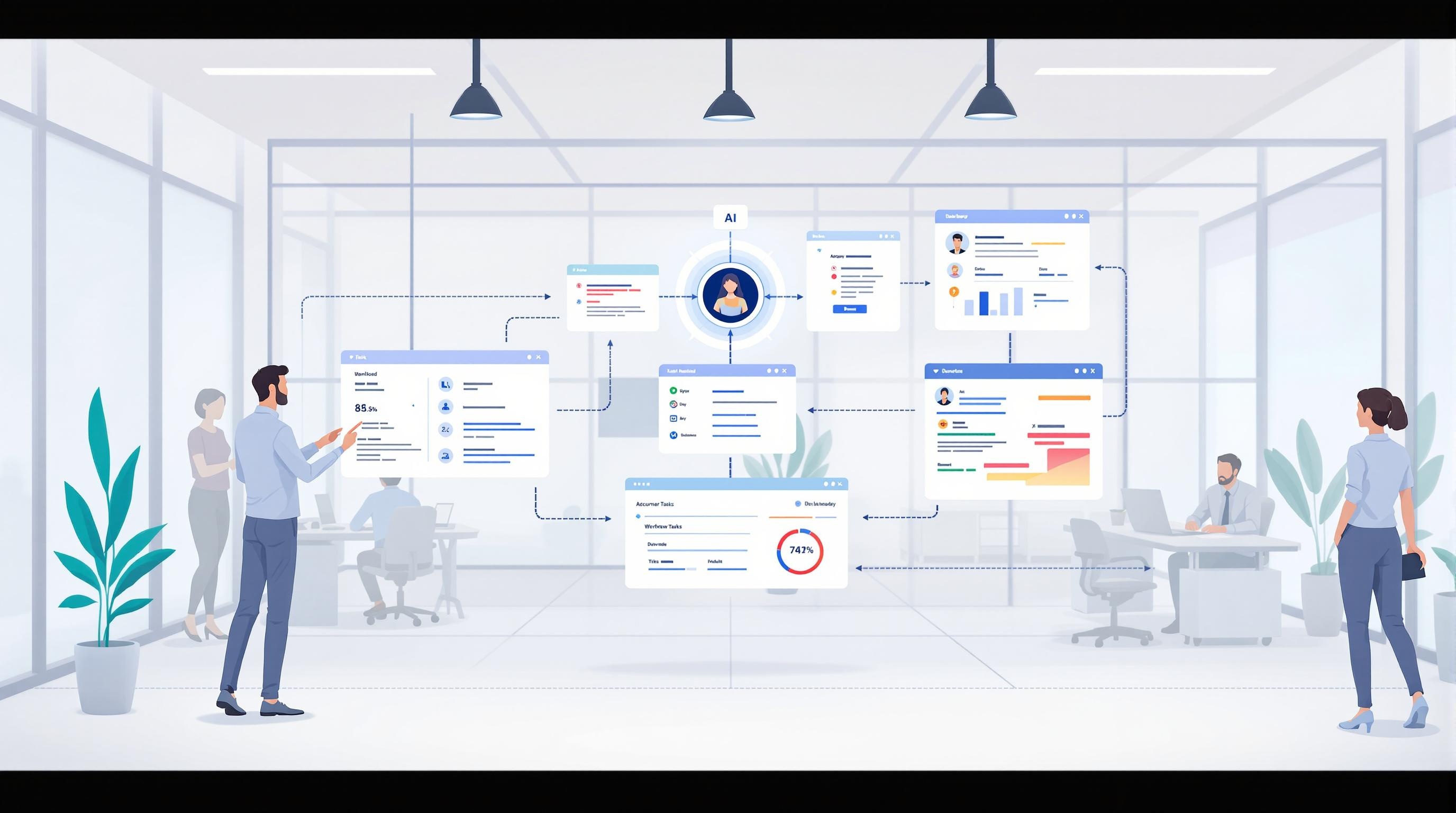
By implementing these ten proven strategies for agent workflow optimization, organizations can dramatically improve productivity, enhance customer satisfaction, and create more engaging work environments for their service teams. The comprehensive approach—from process mapping through continuous optimization—ensures sustainable improvements that adapt to evolving business needs while delivering measurable returns on workflow automation investments.


Discover the 7 stages of artificial intelligence from rule-based systems to the theoretical Singularity. Learn where we stand today and how businesses can leverage current AI capabilities for real results.
Discover the real difference between AI vs algorithm with our expert guide. Learn when to use each for your business needs, how they work, and practical examples from automation to ChatGPT.
Discover the 7 stages of artificial intelligence from rule-based systems to the theoretical Singularity. Learn where we stand today and how businesses can leverage current AI capabilities for real results.
Discover the real difference between AI vs algorithm with our expert guide. Learn when to use each for your business needs, how they work, and practical examples from automation to ChatGPT.
Discover the 7 stages of artificial intelligence from rule-based systems to the theoretical Singularity. Learn where we stand today and how businesses can leverage current AI capabilities for real results.
Discover the real difference between AI vs algorithm with our expert guide. Learn when to use each for your business needs, how they work, and practical examples from automation to ChatGPT.
Discover the 7 stages of artificial intelligence from rule-based systems to the theoretical Singularity. Learn where we stand today and how businesses can leverage current AI capabilities for real results.
Discover the real difference between AI vs algorithm with our expert guide. Learn when to use each for your business needs, how they work, and practical examples from automation to ChatGPT.
Discover the 7 stages of artificial intelligence from rule-based systems to the theoretical Singularity. Learn where we stand today and how businesses can leverage current AI capabilities for real results.
Discover the real difference between AI vs algorithm with our expert guide. Learn when to use each for your business needs, how they work, and practical examples from automation to ChatGPT.