What Is an AI Token?
An AI token is the smallest unit of data that large language models (LLMs) use to read and process text. Think of tokens as AI’s version of reading comprehension—but instead of seeing whole sentences, the model breaks everything into chunks. A token might be a complete word like “marketplace,” part of a word like “market” and “place,” a single character, or even punctuation. This matters because tokens function as the currency of AI systems: they determine how much your API calls cost, how fast your chatbot responds, and how much context your model can remember in a conversation. Whether you’re a developer building AI tools or a business managing AI expenses, understanding tokens directly impacts your budget and application performance.
How Does AI Tokenization Actually Work?
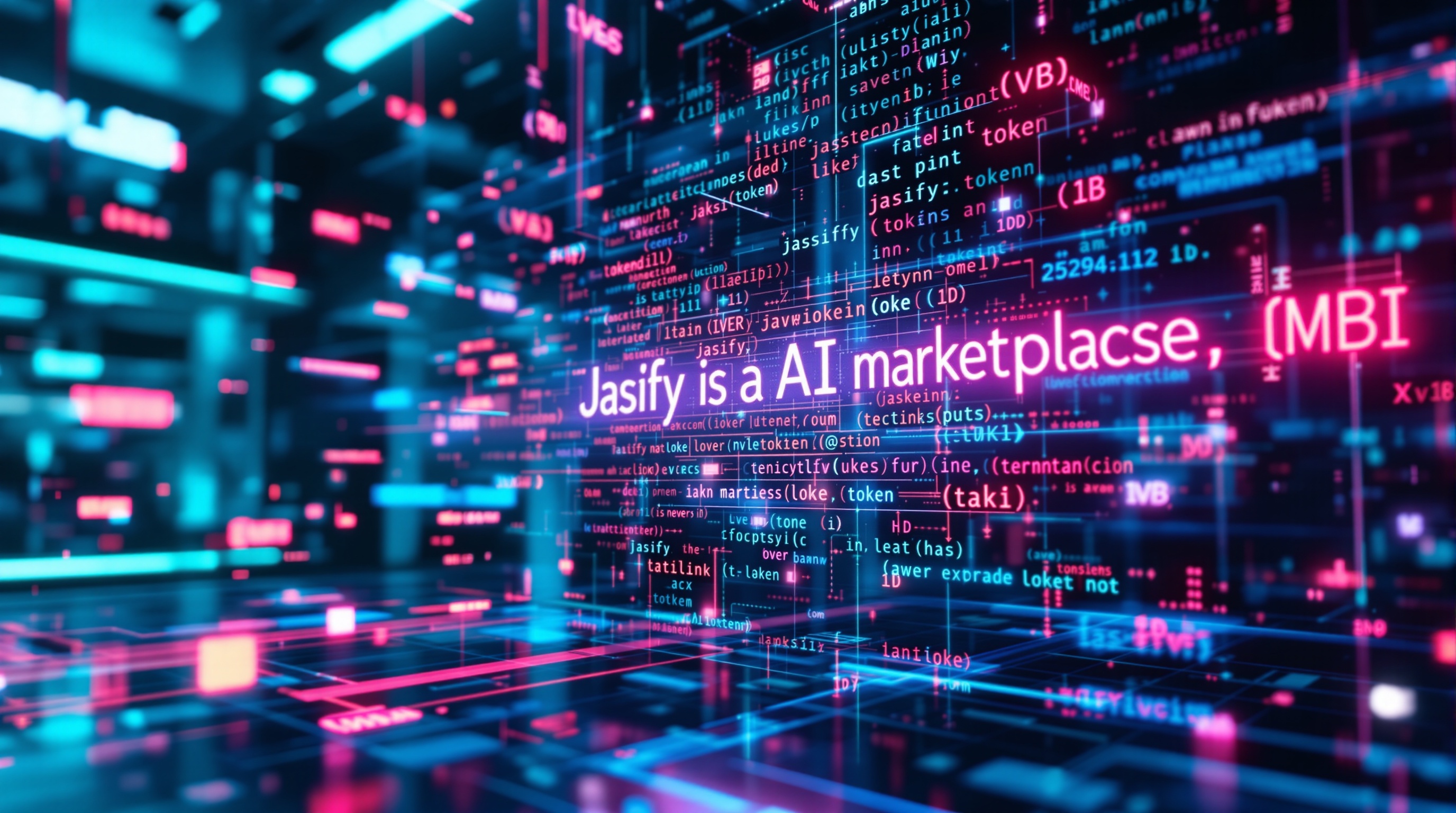
When you type “Jasify is an AI marketplace” into ChatGPT or any other LLM, the model doesn’t see those words the way you do. Instead, it runs the text through a tokenizer—a preprocessing tool that splits your input into a sequence of tokens. Each token gets converted into a numerical ID that the model’s neural network can actually process.
Here’s what happens behind the scenes. The tokenizer looks for common patterns in text based on how the model was trained. Common words like “the” or “is” usually become single tokens. Longer or less common words might get split up. For example, “marketplace” could be one token, or it might become “market” and “place” depending on the tokenization scheme.
According to OpenAI’s documentation, a token can be as short as one character (like “a”) or as long as one word (like “apple”). The model doesn’t understand language—it understands numbers. So “Jasify” might become token ID 45821, “is” becomes 318, “an” becomes 281, and so on.
Different models use different tokenization methods. GPT models use byte-pair encoding (BPE), which balances efficiency and vocabulary size by finding the most common character combinations in training data. The result? Most English text runs about 1 token per 0.75 words, or roughly 4 characters per token.
But here’s where it gets interesting: tokenization isn’t consistent across languages. English is relatively efficient. Languages with different character systems—like Chinese or Japanese—may require more tokens for the same conceptual content. That means the same idea costs different amounts depending on the language you’re working in.
Why Tokenization Design Matters
The way text gets broken into tokens has real consequences. Research published in arXiv (2024) found that different tokenization schemes can change sequence length by 10–20% for identical text. That variance directly affects computational cost and how much effective context the model has to work with.
If your application processes thousands of requests daily, that 10–20% difference translates into significant cost variations and performance shifts.
Why Do Tokens Matter for AI Cost and Performance?
Tokens aren’t just a technical detail—they’re the fundamental unit that determines what you pay and how well your AI application performs. Every API call to services like OpenAI, Anthropic, or Google’s AI models is billed based on token count. Both your input (the prompt) and the output (the model’s response) consume tokens, and you’re charged for both.
As OpenAI explains, each model has a maximum context window—the total number of tokens it can handle in one request. GPT-4, for example, has variants with 8K, 32K, or 128K token limits. That window includes everything: your system instructions, conversation history, the current prompt, and the response.
Here’s the practical impact. Let’s say you’re building a customer support chatbot. If each conversation includes a long context history to maintain continuity, you’re burning through tokens fast. A single back-and-forth exchange might consume 500 input tokens and generate 200 output tokens. At scale—say, 10,000 conversations daily—that’s 7 million tokens per day.
And tokens directly affect latency. Longer prompts take longer to process. More output tokens mean slower response times. If you’re running a real-time application, every extra token adds milliseconds that users notice.
The Economics of Token Management
Most businesses using AI don’t realize how quickly token costs compound. According to OpenAI’s 2024 API updates, many customers achieve significant savings by trimming unnecessary context and capping maximum response tokens for common queries.
Here’s what we’ve seen at Jasify: vendors building AI-powered tools often start with generous token limits during development, then face sticker shock when scaling to production. The businesses that succeed are the ones who treat tokens like a budget line item from day one.
Context windows also limit functionality. If your model has an 8K token limit and your prompt uses 6K tokens for context, you’ve only got 2K tokens left for the response. Run out of room, and the model either truncates the output or fails entirely.
How Are AI Tokens Counted and Priced?
Understanding how to estimate token usage is essential for budgeting and optimization. The general rule of thumb from OpenAI is that 1 token equals approximately 0.75 words or 4 characters in English. So a 100-word prompt runs about 133 tokens.
But pricing isn’t uniform. API providers charge separately for input tokens (what you send) and output tokens (what the model generates). According to OpenAI’s pricing documentation, GPT-4o mini costs significantly less per 1,000 tokens than GPT-4o, making it more cost-efficient for high-volume or simpler tasks.
Here’s a comparison of how different model tiers are typically priced:
Typical token pricing structure for OpenAI models (rates as of late 2024):
| Model | Input Tokens (per 1K) | Output Tokens (per 1K) | Best Use Case |
|---|---|---|---|
| GPT-4o | Higher cost | Higher cost | Complex reasoning, nuanced content |
| GPT-4o mini | Lower cost | Lower cost | High-volume, straightforward tasks |
| GPT-3.5 Turbo | Lowest cost | Lowest cost | Simple queries, chatbots, classification |
The key insight? Output tokens usually cost more than input tokens. If your application generates long responses, that’s where costs escalate. A verbose AI assistant that writes 500-word answers to every question will drain your budget faster than one that keeps responses concise.
Calculating Your Actual Costs
Let’s make this concrete. Say you’re running an AI content tool that helps users draft marketing copy. Each request includes:
- System prompt: 150 tokens
- User input: 200 tokens
- Model output: 400 tokens
That’s 350 input tokens and 400 output tokens per request. If you’re using GPT-4o at (hypothetically) $0.03 per 1K input tokens and $0.06 per 1K output tokens, each request costs about $0.0345. Doesn’t sound like much—until you’re processing 50,000 requests monthly. That’s $1,725/month just in token costs.
Now imagine you optimize the system prompt down to 80 tokens and cap output at 250 tokens. Same functionality, but costs drop to roughly $0.0198 per request. At 50,000 requests, that’s $990/month—a 43% reduction.
How Can You Optimize Your Token Usage to Reduce Costs?

The good news? You’ve got multiple strategies to reduce token consumption without sacrificing quality. Here’s what actually works in production environments.
1. Engineer Your Prompts for Conciseness
Every unnecessary word in your system prompt costs money on every single API call. Review your instructions ruthlessly. Can you say the same thing in fewer words? Remove examples that don’t add value. Cut redundant phrasing.
Instead of: “Please carefully analyze the following user input and provide a detailed, comprehensive response that thoroughly addresses their question.”
Try: “Answer the user’s question clearly and concisely.”
Same intent, 70% fewer tokens.
2. Control Response Length
Most APIs let you set a max_tokens parameter that caps output length. Use it. If you’re building a FAQ bot that needs 50-word answers, don’t let the model generate 300-word essays.
You can also instruct the model directly: “Respond in under 100 words.” Models generally respect length guidelines when explicitly stated.
3. Implement Intelligent Caching
If your application repeatedly uses the same context or frequently answers similar questions, cache those responses. Don’t re-generate identical outputs. Some platforms now offer prompt caching at the API level, which can cut costs dramatically for repeated context.
4. Choose the Right Model for the Task
Don’t use GPT-4 when GPT-3.5 will do the job. Simple classification tasks, basic Q&A, and straightforward content generation don’t need the most expensive model. Reserve premium models for complex reasoning, nuanced content, or tasks that genuinely require advanced capabilities.
At Jasify’s marketplace, we’ve seen developers save 60–70% on token costs by routing requests intelligently—complex queries go to powerful models, simple ones to efficient models.
5. Trim Conversation History
If you’re maintaining context across multiple turns in a conversation, you don’t need to send the entire chat history every time. Summarize older messages or drop early exchanges that are no longer relevant. Keep only what’s necessary for continuity.
6. Monitor Usage Continuously
You can’t optimize what you don’t measure. Track token consumption by feature, user segment, and model. Identify which parts of your application burn the most tokens, then focus optimization efforts there.
Tools like GEOHQ’s AI Search Visibility Platform help businesses monitor how AI systems perform across different queries and use cases—understanding where your tokens go is the first step to using them smarter.
How Jasify Supports Efficient AI Development
At Jasify, we’ve built a marketplace specifically for creators and businesses navigating the economics of AI. Many of the AI tools for business available through Jasify are designed with token efficiency in mind—whether it’s automation systems that minimize API calls or content tools that optimize prompt design.
For developers looking to sell their own AI solutions, understanding token economics isn’t optional. It’s the difference between a profitable SaaS product and one that bleeds money as it scales. That’s why Jasify connects creators who understand these operational realities with buyers who need cost-effective, performance-optimized tools.
Editor’s Note: This article has been reviewed by Jason Goodman, Founder of Jasify, for accuracy and relevance. Key data points have been verified against OpenAI’s official documentation, arXiv research on tokenization efficiency, and OpenAI’s 2024 API updates.