

The Ultimate Guide to AI Content Creation Tools: Revolutionizing Content Strategy for Businesses
Introduction to AI Content Creation
AI content creation represents one of the most significant technological shifts in the marketing world. By leveraging natural language processing and advanced language models, businesses can now generate high-quality content at unprecedented speed and scale. The landscape of AI-powered content creation tools has expanded dramatically, offering solutions for everything from long-form blog posts to social media content, marketing emails, and visual assets.
Today’s AI content creation tools are transforming traditional content development processes that once required days or weeks into tasks that can be completed in minutes or hours. This revolution is having a profound impact on businesses, marketing teams, and content creators by democratizing content production and allowing organizations of all sizes to maintain consistent publishing schedules across multiple platforms.
For marketing teams struggling to keep up with content demands and business owners seeking cost-effective solutions, AI content creation tools offer a powerful alternative to conventional methods. The technology has matured beyond simple text generation to become a comprehensive suite of solutions supporting end-to-end content strategy.
Understanding AI Content Generation Technology
At the heart of AI content creation lies natural language processing (NLP), the technology that enables machines to understand, interpret, and generate human language. Modern AI writing tools are powered by sophisticated language models trained on vast datasets of text from across the internet.
These language models analyze patterns in human writing to predict which words should follow others in a sentence, resulting in coherent, contextually relevant text that often reads as if written by a human. Tools like Jasper AI, Writesonic, and others utilize variations of transformer-based architectures similar to GPT (Generative Pre-trained Transformer) to produce content based on user prompts. GetBlend
The key differences between AI-generated content and human-written content involve trade-offs between efficiency and nuance. While AI excels at speed, consistency, and scale, human writers still maintain advantages in emotional intelligence, critical thinking, and deep contextual understanding. The most effective content strategies often combine AI-generated text with human editing to achieve optimal results. LearnWorlds
Recent technological advancements have dramatically improved the quality of AI-generated content. These include:
- More sophisticated large language models with improved coherence over longer texts
- Better understanding of SEO requirements and search intent
- Enhanced ability to maintain consistent brand voice and tone
- Integration capabilities with existing content workflows through APIs
Benefits of AI Content Creation Tools for Businesses
The adoption of AI content creation tools offers numerous advantages for businesses looking to enhance their content strategy:
Time and Resource Efficiency
AI tools dramatically reduce the time required to produce content, enabling faster publication cycles and more responsive marketing. What might take a human writer several hours can be accomplished in minutes with AI assistance, freeing up valuable time for strategic tasks.
Scaling Content Creation
For businesses needing to maintain multiple channels simultaneously, AI content creation tools provide the ability to scale output across blogs, social media, email, and other platforms without proportional increases in resources or team size.
Maintaining Fresh Content
AI tools help keep content fresh and relevant by enabling rapid updates based on new information, trending topics, or competitive analysis. This constant renewal is critical for maintaining search visibility and audience engagement.
Cost-Effectiveness
Compared to traditional content creation methods involving agencies or large in-house teams, AI tools offer significant cost advantages, especially for high-volume content needs. DesignRush reports that businesses using AI content tools often see 50-80% reduction in content production costs.
Data-Driven Content Strategy
Many AI content creation tools incorporate analytics and keyword research, helping businesses develop more effective content strategies based on actual search data and performance metrics rather than guesswork.
Categories of AI Content Creation Tools
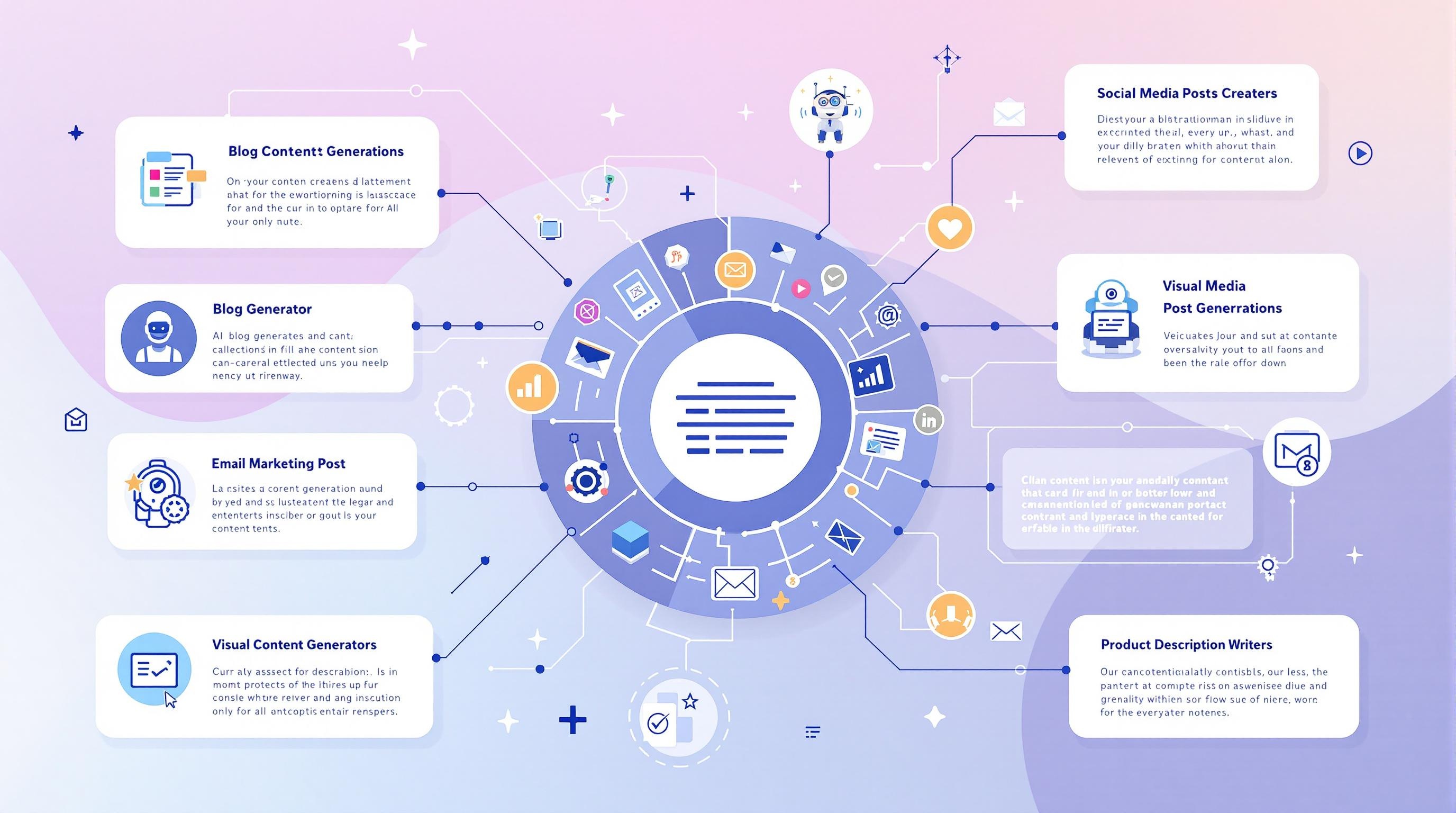
Long-form Content Generators
Specialized for creating comprehensive blog posts, articles, and whitepapers, long-form content generators help businesses produce in-depth content that builds authority and drives organic traffic. These tools typically include features for SEO optimization, content structure, and maintaining narrative coherence over thousands of words.
Tools like Junia AI and Jasper AI excel at producing blog content that ranks well in search engines while maintaining readability and engagement factors important to human audiences. Junia AI
Social Media Content Tools
Creating engaging social media posts consistently across multiple platforms presents a significant challenge for marketing teams. AI solutions for social media content generation provide platform-specific formats and styles, ensuring content is optimized for each channel’s unique requirements.
These tools help maintain consistent brand voice while adapting content to the specific formats needed for Instagram, Twitter, LinkedIn, and other platforms. They typically offer templates for different post types and can generate variations to test for engagement.
Email Marketing Content Tools
AI tools for crafting effective marketing emails help businesses overcome the constant challenge of creating compelling subject lines and email body content that drives opens and conversions. These solutions enable personalized email campaigns at scale, allowing for segmentation and customization that would be impractical with manual methods.
Features often include email subject line generators, A/B testing capabilities, and tools for creating various email types from newsletters to promotional content and automated sequences.
Visual Content Generators
The newest frontier in AI content creation includes tools for generating images, graphics, and videos. These visual content generators help businesses create engaging multimedia assets without extensive design skills or video production capabilities.
AI-generated videos and faceless video content are particularly valuable for businesses looking to expand into video marketing without the complexity and expense of traditional production methods. Synthesia notes that AI video creation can reduce production time by up to 90% compared to conventional methods.
Product Description Writers
E-commerce businesses face the challenge of creating unique, compelling product descriptions across potentially thousands of items. Specialized AI tools for product descriptions solve this problem by generating unique content for each product while maintaining brand voice and highlighting key selling points.
These tools can transform basic product specifications into engaging marketing copy that drives conversions and supports SEO for product pages.
Top AI Content Creation Tools Review
Jasper AI
Key Features: Comprehensive content generation for blogs, social media, emails, and marketing copy; templates for specific content types; team collaboration features; brand voice customization
Pricing: Starting at $49/month with a 7-day free trial
Best For: Marketing teams needing versatile content creation capabilities across multiple formats
Writesonic
Key Features: AI article writer for long-form content; landing page copy; product descriptions; integration with WordPress
Pricing: Plans start at $16/month with a free trial option
Best For: Businesses focused primarily on blog content and SEO
Junia AI
Key Features: SEO-optimized blog content; competitor keyword analysis; content gap identification; Junia AI specializes in creating content designed specifically to rank in search engines
Pricing: Various plans based on content volume
Best For: SEO-focused content strategies aiming to build organic traffic
Rytr
Key Features: Budget-friendly tool with 40+ templates; good for short-form content; supports multiple languages
Pricing: Plans from $9/month
Best For: Small businesses and entrepreneurs with limited content budgets
StoryChief
Key Features: Content calendar; multi-channel distribution; SEO optimization; analytics
Pricing: Starting at $55/month
Best For: Teams needing content creation and distribution capabilities in one platform
Implementing AI Content Tools in Your Workflow
Successfully integrating AI content creation tools into your existing processes requires a strategic approach:
Creating Effective Content Briefs
The quality of AI-generated content depends heavily on the quality of inputs. Developing detailed content briefs with clear objectives, target keywords, competitor examples, and brand guidelines significantly improves output quality.
Balancing AI and Human Input
The most successful implementations of AI content tools involve human oversight and editing. This hybrid approach leverages AI for initial drafts and research while relying on human expertise for refinement, fact-checking, and adding unique insights.
Content marketers should view AI as a collaboration tool rather than a replacement, using it to handle routine aspects of content creation while focusing human creativity on strategic elements. Zapier
Integration with Existing Systems
Many AI content creation tools integrate with Google Docs, WordPress, and marketing platforms through APIs or services like Zapier and Make.com. This connectivity allows businesses to build automated content workflows that move seamlessly from generation to publication.
Industry-Specific Applications
E-commerce
Online retailers leverage AI content tools for creating product descriptions at scale, category pages, promotional emails, and ad copy. These businesses particularly benefit from AI’s ability to maintain consistency across large product catalogs while creating unique content for each item.
B2B Marketing
B2B companies use AI content creation for thought leadership articles, white papers, case studies, and technical content. The technology helps B2B marketing teams maintain regular publishing schedules for lead generation while ensuring consistent quality across complex topics.
Small Business Applications
For small business owners with limited marketing resources, AI content tools provide an affordable way to compete with larger organizations. Budget-friendly solutions enable small teams to maintain active blogs, social media presence, and email marketing programs without dedicated content staff.
Measuring AI Content Performance
To maximize the value of AI content creation tools, businesses should establish clear performance metrics:
- SEO rankings and organic traffic for blog posts and website content
- Engagement metrics including time on page, bounce rate, and social shares
- Conversion rates for emails, landing pages, and product descriptions
- Production efficiency metrics comparing content output to resource investment
Regular A/B testing of AI-generated content against human-written alternatives helps refine prompts and processes for continual improvement. Many content creation tools now include built-in analytics to track these performance indicators. Synthesia
Ethical Considerations and Limitations
While AI content creation tools offer tremendous benefits, they come with important limitations and ethical considerations:
- AI-generated content may contain factual errors or inaccuracies requiring human verification
- Some AI outputs can appear generic without sufficient customization and editing
- Transparency about AI use may be required in some contexts or industries
- Over-reliance on AI can lead to content that lacks authentic brand voice or unique perspective
Responsible implementation involves human oversight, fact-checking, and using AI as an enhancement to human creativity rather than a complete replacement. LearnWorlds emphasizes that the most successful content strategies maintain human judgment in the review process.
Future of AI Content Creation
The AI content creation landscape continues to evolve rapidly, with several emerging trends pointing to future developments:
- Integration of generative AI tools across the entire content lifecycle from ideation to distribution
- More sophisticated multimodal capabilities combining text, image, and video generation
- Enhanced personalization capabilities for creating audience-specific variations
- Improved analytics and performance prediction before publication
Businesses preparing for these advancements should focus on developing clear content strategies that can leverage AI capabilities while maintaining brand distinctiveness and quality standards.
Conclusion: Building a Balanced AI Content Strategy
AI content creation tools have fundamentally changed how businesses approach content strategy, offering unprecedented efficiency, scale, and consistency. The most successful implementations combine AI’s productive capacity with human creativity and strategic oversight.
For businesses looking to leverage these powerful tools, the process should begin with clearly defined content objectives and a strategic framework that identifies where AI can add the most value. Starting with specific use cases like blog posts or product descriptions allows for controlled implementation before expanding to broader applications.
As AI content creation technology continues to advance, the competitive advantage will increasingly go to organizations that master the balance between automation and authenticity, using AI to handle volume and consistency while preserving the human elements that connect with audiences on an emotional level.
Whether you’re a small business owner looking to establish a content presence or a marketing team seeking to scale your output, today’s AI content creation tools offer solutions that can transform your approach to content strategy and deliver measurable business results.
Explore Jasify AI Marketplace, your hub to find, share, and sell the best AI tools and automation resources online.
