

Synthetic data generation involves creating artificial datasets that replicate the statistical properties, patterns, and structures of real-world data without exposing sensitive information. This technology has become increasingly vital in modern data science as organizations seek ways to develop AI systems while addressing privacy concerns, reducing costs, and enabling testing of rare scenarios.
The market for synthetic data is expanding rapidly, with projections estimating growth from $381.3 million in 2022 to approximately $1.5 billion by 2027. This surge reflects the increasing adoption of artificial dataset creation across diverse industries, from healthcare to finance and autonomous vehicle development.
The benefits of synthetic data generation extend beyond privacy protection:
- Enhanced Privacy: Generate synthetic data that maintains statistical properties without exposing real personal information
- Cost Reduction: Eliminate or reduce expensive data collection and labeling processes
- Rare Scenario Testing: Create simulated data for edge cases that are difficult, dangerous, or impossible to capture in real life
- Bias Mitigation: Develop balanced datasets that address inherent biases in real-world data
According to Netguru, synthetic data comes in various forms to suit different applications. Tabular data resembles structured database records, time-series data represents sequential events or sensor readings, image data supports computer vision tasks, and text data enables natural language processing. Gartner reports that text-based synthetic data is currently the most widely used form (84% of organizations), followed by image (54%) and tabular data (53%).
The Evolution of Data Simulation Algorithms
The journey of data simulation algorithms has evolved dramatically over the past decade. What began as simple random number generation and rule-based systems has transformed into sophisticated machine learning approaches capable of producing remarkably realistic synthetic datasets.
Early data simulation methods relied heavily on statistical sampling techniques and basic randomization. These approaches were limited in their ability to capture complex relationships within data. The landscape shifted significantly with the emergence of advanced data synthesis methods powered by machine learning, particularly deep learning architectures.
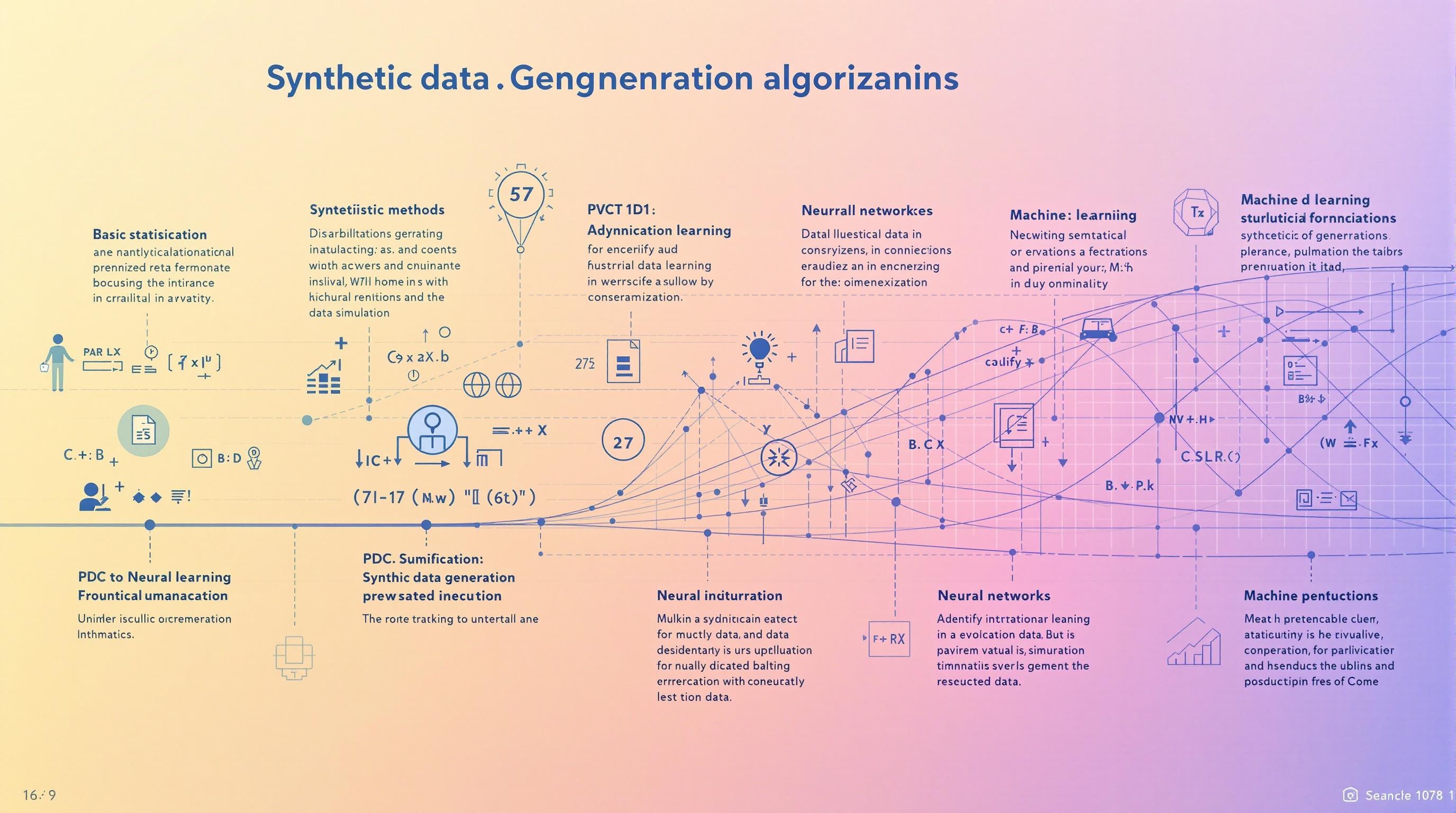
This evolution from rule-based to ML-based data simulation algorithms represents a fundamental shift in synthetic data generation approaches. Modern techniques can learn intricate patterns and relationships directly from real data, then generate new samples that preserve these characteristics without copying actual records.
Regulatory factors have been powerful drivers behind synthetic data adoption. With the implementation of stringent privacy laws like GDPR in Europe and CCPA in California, organizations face increasing pressure to protect personal data. Synthetic data generation provides a viable solution by enabling the creation of statistically equivalent datasets that don’t contain actual personal information, thereby reducing compliance risks while maintaining data utility.
Algorithm 1: Generative Adversarial Networks (GANs)
How GANs Generate Synthetic Data
Generative Adversarial Networks (GANs) have revolutionized computer-generated data by implementing an adversarial training process between two neural networks: a generator and a discriminator. This architecture, pioneered by Ian Goodfellow in 2014, has become fundamental to modern data fabrication techniques.
The generator network attempts to create synthetic data samples, while the discriminator network evaluates their authenticity by comparing them to real data. Through this competitive process, the generator continuously improves its ability to produce increasingly realistic data that can eventually fool the discriminator.
GANs excel at generating diverse data types:
- Images: Creating realistic photographs, artwork, and medical imagery
- Tabular data: Producing synthetic customer records or financial transactions
- Time-series: Generating sequential data like stock prices or sensor readings
While GANs offer impressive capabilities for synthetic data fabrication, they also present challenges including training instability, potential mode collapse (generating limited varieties), and computational intensity. Despite these limitations, GANs remain among the most powerful data generation frameworks for producing high-quality synthetic samples.
Algorithm 2: Variational Autoencoders (VAEs)
Probabilistic Data Generation with VAEs
Variational Autoencoders represent another powerful approach to generate synthetic data through an encoder-decoder architecture with a probabilistic twist. Unlike standard autoencoders that learn to compress and reconstruct data, VAEs encode data into a probability distribution in latent space, enabling more diverse data synthesis methods.
The VAE architecture consists of two primary components: an encoder network that maps input data to a distribution in latent space (typically a multivariate Gaussian), and a decoder network that reconstructs data from samples drawn from this distribution. This probabilistic encoding creates a continuous latent space from which new, unique samples can be generated.
One significant advantage of VAEs over GANs is their stability during training. The encoder-decoder structure with a well-defined loss function makes VAEs more predictable and easier to optimize. Additionally, the learned latent space allows for meaningful interpolation between data points, enabling controlled generation of new samples with specific characteristics.
When implementing VAEs for synthetic data creation, practitioners must carefully consider several parameters including latent space dimensionality, network architecture, and regularization strength. These factors significantly impact the quality and diversity of the generated data. For certain applications, particularly those involving tabular or structured data, VAEs often outperform GANs in maintaining statistical relationships while ensuring sample diversity.
Algorithm 3: Diffusion Models
Noise-Based Data Generation
Diffusion models represent a breakthrough in synthetic data creation by employing a fundamentally different approach based on gradually adding and then removing noise. These models have gained significant attention for their exceptional ability to generate high-quality synthetic data, particularly images.
The diffusion process involves two phases: a forward diffusion process that progressively adds random noise to data until it becomes pure noise, and a reverse diffusion process that learns to recover the original data distribution by removing noise step-by-step. This approach creates a controlled path between random noise and structured data, enabling highly realistic data generation software capabilities.
While initially popularized for image synthesis through models like DALL-E 2 and Stable Diffusion, recent research has successfully adapted diffusion models for structured data types including tabular and time-series data. Their strength lies in capturing complex dependencies and generating highly diverse samples.
According to K2view, diffusion-based synthetic data generation tools are demonstrating remarkable performance metrics compared to earlier approaches, particularly in maintaining statistical fidelity while ensuring privacy. Their ability to generate realistic yet novel samples makes them increasingly valuable for applications ranging from healthcare to financial services.
Algorithm 4: Transformer-Based Synthetic Data
Leveraging NLP Techniques for Data Creation
Transformer architectures, which revolutionized natural language processing, have been successfully adapted for diverse synthetic data generation tasks. These models excel at capturing long-range dependencies and complex patterns in sequential data, making them powerful tools for automatic data generation across multiple domains.
The key to transformer-based synthetic data lies in their self-attention mechanism, which allows the model to consider relationships between all elements in a sequence simultaneously. This capability makes transformers particularly effective for generating not just text but also other structured data types when properly adapted.
Fine-tuning strategies play a crucial role in adapting transformers for domain-specific data generation. By training these models on specialized datasets, they can learn the unique characteristics and constraints of particular industries or data types. For example, financial services organizations might fine-tune transformers to generate synthetic transaction data that preserves temporal patterns and regulatory constraints.
Several successful implementations demonstrate the effectiveness of transformer-based synthetic data generation. For instance, GPT models have been adapted to generate tabular data by encoding table structures into sequences, while specialized architectures like TabTransformer focus specifically on learning and generating tabular data with high fidelity. These algorithmically generated data approaches are becoming increasingly important for organizations seeking to develop AI systems without exposing sensitive information.
Algorithm 5: Copula-Based Methods
Preserving Data Correlations
Copula-based methods represent a mathematically rigorous approach to synthetic data generation that excels at preserving complex relationships between variables. Originating from statistical theory, copulas provide a framework for modeling the dependency structure between variables separately from their individual distributions.
The mathematical foundation of copula functions allows them to capture and reproduce correlation structures independently of the marginal distributions of individual variables. This separation makes copula-based methods particularly valuable for generating statistically generated data that maintains realistic interdependencies while allowing flexibility in the distribution of individual features.
Implementation for multivariate distributions typically follows a two-step process: first modeling the marginal distributions of individual variables, then applying a copula function to describe their joint behavior. This approach enables precise control over both the statistical properties of individual variables and their relationships.
Several specialized libraries and tools support copula-based simulated data modeling, including the R copula package and Python implementations in scikit-learn and SciPy. These tools provide accessible interfaces for implementing sophisticated copula-based generation while handling the underlying mathematical complexity.
Algorithm 6: Agent-Based Simulation (ABS)
Behavioral Modeling for Synthetic Data
Agent-Based Simulation (ABS) offers a unique approach to synthetic data generation by modeling individual entities (agents) and their interactions according to defined rules and behaviors. This bottom-up methodology creates emergent patterns that can closely mimic real-world phenomena, making it ideal for generating simulated data sets with complex interdependencies.
The core principles of agent-based modeling involve defining:
- Agent characteristics and states
- Behavioral rules governing agent decisions
- Interaction mechanisms between agents
- Environmental constraints and influences
ABS excels in applications involving social, economic, and behavioral data where individual decisions collectively produce system-level patterns. For example, it can generate synthetic customer journey data by simulating individual shopping behaviors, or model traffic patterns by simulating driver decisions and interactions.
Modern data simulation methods often integrate ABS with machine learning approaches for enhanced realism. By training ML models on real data to inform agent behaviors, these hybrid approaches can generate highly realistic synthetic datasets that capture both statistical properties and behavioral patterns. This integration represents a powerful advancement in data simulation methods for complex systems.
Algorithm 7: SMOTE and Advanced Oversampling Techniques
Generating Minority Class Data
Synthetic Minority Oversampling Technique (SMOTE) and its advanced variants address a critical challenge in machine learning: imbalanced datasets where minority classes are underrepresented. These data augmentation techniques create synthetic samples of minority classes to improve model training and performance.
The SMOTE algorithm operates by generating synthetic examples along the line segments connecting neighboring minority class instances in feature space. This approach produces more realistic samples than simple duplication while expanding the minority class representation. Several extensions have been developed to address SMOTE’s limitations:
- Borderline-SMOTE: Focuses on generating samples near the decision boundary where classification is most challenging
- ADASYN: Adaptively generates more synthetic samples for minority instances that are harder to learn
- ROSE: Uses a smoothed bootstrap approach for generating synthetic samples
These data randomization techniques are particularly valuable in domains like fraud detection, medical diagnostics, and rare event prediction where minority classes often represent the most important cases to identify. Their effectiveness can be measured through performance metrics including balanced accuracy, F1-score, and area under the precision-recall curve.
According to Daffodil Software, these techniques have become essential components in the machine learning workflow, particularly for critical applications where missing minority cases carries high costs.
Algorithm 8: Synthetic Data Vault (SDV)
Automated Multi-Table Data Synthesis
The Synthetic Data Vault (SDV) represents a comprehensive framework specifically designed for generating synthetic relational data that preserves complex database structures. Developed at MIT, this approach addresses the challenges of mock data creation for interconnected database tables.
SDV’s architecture consists of multiple components working together to understand and reproduce database schemas:
- Table modeling components that learn distributions of individual tables
- Relationship modeling to capture foreign key constraints
- Hierarchical generation processes that respect table dependencies
- Metadata capture mechanisms that ensure consistency
One of SDV’s most valuable capabilities is preserving primary-foreign key relationships across tables. This ensures referential integrity in the generated data, making it particularly useful for testing database applications, data warehousing solutions, and analytics workflows that depend on relational data structures.
Quality assessment in SDV involves several validation approaches including statistical similarity tests, data type consistency checks, and relationship verification. These ensure the synthetic dataset generation maintains both the statistical properties of individual tables and the structural integrity of the overall database.
Algorithm 9: Differential Privacy-Based Generation
Privacy-Preserving Data Synthesis
Differential privacy-based synthetic data generation represents the gold standard for creating datasets with mathematical privacy guarantees. This approach applies formal privacy protections during the generation process, ensuring that synthetic data cannot reveal sensitive information about individuals in the original dataset.
The foundation of differential privacy lies in adding carefully calibrated noise to the data generation process. This noise makes it mathematically impossible to determine whether any specific individual’s data influenced the synthetic output, providing provable privacy protection. The key parameter in differential privacy is epsilon (ε), which controls the privacy-utility tradeoff: lower ε values provide stronger privacy but potentially less accurate synthetic data.
According to Google Research, recent advancements have combined differential privacy with large language models (LLMs) to generate high-quality synthetic data without costly private fine-tuning. This approach represents a significant improvement in both efficiency and data utility while maintaining strong privacy guarantees.
Data anonymization techniques and data masking methods based on differential privacy can be integrated with various generative models including GANs, VAEs, and statistical approaches. This integration allows organizations to leverage the strengths of advanced generative algorithms while ensuring compliance with privacy regulations and ethical data use principles.
Algorithm 10: Physics-Informed Neural Networks (PINNs)
Integrating Domain Knowledge in Data Generation
Physics-Informed Neural Networks (PINNs) represent a specialized approach to synthetic data generation that incorporates scientific principles and domain knowledge directly into the generation process. This technique produces mathematically generated data that not only looks realistic but also obeys the underlying physical laws governing the system being modeled.
The core innovation of PINNs lies in their ability to encode physical constraints, differential equations, and domain-specific rules as part of the neural network’s loss function. This ensures that generated data points satisfy physical principles like conservation laws, boundary conditions, or system dynamics. For example, synthetic fluid dynamics data generated through PINNs would obey the Navier-Stokes equations governing fluid flow.
Applications of PINNs span numerous scientific and engineering domains:
- Computational fluid dynamics simulations
- Material science property prediction
- Structural engineering stress analysis
- Climate and weather modeling
- Electromagnetic field simulation
While PINNs offer remarkable benefits for high-fidelity simulation data, they also present implementation challenges including complex loss function design, hyperparameter tuning, and computational intensity. Researchers continue to develop solutions to these challenges, including adaptive weighting schemes, multi-scale architectures, and efficient training methods that make PINNs increasingly practical for complex real-world applications.
Evaluating Synthetic Data Quality
Metrics and Validation Techniques
Rigorous evaluation is essential to ensure synthetic data generation tools produce high-quality outputs that serve their intended purpose. Several complementary approaches help assess different aspects of synthetic data quality.
Statistical similarity measures quantify how well synthetic data captures the distributions and relationships in real data. Key metrics include:
- Kullback-Leibler (KL) divergence: Measures the difference between real and synthetic probability distributions
- Maximum Mean Discrepancy (MMD): Quantifies the distance between distributions in a high-dimensional feature space
- Correlation and covariance preservation: Assesses whether relationships between variables are maintained
Machine learning utility metrics evaluate synthetic data based on its performance in downstream tasks. This typically involves training models on synthetic data and testing them on real data (or vice versa) to measure how well the synthetic data preserves predictive relationships. Common approaches include classification accuracy comparisons, regression error analysis, and feature importance stability.
Privacy and identifiability assessments are crucial when synthetic data aims to protect sensitive information. Techniques like membership inference attacks, attribute inference testing, and re-identification risk analysis help quantify how well data fabrication techniques protect against privacy breaches.
Several practical frameworks and tools support comprehensive synthetic data evaluation, including the SDMetrics library, the Synthetic Data Vault evaluation module, and specialized privacy assessment tools like the ARX Data Anonymization Tool. These resources help organizations systematically validate synthetic data before deployment.
Practical Implementation Guidelines
Best Practices for Deployment
Implementing synthetic data generation effectively requires careful consideration of several key factors to ensure the generated data serves its intended purpose while avoiding common pitfalls.
Algorithm selection should be driven by your specific data types and requirements. For tabular data with complex relationships, copula-based methods or SDV might be most appropriate. Image generation typically benefits from GANs or diffusion models, while time-series data might be best served by transformer-based approaches or specialized recurrent architectures. Consider both the statistical properties you need to preserve and the specific constraints of your domain.
Computational resources significantly impact implementation feasibility. While some approaches like basic SMOTE require minimal computing power, advanced generative models like GANs and diffusion models can demand substantial GPU resources and training time. Evaluate your available infrastructure and consider cloud-based options for resource-intensive approaches. Data generation frameworks like NVIDIA’s Synthetic Data Generation platform or Google’s Synthetic Data Generation Service can provide scalable solutions.
Integrating synthesized data creation with existing data pipelines requires careful planning. Consider:
- Data format compatibility and conversion needs
- Version control for synthetic datasets
- Quality validation checkpoints
- Documentation of generation parameters and limitations
- Privacy and security controls throughout the pipeline
Common pitfalls to avoid include overfitting to source data, underestimating privacy risks, neglecting edge cases, and failing to validate synthetic data thoroughly. Regular auditing and testing should be part of any synthetic data implementation to ensure ongoing quality and utility.
Future Trends in Synthetic Data Generation
The field of synthetic data generation continues to evolve rapidly, with several emerging trends poised to shape its future development. Understanding these directions can help organizations prepare for the next generation of artificial data generation capabilities.
Hybrid approaches combining multiple algorithms represent a significant trend, with researchers integrating complementary strengths of different techniques. For instance, combining GAN architectures with differential privacy mechanisms or enhancing diffusion models with physics-informed constraints. These hybrid models aim to address limitations of individual approaches while preserving their unique advantages.
Federated synthetic data generation is gaining traction as privacy concerns intensify. This approach enables organizations to collaboratively train synthetic data models without sharing their actual data. Instead, model updates are exchanged, allowing the creation of diverse, high-quality synthetic datasets while keeping sensitive information within organizational boundaries.
Industry-specific simulation advances are emerging across sectors with specialized needs. Financial services are developing synthetic data tools that preserve complex transaction patterns while respecting regulatory constraints. Healthcare organizations are creating patient simulators that capture complex medical histories and treatment responses. Autonomous vehicle companies are building advanced simulation frameworks for rare driving scenarios.
The regulatory landscape continues to evolve, with frameworks like GDPR in Europe and CCPA in California influencing how synthetic data is developed and deployed. Future regulations will likely provide more specific guidance on synthetic data use, potentially recognizing it as a privacy-enhancing technology while establishing standards for quality and protection.
As these trends converge, synthetic data will become increasingly central to AI development, testing, and deployment across industries. Organizations that invest in understanding and implementing advanced data simulation approaches will gain competitive advantages in building robust, ethical AI systems while managing data privacy concerns.
You can explore various AI tools available on Jasify’s marketplace that leverage synthetic data for training models and creating realistic simulations across various domains.
Trending AI Listings on Jasify
- Custom 24/7 AI Worker – Automate Your Business with a Personalized GPT System – Perfect for organizations looking to automate data generation and workflow processes with customized AI solutions.
- High-Impact SEO Blog – 1000+ Words (AI-Powered & Rank-Ready) – Helps businesses create content that leverages synthetic data concepts for better search rankings and audience engagement.
- Custom AI Product Recommendation Chatbot (Built for Your Health Brand) – Utilizes synthetic data training methods to create intelligent chatbots that provide personalized recommendations.
