

Neural Network Architectures: How Deep Learning Models Transform Image Recognition and Natural Language Processing
Neural network architectures have revolutionized artificial intelligence, enabling machines to recognize images with remarkable accuracy and process human language with unprecedented sophistication. These architectures form the backbone of modern AI systems, from self-driving cars to language translation services. This article explores how various neural network architectures function and transform the fields of image recognition and natural language processing.
Understanding Neural Network Foundations
At their core, neural networks are computational systems inspired by the human brain. They consist of interconnected nodes or neurons that process and transmit information, mimicking biological neural systems.
Definition and Core Components
Neural networks comprise three fundamental components: nodes (artificial neurons), layers, and connections. The basic structure includes an input layer that receives data, one or more hidden layers that process it, and an output layer that produces the final result. Connections between these nodes carry weighted signals that determine how information flows through the network. Each single neuron or single node receives inputs, applies mathematical operations, and passes the result through an activation function to produce an output. This simple operation, repeated across thousands or millions of neurons, enables neural networks to learn complex patterns and relationships. IBM, Codecademy
Historical Evolution
The journey from simple perceptrons to sophisticated deep learning models spans decades. Frank Rosenblatt’s perceptron in the 1950s represented the first implementation of a neural network for pattern recognition. However, these early models could only solve linearly separable problems. The field stagnated until the 1980s when backpropagation algorithms emerged, allowing multi-layer networks to be effectively trained. The true revolution came in the 2010s with deep learning, when researchers at the Massachusetts Institute of Technology and other institutions developed architectures capable of handling vast amounts of data and complex tasks. V7 Labs
Biological vs. Artificial Neurons
Biological neurons transmit signals through electrochemical processes across synapses. Artificial neurons simulate this process using mathematical functions. While simplified, these artificial models capture the essential behavior of their biological counterparts: receiving multiple inputs, processing them, and generating an output signal. upGrad
Anatomy of Neural Network Architecture
Input Layer Mechanics
The input layer serves as the network’s sensory system, receiving raw data and standardizing it for processing. Each input node corresponds to a feature in the dataset. For image recognition, input nodes typically represent pixel values of an input image. In natural language processing, they might represent word embeddings or character encodings. The dimensionality of this layer directly affects the network’s complexity and computational requirements. Functionize
Hidden Layer Dynamics
The hidden layer is where the real magic happens. These layers transform input data through various functions to extract features and identify patterns. A network may contain multiple hidden layers, with each successive layer learning increasingly abstract features. The depth of a network (number of hidden layers) significantly impacts its capabilities. Deep networks can learn more complex representations but require more data and computational resources to train effectively. Different tasks require different configurations – image recognition might use convolutional layers, while sequential data processing often employs recurrent structures. Non-linear activation functions like ReLU (Rectified Linear Unit), sigmoid, or tanh introduce non-linearity, enabling networks to learn complex, non-linear relationships in data. Without these non-linear activation functions, neural networks would be limited to learning only linear mappings.
Output Layer Design
The output layer produces the network’s final result. Its structure varies depending on the task:
- For classification tasks, each output node typically represents a class
- For regression problems, the output might be a continuous value
- For generative tasks, outputs might be complex structures like images or text
The choice of activation function in this layer is critical – softmax for multi-class classification, sigmoid for binary classification, or linear functions for regression tasks. This design directly affects the accuracy of predictions made by the network.
Convolutional Neural Networks (CNNs) for Image Recognition
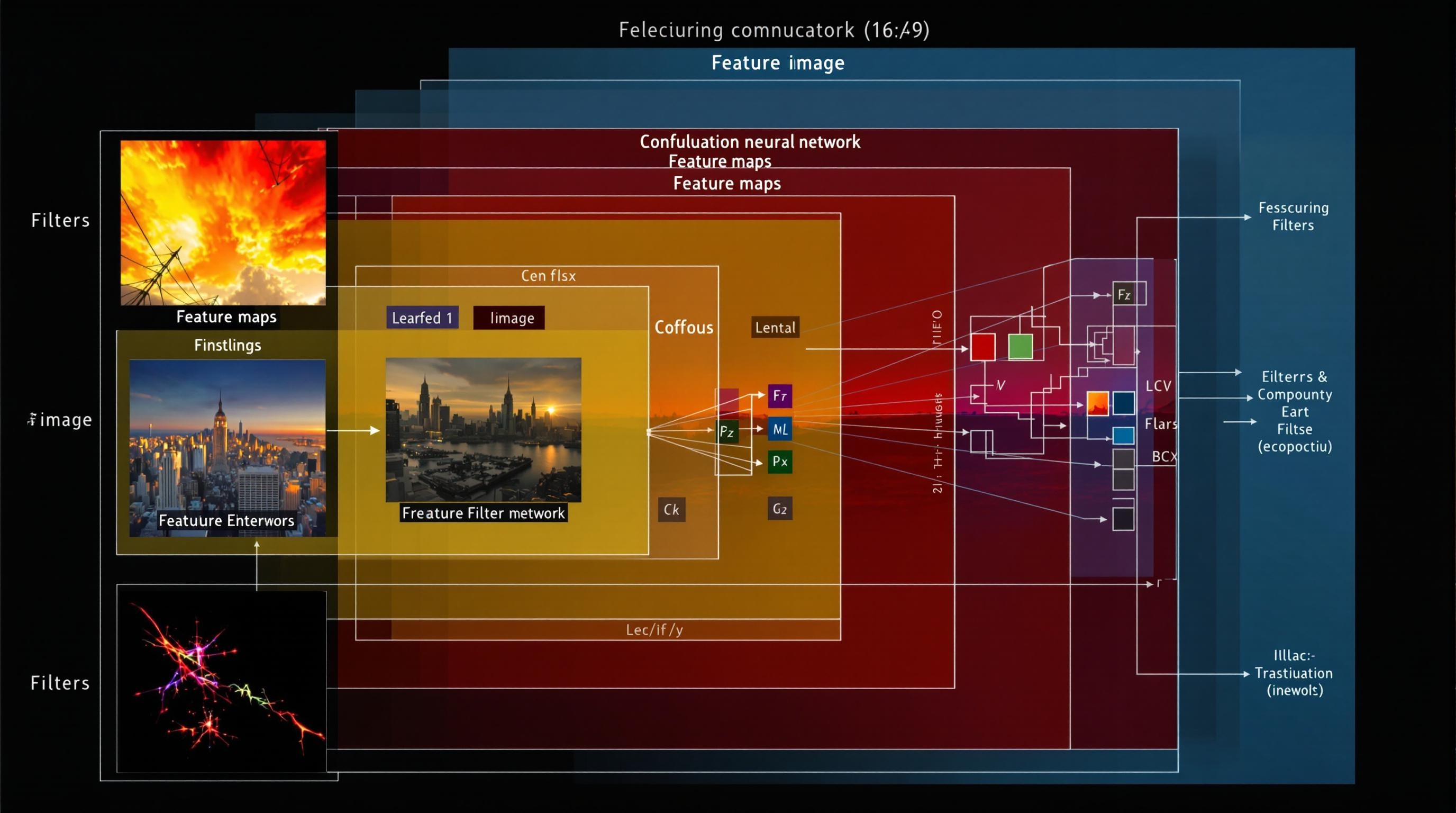
Convolutional Neural Networks have transformed image recognition, image classification, and object detection. Their architecture is specifically designed to process grid-like data such as images.
Architecture Components
CNNs consist of several specialized layers:
- Convolutional layer: Applies filters to detect features through convolution operations
- Pooling layer: Reduces dimensionality while preserving important information
- Connected layer (fully connected): Performs classification based on extracted features
The convolutional layer performs computations that detect edges, textures, and other visual elements. As data progresses through deeper layers, the network identifies increasingly complex features – from simple edges to entire objects. According to V7 Labs, breakthrough CNN architectures like AlexNet, ResNet, and EfficientNet have progressively improved performance while addressing challenges like vanishing gradients and computational efficiency.
Applications
CNNs excel in numerous visual processing tasks:
- Image classification: Identifying what objects appear in images
- Object detection: Locating and classifying multiple objects within an image
- Facial recognition: Identifying and verifying individuals from facial features
- Medical image analysis: Detecting abnormalities in medical scans
Their ability to automatically learn relevant features from images has made them indispensable in applications ranging from self-driving cars to medical image analysis. OpenCV
Recurrent Neural Networks for Natural Language Processing
While CNNs excel at spatial data, Recurrent Neural Networks (RNNs) are designed for sequential data, making them ideal for natural language processing tasks.
RNN Architecture and Memory
What makes RNNs special is their ability to maintain memory of previous inputs. Unlike feedforward networks, RNNs have connections that form cycles, allowing information to persist. This makes them particularly effective for tasks where context and order matter, such as understanding sentences where the meaning of words depends on surrounding words. The basic RNN architecture processes inputs sequentially, with each step taking both the current input and the output from the previous step. This recurrent connection serves as a form of memory, allowing the network to track dependencies over time. However, as Functionize explains, traditional RNNs struggle with long-term dependencies due to the vanishing gradient problem, where gradients become too small to effectively update weights during training.
Advanced RNN Variants
LSTM and GRU Architectures
To address the limitations of standard RNNs, researchers developed more sophisticated architectures.
- Long Short-Term Memory (LSTM) networks use a complex cell structure with multiple gates:
- Input gate: Controls what new information is stored in memory
- Output gate: Determines what information from memory affects the output
- Forget gate: Decides what information to discard from memory
- Gated Recurrent Units (GRUs) offer a simplified alternative with just two gates:
- Reset gate: Controls how much past information to forget
- Update gate: Determines how much past information to retain
Both architectures have significantly improved performance in natural language processing tasks like language translation, sentiment analysis, and text generation. Junia AI
Generative Adversarial Networks (GANs)
Generative Adversarial Networks represent one of the most innovative neural network architectures developed in recent years. These adversarial networks consist of two competing networks: a generator that creates content and a discriminator that evaluates it.
Dual-Network Architecture
The generator attempts to create data (like images) that resembles real data, while the discriminator tries to distinguish between real and generated samples. Through adversarial training, both networks improve – the generator creates increasingly realistic outputs, and the discriminator becomes better at spotting fakes. This architecture has enabled remarkable advances in generative models, far surpassing previous approaches. GANs can generate photorealistic images that are indistinguishable from real photographs. V7 Labs
Applications and Ethical Considerations
GANs have numerous applications:
- Image generation and enhancement
- Style transfer between images
- Data augmentation for training other models
- Creating synthetic data for testing
However, their ability to create convincing fake image content raises ethical concerns, particularly regarding deepfakes and misinformation. The technology behind generating realistic but artificial content continues to advance rapidly, necessitating parallel development of detection systems.
Transfer Learning and Neural Architecture Search
Modern deep learning approaches increasingly leverage existing knowledge through transfer learning and optimize architectures automatically.
Leveraging Pre-trained Models
Transfer learning allows models trained on one task to be repurposed for another, similar task. Instead of training from scratch, networks can build upon knowledge learned from previous tasks, significantly reducing the data and computation required. For example, a network pre-trained on general image classification can be fine-tuned for specific domains like medical image analysis with relatively small datasets, enabling more efficient training. OpenCV
Discovering Optimal Structures
Neural architecture search (NAS) automates the design of neural network architectures through computational search algorithms. Rather than manually designing architectures, NAS techniques can discover novel and efficient neural network structures optimized for specific tasks. According to OpenCV, these approaches have produced architectures that outperform human-designed models while using fewer computational resources, representing a significant advancement in efficient architecture search.
Industry Applications and Future Directions
Image Recognition Breakthroughs
Neural network architectures have transformed numerous industries through advanced image recognition capabilities:
- Medical image analysis: Detecting tumors and other anomalies in radiological images with accuracy rivaling human specialists
- Self-driving cars: Enabling vehicles to interpret visual information and navigate complex environments
- Facial recognition: Powering security systems with the ability to identify individuals in varying conditions
Natural Language Processing Innovations
Advances in NLP have similarly revolutionized how machines understand and generate human language:
- Machine translation: Systems that can translate between languages with increasing fluency
- Sentiment analysis: Tools that understand the emotional tone of text for business intelligence
- Conversational AI: Virtual assistants that can understand and respond to natural language queries
These applications demonstrate how neural network architectures have moved from research curiosities to practical technologies with real-world impact.
Challenges and Future Trends
Despite impressive advances, neural network architectures face significant challenges:
- Computational demands of training deep models
- Large data requirements for effective learning
- Interpretability issues with complex networks
- Energy efficiency concerns in deployment
Future research directions include:
- Neuromorphic computing approaches that more closely mimic biological neural systems
- Energy-efficient designs for mobile and edge deployment
- Integration with unsupervised learning to reduce dependence on labeled data
- Hybrid architectures combining multiple paradigms to leverage complementary strengths
Conclusion
Neural network architectures have transformed our technological landscape, enabling machines to see, understand language, and generate creative content with capabilities approaching or exceeding human abilities in specific domains. From the foundational Feed-Forward Networks to sophisticated Recurrent Neural Networks, Convolutional Neural Networks, and Generative Adversarial Networks, each architecture brings unique strengths to different problem domains. As research continues and these architectures evolve, we can expect even more powerful and efficient systems that will further extend the boundaries of what artificial intelligence can accomplish in image recognition, natural language processing, and beyond.
