
Natural Language Processing: How AI Transforms Human Language Understanding and Communication
Understanding Natural Language Processing (NLP)
Natural Language Processing (NLP) represents one of the most transformative applications of artificial intelligence, enabling machines to understand, interpret, and generate human language in ways that were once confined to science fiction. As a subfield of AI, Natural Language Processing bridges the fundamental gap between the ambiguous, context-rich nature of human communication and the precise, structured world of computer algorithms.
At its core, AI Natural Language Processing allows computers to process vast amounts of linguistic data, extract meaning, and respond appropriately – whether analyzing customer feedback, translating between languages, or engaging in conversation through virtual assistants. This technology has evolved dramatically over recent decades, reshaping how humans and machines interact on a daily basis.
Evolution from Rule-Based Systems to Advanced Models
The journey of NLP has been marked by three distinct evolutionary phases. Early NLP systems relied on rule-based approaches, where linguists manually coded grammatical structures and vocabulary into rigid frameworks. While precise for specific tasks, these systems struggled with language’s inherent ambiguity and couldn’t adapt to new expressions or contexts.
The second wave introduced statistical methods, which allowed systems to learn language patterns from data rather than following explicit rules. This approach significantly improved flexibility but still required extensive feature engineering by human experts.
The current revolution in NLP began with the application of deep learning models to language tasks. Technologies like recurrent neural networks and transformer architectures have enabled unprecedented advances in language understanding and generation capabilities. Modern NLP systems can now process text with a contextual understanding that approaches human-level comprehension in many domains.
As DeepLearning.AI notes, these deep learning methods have fundamentally transformed what’s possible in language processing, enabling applications that were previously unimaginable.
NLP, Computational Linguistics, and Artificial Intelligence
Natural Language Processing exists at the intersection of several disciplines. While computational linguistics focuses on the theoretical frameworks and structures of language from a computational perspective, NLP is more concerned with practical applications and engineering solutions.
As an integral component of artificial intelligence, NLP embodies a crucial criterion of intelligence: the ability to communicate effectively through language. Many AI researchers consider advanced language processing capabilities as essential to achieving general artificial intelligence – systems that can perform the full range of cognitive tasks that humans can.
The relationship between these fields is symbiotic; advances in computational linguistics inform NLP techniques, while practical NLP implementations provide real-world testing grounds for linguistic theories. Together, they push the boundaries of machine intelligence and human-computer interaction.
Natural Language Understanding vs. Natural Language Generation
Within the broader field of NLP, two complementary approaches address different aspects of language processing:
- Natural language understanding (NLU) focuses on interpreting and extracting meaning from human language inputs. This involves analyzing sentence structure, recognizing entities, determining intent, and grasping contextual nuances. NLU powers applications like search engines, sentiment analysis tools, and the comprehension component of virtual assistants.
- Natural language generation (NLG) involves creating human-readable text or speech from structured data or machine representations. This ranges from simple template-based systems to sophisticated models that can produce fluent, contextually appropriate content. NLG enables applications like automated report writing, chatbot responses, and content summarization.
According to DataVersity, the differences between language understanding and generation approaches reflect the complex, bidirectional nature of human communication that NLP systems aim to replicate.
Core NLP Components and Techniques
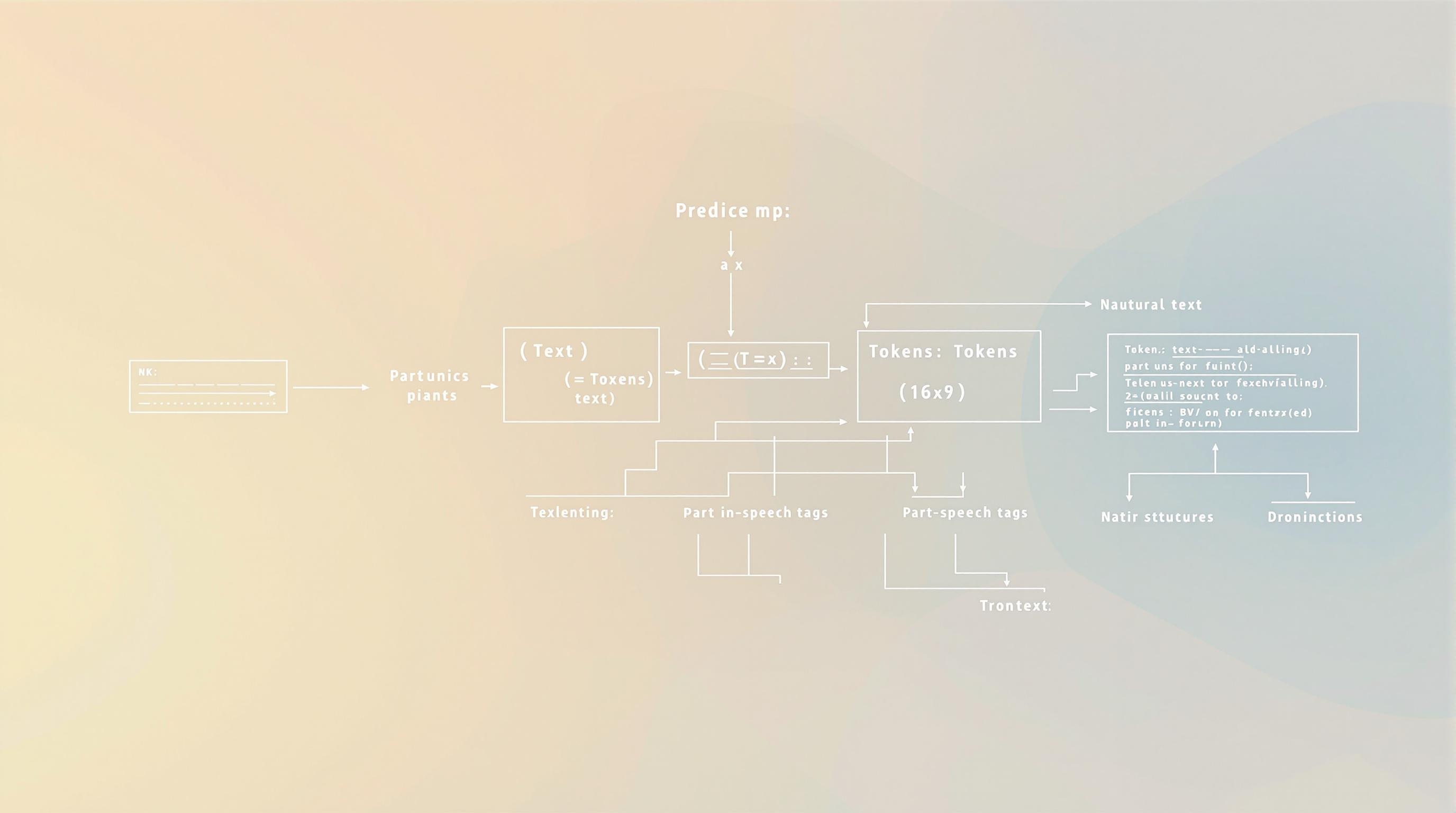
The foundation of any natural language processing system begins with several fundamental techniques that transform raw text into structured representations that machines can analyze:
- Tokenization divides text into meaningful units (tokens) such as words, phrases, or symbols. This seemingly simple task becomes complex with issues like contractions, hyphenated words, and punctuation across different languages.
- Part-of-speech (PoS) tagging identifies the grammatical role of each word in a sentence (noun, verb, adjective, etc.), providing crucial information about the structure of sentences and how words relate to each other.
- Lemmatization and stemming reduce words to their base form, allowing algorithms to recognize variations of the same term. While stemming uses simple rules to truncate words, lemmatization considers the linguistic context to determine the proper base form.
- Named-entity recognition identifies and classifies named entities in text into predefined categories such as person names, organizations, locations, and dates – essential for information extraction tasks.
These foundational techniques form the preprocessing pipeline for more advanced NLP tasks. As Coursera explains, mastering these fundamentals is essential for building sophisticated language processing applications.
Syntactic and Semantic Processing
Moving beyond basic text analysis, NLP systems employ various methods to understand both the structure and meaning of language:
- Dependency parsing analyzes grammatical structure by identifying relationships between words, where each word depends on another (except the root). This helps determine how words modify each other and reveals the functional roles within a sentence.
- Constituency parsing, in contrast, breaks sentences into nested phrases (noun phrases, verb phrases, etc.), creating hierarchical tree structures that reveal grammatical components.
- Semantic analysis moves beyond syntax to extract meaning from text. This includes techniques for word sense disambiguation, semantic role labelling, and relationship extraction between entities mentioned in text.
Modern NLP systems combine these syntactic and semantic approaches with contextual understanding capabilities to grasp not just the literal meaning of words but their intended meaning in specific contexts. This has dramatically improved performance in tasks ranging from machine translation to question answering.
Advanced NLP Technologies
Machine Learning in NLP
The revolutionary advances in NLP over the past decade have been driven primarily by machine learning approaches:
- Supervised learning trains models on labeled examples, enabling them to perform specific tasks like sentiment analysis or document classification after learning from thousands or millions of human-annotated examples.
- Unsupervised learning discovers patterns in data without explicit labels, useful for tasks like topic modeling through techniques such as Latent Dirichlet Allocation or clustering similar documents.
- Deep learning models, particularly transformer architectures, have dramatically reshaped the field. Models like BERT (Bidirectional Encoder Representations from Transformers) and GPT (Generative Pre-trained Transformer) can capture complex linguistic patterns from massive datasets.
Pre-trained language models represent one of the most significant breakthroughs in NLP. These models are trained on vast corpora of text to develop general language understanding capabilities and can then be fine-tuned for specific applications with relatively small amounts of task-specific data.
For a deeper dive into these technologies, see DataCamp.
Natural Language Understanding
Advanced natural language understanding focuses on interpreting user queries and conversational input in ways that grasp both explicit content and implicit meaning:
- Intent recognition identifies what a user is trying to accomplish with their query or statement, differentiating between requests for information, commands, small talk, and other conversation types.
- Entity extraction identifies and categorizes important information in user input, such as dates, locations, product names, or quantities.
- Contextual comprehension maintains conversation history and situational awareness to properly interpret ambiguous statements or references.
Despite significant progress, machines still face limitations in understanding linguistic nuances, cultural references, humor, and figurative language – areas where human intelligence still outperforms artificial intelligence. These challenges represent active research frontiers in the field.
Real-World Applications of NLP
NLP has transformed how businesses understand their customers and provide service:
- Customer feedback analysis uses sentiment analysis and topic modeling to automatically process thousands of customer reviews, social media posts, and survey responses, extracting actionable insights without manual review.
- Automated customer query handling through chatbots and conversational interfaces can resolve common customer issues instantly, improving customer satisfaction while reducing support costs.
- Email spam filtering and document classification systems automatically categorize and prioritize communications, ensuring important messages receive appropriate attention.
According to MobiDev, NLP-powered systems are revolutionizing customer engagement across industries, enabling personalized experiences at scale while providing businesses with deeper customer insights.
Some of the most visible applications of NLP technology are found in communication tools:
- Voice assistants like Siri, Alexa, and Google Assistant combine speech recognition with natural language understanding to interpret voice commands and provide relevant responses or actions.
- Machine translation services break down language barriers, enabling cross-language communication for both personal and business purposes. Modern neural machine translation systems approach human-level quality for many language pairs.
- Document AI technologies can automatically summarize lengthy documents, extract key information, and organize unstructured content into structured formats.
- Social media analysis tools monitor brand mentions, analyze public sentiment, and identify emerging trends across platforms.
These applications demonstrate how NLP is becoming integrated into our daily digital interactions, often operating invisibly to enhance user experiences.
Challenges and Limitations in NLP
Despite remarkable progress, natural language processing still faces significant challenges:
- Linguistic ambiguity remains a fundamental challenge. Words and phrases can have multiple meanings depending on context, and resolving these ambiguities requires sophisticated contextual understanding.
- Cultural and contextual nuances vary widely across languages and communities. Idioms, cultural references, and implicit knowledge that human speakers take for granted are difficult for machines to grasp.
- Ethical considerations have become increasingly important as NLP systems become more powerful. Issues include bias in training data and models, privacy concerns with processing personal communications, and potential misuse of text generation capabilities.
- Balancing rule-based precision with statistical flexibility remains a design challenge. Pure statistical approaches may miss critical linguistic patterns, while overly rigid rule-based systems cannot adapt to language’s natural variation.
These challenges highlight the gap between current capabilities and the complexity of human language understanding. As research continues, systems are gradually addressing these limitations, but true human-level language understanding remains an aspiration rather than a reality.
The Future of NLP Technologies
As NLP continues to evolve, several emerging trends point to the future of language processing:
- Multilingual and cross-cultural language processing is expanding beyond English-centric models to develop truly global language capabilities that respect linguistic diversity.
- Integration with other AI technologies like computer vision and knowledge graphs is creating multimodal systems that can process language in context with images, videos, and structured information.
- Advancements in conversational language understanding are making human-computer dialogue more natural, contextual, and helpful across a wide range of technologies.
- Specialized domain applications are bringing NLP’s benefits to fields like healthcare (medical records analysis, clinical decision support), legal (contract analysis, case research), and finance (risk assessment, regulatory compliance).
According to DataCamp, these advances are transforming human-computer interaction on a daily basis, making technology more accessible and useful to people regardless of their technical expertise.
Conclusion
Natural Language Processing represents one of artificial intelligence’s most profound achievements – teaching machines to engage with humanity’s most distinctive tool: language. From the rule-based systems of decades past to today’s sophisticated deep learning models, NLP has evolved to perform complex tasks that once seemed exclusive to human intelligence.
As NLP technologies continue to mature, they’re reshaping how we interact with technology, process information, and communicate across languages and cultures. The field’s rapid progress promises even more transformative applications in the coming years, further blurring the line between human and machine communication capabilities.
For businesses and individuals looking to leverage these powerful language technologies, AI tools that incorporate NLP are becoming increasingly accessible. From content generation and analysis to sophisticated conversational AI interfaces, these technologies offer unprecedented opportunities to enhance productivity, gain insights, and create more natural human-computer interactions.
As we continue to refine these systems and address their current limitations, the future of language technology promises to bring us closer to the long-standing dream of computers that truly understand us – not just our words, but our intentions, emotions, and the rich contextual tapestry of human communication.
Trending AI Listing on Jasify
-
Full AI Marketing System Setup – Use AI Media (One-Time Build) by Jasify Store
Launch a fully customized AI-powered growth infrastructure for your business, including AI website design, SEO blog automation, video repurposing, email outreach, and social media growth. Perfect for founders and brands seeking a managed inbound and outbound growth engine. -
AI Short-Form Repurposing System (From 2+ Hours of Content to 100+ Posts/Month) by Jasify Store
Transform long-form content into daily short-form posts optimized for social media. Ideal for creators and brands wanting consistent social growth without manual editing or posting.
