

Deep learning models continue to grow in complexity and size, creating challenges for deployment on resource-constrained edge devices. Model quantization has emerged as a powerful technique to bridge this gap, allowing sophisticated AI capabilities to run efficiently on smartphones, IoT devices, and embedded systems. This article explores how model quantization techniques can dramatically reduce model size while maintaining performance, enabling the deployment of advanced AI capabilities in environments where computational resources are limited.
Understanding Model Quantization
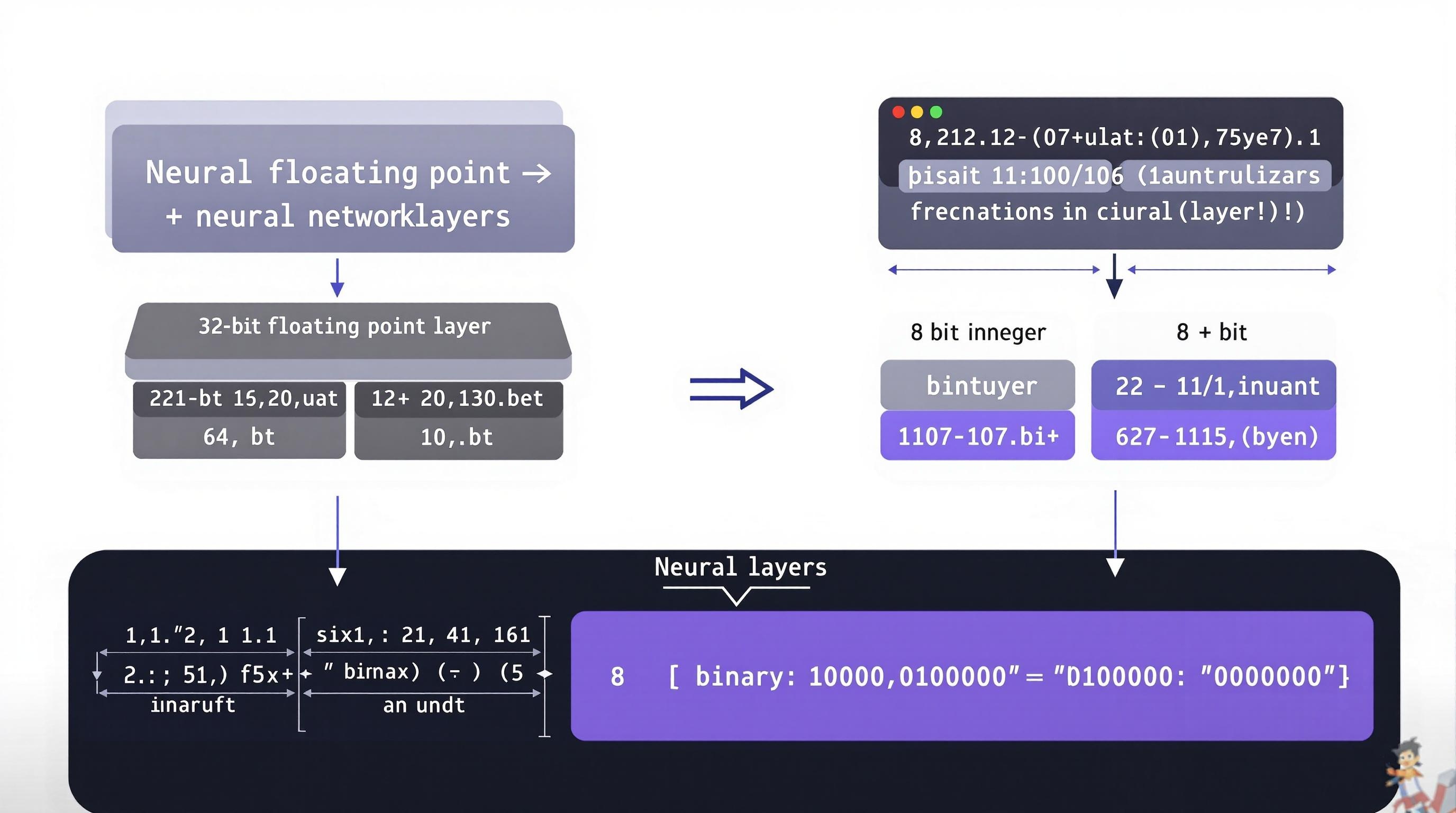
Model quantization is the process of converting the high-precision parameters of a neural network (typically 32-bit floating-point numbers) to lower bit precision representations (such as 8-bit integers). This technique significantly reduces the memory footprint and computational requirements of deep learning models without substantially sacrificing their performance.
The fundamental concept behind model quantization is surprisingly straightforward: by using low bit precision instead of full 32-bit floating-point values, we can achieve substantial savings in both storage and computation. A typical uncompressed deep learning model might require hundreds of megabytes for storage, making deployment on edge devices challenging. Through quantization, these models can be compressed to a fraction of their original size – often 8-16x smaller – while maintaining most of their accuracy.
Key Benefits of Model Quantization
- Memory efficiency: Quantized models require significantly less storage and runtime memory, enabling deployment on devices with limited RAM.
- Computational efficiency: Integer operations are faster and more energy-efficient than floating-point operations on most hardware.
- Faster inference speed: Reduced precision enables quicker calculations, resulting in lower latency for real-time applications.
- Energy savings: Lower computational complexity translates to reduced power consumption, extending battery life on mobile and IoT devices.
According to RINF.tech, quantized models typically achieve 2-4x faster inference speeds on CPUs and edge hardware while consuming up to 3x less power – critical advantages for deployment in resource-constrained environments.
The Fundamentals of Neural Network Compression
Model quantization is part of a broader category of neural network compression techniques designed to optimize deep learning models for real-world deployment. Understanding the landscape of compression methods helps contextualize quantization’s specific advantages.
Common Deep Learning Model Optimization Techniques
Several approaches exist for neural network compression:
- Model quantization: Reducing parameter precision from 32-bit floats to lower bit representations
- Model pruning: Removing redundant or less important connections from the network
- Knowledge distillation: Training a smaller “student” model to mimic a larger “teacher” model
- Low-rank factorization: Decomposing weight matrices into smaller components
While each method has its merits, parameter quantization offers an excellent balance of implementation simplicity and performance benefits, making it particularly popular for edge deployments.
The Mathematics Behind Parameter Quantization
The technical process of quantization involves mapping floating-point values to a discrete set of values using fixed-point or integer arithmetic. This typically employs a linear transformation:
q = round(r/s) + z
Where q is the quantized integer, r is the original real number, s is a scale factor, and z is an offset zero-point. Through this process, the continuous range of floating-point values is mapped to a much smaller set of discrete values, significantly reducing storage requirements while preserving the model’s ability to make accurate predictions.
Types of Quantization Approaches
Post-Training Quantization
Post-training quantization (PTQ) converts an already trained model to a lower-precision format without retraining. This approach is particularly valuable when access to the original training data or computational resources for retraining is limited.
The process typically involves:
- Taking a pre-trained floating-point model
- Calibrating the quantization parameters using a small representative dataset
- Converting weights and activations to lower precision
PTQ is supported by most major deep learning frameworks, including TensorFlow and PyTorch, making it accessible for many development teams. While this approach may result in some accuracy degradation, particularly for complex models, it offers a quick path to model compression with minimal engineering effort.
Quantization-Aware Training
Quantization-aware training (QAT) integrates quantization effects directly into the training process. This approach simulates the impact of quantization during training, allowing the model to adapt its parameters to work effectively at lower precision.
According to GeeksforGeeks, QAT typically preserves accuracy better than post-training approaches, with accuracy losses often less than 1% compared to the original model. The improved accuracy comes at the cost of requiring a complete training or fine-tuning cycle, which demands more computational resources and time.
QAT is particularly valuable for models deployed in applications where even small accuracy drops are unacceptable, such as medical diagnostics or safety-critical systems.
Dynamic vs. Static Quantization
The timing of when quantization occurs creates another important distinction:
Dynamic quantization quantizes weights ahead of time but calculates activation quantization parameters on-the-fly during inference. This approach offers flexibility and can work well for models with varying input distributions but introduces some computational overhead during inference.
Static quantization pre-computes all quantization parameters for both weights and activations before deployment. This maximizes inference performance but requires calibration with representative data to determine appropriate quantization ranges for activations.
The choice between these approaches depends on specific application requirements, with static quantization typically preferred for maximum performance in edge deployments where inference speed and energy efficiency are paramount.
Quantization Algorithms and Techniques
Integer Quantization
Integer quantization is the most widely adopted quantization technique, converting floating-point weights and activations to 8-bit integers (INT8). This approach is particularly effective because most modern hardware, including mobile processors and dedicated AI accelerators, offers optimized support for integer arithmetic.
The process involves determining scaling factors that map the floating-point range to the integer range while minimizing quantization error. These scaling factors are typically derived from the statistical distribution of values in each layer.
Integer quantization delivers impressive efficiency gains, with Number Analytics reporting that INT8 models typically run 2-4x faster on common hardware while consuming significantly less memory compared to FP32 models.
Binary Neural Networks
Binary neural networks (BNNs) represent an extreme form of quantization, reducing weights and sometimes activations to just 1 bit (binary values of +1 or -1). This radical compression creates extraordinarily compact models and enables highly efficient computations using bitwise operations.
The dramatic reduction in precision comes with implementation challenges, including potential accuracy degradation, especially for complex tasks. However, research in binarized neural networks continues to advance, with techniques like improved training algorithms and architectural modifications helping to close the performance gap.
BNNs are particularly suited for ultra-low-power applications where extreme efficiency is more important than achieving state-of-the-art accuracy.
Mixed Precision Techniques
Mixed precision quantization takes a more nuanced approach by applying different bit widths to different parts of the model. This technique recognizes that not all layers in a neural network are equally sensitive to quantization.
Implementation typically involves:
- Analyzing the sensitivity of each layer to quantization
- Assigning higher bit precision to sensitive layers
- Using lower precision for robust layers that maintain accuracy even with aggressive quantization
This approach optimizes the trade-off between model size/speed and accuracy, creating hardware-friendly models that maintain high performance. Research has shown that mixed precision approaches can achieve nearly the same compression benefits as uniform low-precision quantization while preserving accuracy much more effectively.
Framework-Specific Implementations
TensorFlow Quantization
TensorFlow offers comprehensive support for model quantization through TensorFlow Lite, its lightweight solution for mobile and edge devices. TensorFlow quantization includes tools for both post-training and quantization-aware training approaches.
Key TensorFlow quantization features include:
- Support for INT8, INT16, and floating-point quantization
- Built-in APIs for quantization-aware training
- Tools for benchmarking quantized model performance
- Integration with TensorFlow Model Optimization Toolkit
Tensorflow quantization has demonstrated impressive results across various model architectures. According to benchmarks, quantized TensorFlow models typically achieve up to 4x speedups and 75% smaller model sizes compared to their floating-point counterparts, with minimal accuracy loss when properly implemented.
PyTorch Quantization
PyTorch provides a flexible quantization framework through its torch.quantization module. This framework supports various quantization methods, including dynamic quantization, static quantization, and quantization-aware training.
PyTorch’s quantization workflow typically involves:
- Preparing the model for quantization by inserting observers
- Calibrating the model with representative data
- Converting the model to a quantized version
PyTorch quantization is particularly valued for its integration with PyTorch’s eager execution mode, making it accessible for researchers and developers familiar with the PyTorch ecosystem. The framework also provides support for custom quantization schemes, allowing advanced users to implement specialized techniques for their specific hardware targets.
Quantization Impact on Model Performance
Managing Quantization-Induced Accuracy Loss
While quantization offers significant efficiency gains, it can introduce accuracy loss due to the reduced numerical precision. Several techniques can mitigate this quantization-induced accuracy loss:
Calibration optimization: Carefully selecting representative data for calibration helps ensure that quantization parameters accurately capture the distribution of activations.
Fine-tuning after quantization: Performing a few training iterations on the quantized model can help recover accuracy by adapting parameters to work better in the quantized domain.
Quantization error analysis: Identifying layers most affected by quantization and applying higher precision or special handling to these sensitive components.
With proper implementation of these techniques, quantization-induced accuracy loss can often be kept below 1-2%, making the trade-off worthwhile for many applications.
Measuring and Benchmarking Quantized Models
Comprehensive evaluation of quantized models requires measuring multiple performance dimensions:
- Accuracy metrics: Comparing the quantized model’s accuracy to the original model on validation datasets
- Inference latency: Measuring the time required to process a single input
- Throughput: Determining how many inferences can be performed per second
- Memory usage: Quantifying the reduced model size and runtime memory requirements
- Energy consumption: Measuring battery usage or power draw during inference
Tools like TensorFlow Lite Benchmark Tool and PyTorch’s profiling utilities help developers gather these metrics systematically. Balancing these factors is crucial for optimizing quantized models for specific deployment scenarios, as different applications may prioritize different aspects of performance.
Edge Deployment Strategies
Hardware Considerations for Quantized Models
The effectiveness of quantized models depends significantly on the target hardware’s capabilities. Modern mobile and edge processors increasingly offer specialized support for efficient execution of quantized neural networks.
Key hardware considerations include:
- Support for efficient integer arithmetic (e.g., ARM NEON instructions)
- Dedicated AI accelerators (NPUs, TPUs) with quantization support
- Memory bandwidth and cache characteristics
- Power efficiency for sustained operation
Hardware-friendly models designed with these considerations in mind can achieve significantly better performance than generic implementations. For instance, leveraging hardware acceleration for integer operations can provide 3-10x speedups compared to floating-point execution on the same device.
Model Deployment in Low-Resource Environments
Deploying deep learning models in low-resource environments presents unique challenges that quantization helps address:
Memory constraints: Edge devices often have limited RAM, making reduced model size essential for deployment feasibility. Quantization’s 4-16x memory reduction enables sophisticated models to fit within these constraints.
Real-time requirements: Many edge applications require near-instantaneous responses. The inference speed improvements from quantization help meet these latency requirements.
Energy limitations: Battery-powered devices must optimize for energy efficiency. The computational efficiency of quantized models translates directly to extended battery life.
As IBM notes, these optimizations don’t just improve technical metrics—they enable entirely new categories of AI applications on edge devices that would be impossible with full-precision models.
Case Studies and Real-World Applications
Quantized models have enabled remarkable AI capabilities on edge devices across numerous domains:
In mobile applications, quantized computer vision models power features like real-time object detection in smartphone cameras, with inference times reduced from seconds to milliseconds. Speech recognition models have similarly benefited, enabling on-device processing that preserves privacy while reducing latency.
For IoT and embedded systems, quantized models have proven transformative. Environmental sensors with quantized anomaly detection models can operate for months on battery power. Medical wearables can continuously monitor vital signs using quantized neural networks that process data locally, only transmitting alerts when necessary.
These examples demonstrate that quantization isn’t just about technical optimization—it’s about enabling practical AI deployment in scenarios where it would otherwise be impossible due to resource constraints.
Advanced Techniques and Future Directions
Distillation with Quantization
Combining model distillation with quantization creates particularly powerful compression results. In this approach, a smaller “student” model is trained to mimic a larger “teacher” model, and quantization techniques are applied to further reduce the student model’s size.
This combined approach often yields better results than either technique alone, as the distillation process can help the model become more robust to the effects of quantization. Research has shown that distillation with quantization can reduce model size by 20-30x while maintaining acceptable accuracy levels.
Automated Quantization Workflows
The future of model quantization lies in increasingly automated workflows that simplify the process of optimizing models for deployment. These workflows include:
Automatic bit-width selection: Tools that analyze layer sensitivity and automatically determine optimal precision for each component
Hardware-aware optimization: Systems that tailor quantization strategies to specific target devices
MLOps integration: Quantization pipelines that seamlessly fit into broader machine learning operations workflows
These advancements promise to make quantization more accessible to developers without specialized expertise in model optimization, democratizing the deployment of efficient deep learning models.
Conclusion
Model quantization represents a critical technique for bridging the gap between advanced deep learning capabilities and the resource constraints of edge devices. By reducing bit precision, quantized models achieve dramatically reduced model size, faster inference speed, and improved energy efficiency—all while maintaining acceptable accuracy.
As edge AI continues to expand into new domains, quantization techniques will remain essential for enabling sophisticated intelligence on resource-constrained devices. The ongoing research in areas like binary neural networks, mixed-precision approaches, and automated quantization workflows promises to further improve the effectiveness of these techniques.
For developers looking to deploy deep learning models in edge environments, understanding and implementing appropriate model quantization techniques has become a crucial skill—one that unlocks the ability to bring AI capabilities to billions of devices worldwide.
To explore AI-powered tools that leverage these optimization techniques for edge deployment, visit Jasify’s AI tools marketplace, where you’ll find a range of solutions designed for efficient deployment across various hardware platforms.
Trending AI Listings on Jasify
- Custom 24/7 AI Worker – Automate Your Business with a Personalized GPT System – Perfect for developing automated workflows that could benefit from model quantization for edge deployment and efficiency.
- Custom AI Product Recommendation Chatbot (Built for Your Health Brand) – An AI-powered chatbot that could leverage model quantization techniques for efficient deployment on mobile and web platforms.
- High-Impact SEO Blog – 1000+ Words (AI-Powered & Rank-Ready) – Content service that could help businesses explain technical concepts like model quantization to their audiences.
