
What is AI-Driven Industry Transformation?
AI-driven industry transformation refers to how artificial intelligence is fundamentally reshaping how businesses operate, make decisions, and create value across entire sectors. It’s not just about automating repetitive tasks—it’s about using technologies like machine learning and predictive analytics to reimagine business models from the ground up. This transformation matters because companies that integrate AI strategically gain competitive advantages through faster innovation, better customer experiences, and smarter operations. Everyone from Fortune 500 executives to small business owners is impacted, with applications spanning healthcare diagnostics, retail personalization, manufacturing efficiency, and financial services. The change is happening across every major industry, redefining workflows and creating opportunities that didn’t exist five years ago.
What Core AI Technologies Drive This Transformation?
Behind every AI transformation story, there are specific technologies doing the heavy lifting. Understanding these core building blocks helps explain why AI’s impact varies so dramatically across different industries. Here’s what’s actually powering the change.
Machine Learning: The Foundation
Machine learning enables systems to learn from data and improve over time without explicit programming. The global machine learning market is projected to reach $113.10 billion in 2025 and grow to $503.40 billion by 2030, reflecting its role as the backbone of modern AI applications. It powers everything from fraud detection algorithms in banking to recommendation engines in streaming services.
What makes ML particularly transformative? It handles complexity humans can’t. A machine learning system can analyze millions of transactions in seconds, spotting patterns that would take human analysts months to identify—if they could spot them at all.
Natural Language Processing: Teaching Machines to Understand Us
NLP allows computers to understand, interpret, and generate human language. The market is expected to grow from $42.47 billion in 2025 to $791.16 billion by 2034. This technology powers chatbots, voice assistants, sentiment analysis tools, and automated content generation.
The real breakthrough? Businesses can now interact with customers at scale while maintaining a personal touch. An NLP-powered customer service system can handle thousands of conversations simultaneously, understanding context and emotion in ways that earlier chatbots never could.
Computer Vision: Giving AI Eyes
Computer vision enables machines to interpret and understand visual information from the world. The global market is projected to exceed $58 billion by 2030. Applications range from quality control in manufacturing (spotting defects invisible to human inspectors) to medical imaging (detecting cancerous cells earlier than traditional methods).
Retailers use computer vision to track inventory, monitor customer behavior, and enable checkout-free shopping experiences. Manufacturers deploy it for predictive maintenance, identifying equipment problems before breakdowns occur.
Generative AI: Creating New Content
Generative AI creates new content—text, images, code, even music—based on patterns learned from existing data. The generative AI market is expected to grow at a 46.47% CAGR from 2024 to 2030, reaching $356.10 billion, with Bloomberg estimating it’ll surpass $1.3 trillion globally by 2032.
This technology is revolutionizing creative work, software development, and content marketing. But here’s what many overlook: generative AI’s biggest impact isn’t replacing human creativity—it’s augmenting it, allowing professionals to work faster and explore more possibilities.
Conversational AI: Natural Interactions
Conversational AI combines NLP with machine learning to create systems that can engage in natural, context-aware dialogues. The market, estimated at $11.58 billion in 2024, is expected to reach $41.39 billion by 2030. These systems power virtual assistants, customer support bots, and interactive voice response systems that actually understand what you’re asking.
For businesses exploring conversational AI tools, Jasify’s AI chatbot marketplace offers solutions designed for various use cases and business sizes.
Which Industries Are Being Transformed Most by AI?
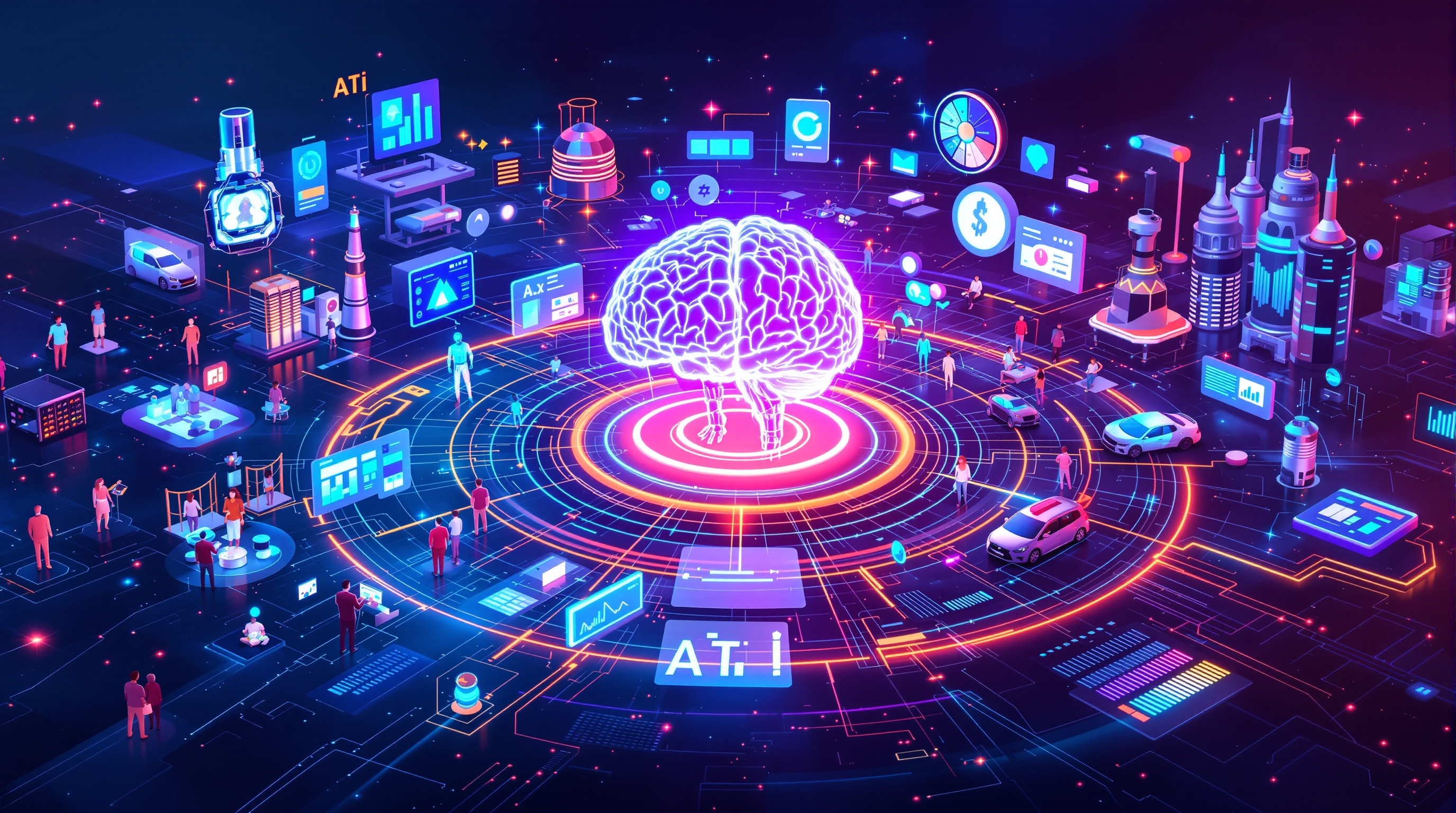
While AI touches virtually every sector, some industries are experiencing particularly dramatic shifts. The transformation isn’t uniform—adoption rates and applications vary significantly based on data availability, regulatory environments, and business models. Let’s look at where AI is making the biggest impact right now.
Healthcare: From Diagnosis to Drug Discovery
Healthcare is undergoing a fundamental AI-driven transformation. The global AI in healthcare market was valued at $19.27 billion in 2023 and is expected to reach $613.81 billion by 2034. That’s not just growth—it’s a complete reimagining of how healthcare works.
Here’s what that looks like in practice: AI systems now analyze medical images with accuracy matching or exceeding human radiologists. They predict patient deterioration hours before traditional monitoring would catch it. Drug discovery processes that took years now happen in months.
The patient experience is changing too. 81% of consumers have used an AI chatbot or voice assistant for healthcare support, and 84% of patients prefer speaking to an AI assistant when wait times are too long. That’s not because AI replaces doctors—it’s because AI handles routine questions and triage, letting medical professionals focus on complex cases requiring human judgment.
Retail and eCommerce: Personalization at Scale
The AI in retail market is forecasted to grow from $9.97 billion in 2023 to $54.92 billion by 2033 at an 18.6% CAGR. But the numbers don’t capture the experience shift: shopping is becoming predictive rather than reactive.
Top AI use cases include personalized product recommendations (47%), conversational AI solutions (36%), and adaptive advertising (28%). 78% of brands have implemented or plan to integrate AI, with most focusing on creating individualized experiences that feel personal without being intrusive.
Think about how Amazon predicts what you’ll buy before you search for it, or how Netflix recommends shows based on viewing patterns you didn’t know you had. That’s AI working behind the scenes, analyzing millions of data points to create experiences that feel custom-built.
For businesses looking to implement AI-driven eCommerce solutions, Jasify’s AI for eCommerce category features tools specifically designed for online retailers.
Automotive: Driving Toward Autonomy
75% of automotive companies are experimenting with at least one generative AI use case, with the remaining 25% planning to start within a year. The generative AI market in automotive is expected to grow from $312.46 million in 2022 to $2.69 billion by 2032, with McKinsey predicting the technology will generate $300 billion annually for the industry by 2035.
Beyond self-driving cars (which remain years from mainstream adoption), AI is transforming vehicle design, manufacturing efficiency, predictive maintenance, and in-car experiences. Modern vehicles use AI for adaptive cruise control, collision avoidance, driver monitoring, and personalized infotainment systems.
Hospitality: Enhancing Guest Experiences
The generative AI market in hospitality is projected to grow to $3.58 billion by 2032. 79% of the industry adopts AI to improve customer experience, 48% to streamline creative content generation, and 67% to optimize processes. Integration is improving operational efficiency by 20–40% and boosting revenue by 5–20%.
Hotels use AI for dynamic pricing, personalized recommendations, automated check-in/check-out, and predictive maintenance of facilities. Restaurants deploy AI for demand forecasting, inventory management, and menu optimization based on customer preferences and seasonal trends.
Financial Services: Security and Speed
Banks and financial institutions use AI for fraud detection, risk assessment, algorithmic trading, and customer service. Machine learning models analyze transaction patterns in real-time, flagging suspicious activity before it becomes a problem. AI-powered chatbots handle routine banking queries, freeing human agents for complex financial planning conversations.
The transformation here isn’t just operational—it’s existential. Financial institutions that don’t embrace AI risk becoming obsolete as nimbler, AI-native competitors offer faster, cheaper, and more personalized services.
What Are the Primary Benefits of AI Transformation?
Talk is cheap. Let’s look at what AI transformation actually delivers when implemented effectively. The benefits fall into several clear categories, backed by data showing real business outcomes rather than theoretical advantages.
Measurable Productivity Gains
Capgemini estimates that AI tools could generate up to $450 billion in value by 2028, driven largely by productivity gains and faster innovation cycles. Current GenAI scenarios show 26–34% ROI in customer service, productivity, sales and marketing, digital commerce, back-office processes, and manufacturing.
Here’s what that looks like in practice: tasks that took hours now take minutes. A marketing team that previously spent weeks creating campaign variations can now generate dozens in days. Customer service teams handle triple the volume without adding headcount. Software developers write code 30–40% faster using AI pair programming tools.
The adoption of GenAI across enterprise marketing activities will result in an estimated increase in productivity of over 40% by 2029. The share of sales tasks fulfilled by AI is expected to grow from 45% in 2023 to 60% by 2028.
Revenue Growth and Market Advantage
86% of companies using intelligent technology in production report revenue growth, with an increase of 6% or more in annual income. That’s not marginal improvement—it’s a significant competitive advantage in most industries.
Furthermore, 84% of organizations move an AI-based use case from concept to launch within six months, with profits reported within a year of deployment. The speed of implementation and value realization surprises many executives accustomed to multi-year technology rollouts.
Enhanced Decision-Making
AI doesn’t just process data faster—it reveals insights humans would miss. Predictive analytics identify market trends before they’re obvious. Sentiment analysis gauges customer mood across thousands of interactions. Risk assessment models evaluate scenarios considering hundreds of variables simultaneously.
The result? Decisions based on comprehensive data analysis rather than gut feeling or limited samples. That doesn’t eliminate human judgment—it enhances it by providing better information to work with.
Personalization at Scale
Pre-AI, personalization meant segmenting customers into broad categories. AI enables true one-to-one personalization: unique product recommendations, customized content, individualized pricing, and tailored customer service—all delivered automatically to millions of customers.
This capability is transforming customer expectations across industries. People now expect businesses to “know” them, anticipate needs, and provide relevant experiences without explicit instruction. Companies that don’t deliver feel outdated.
Operational Efficiency and Cost Reduction
AI optimizes operations in ways that compound over time. Predictive maintenance reduces downtime. Smart inventory management minimizes waste. Automated quality control catches defects earlier. Energy management systems reduce consumption without impacting performance.
These aren’t headline-grabbing changes, but they add up. A 5% reduction in energy costs, 10% improvement in inventory turnover, and 15% decrease in equipment downtime might not sound revolutionary individually—but together they transform profitability.
If you’re exploring how AI can optimize your business operations, Jasify’s AI for Business tools include solutions designed for operational efficiency across various business functions.
What Are the Key Challenges of Implementing AI?
Let’s be real: AI transformation isn’t a smooth journey for most organizations. While the benefits are substantial, the path to realizing them is littered with obstacles. Understanding these challenges upfront makes the difference between successful implementation and expensive failure.
Implementation Costs and ROI Uncertainty
AI projects require significant upfront investment—not just in technology, but in data infrastructure, talent, and organizational change. Many businesses underestimate the total cost of ownership, focusing on software licenses while overlooking data preparation, integration, training, and ongoing maintenance.
The market reality is sobering. C3.ai, an enterprise AI software provider, is facing a challenging fiscal 2026, with revenue expected to fall 23% year-over-year to $300 million, following robust 25% growth in 2025. Analysts attribute this to customers delaying spending and lengthening sales cycles amid broader reassessment of enterprise AI budgets.
This isn’t a signal that AI doesn’t work—it’s a reminder that not all implementations succeed immediately. Organizations need realistic expectations and patience for ROI realization.
Data Quality and Availability
Here’s the thing about AI: it’s only as good as the data feeding it. Many organizations discover their data is incomplete, inconsistent, outdated, or siloed across incompatible systems. Cleaning and organizing data often takes longer and costs more than the actual AI implementation.
According to Capgemini, data quality and governance remain top priorities for 2026, with organizations increasingly investing in synthetic data to supplement real-world datasets. While 71% of organizations currently utilize intelligent systems, and an additional 22% plan to implement them within the next year, significant implementation challenges remain around data quality, talent acquisition, and legacy system integration.
Talent Gap and Skills Shortage
Everyone wants AI experts; few can find or afford them. The talent shortage affects every phase of AI adoption—from strategy development to implementation to ongoing optimization. Data scientists, machine learning engineers, and AI specialists command premium salaries, putting them out of reach for many organizations.
But here’s what we’ve observed at Jasify: the talent gap isn’t always about hiring PhDs. Many successful AI implementations rely on upskilling existing staff, using no-code/low-code AI tools, and partnering with specialized vendors. The key is matching the solution complexity to your actual needs rather than pursuing bleeding-edge technology for its own sake.
Integration with Legacy Systems
Most organizations aren’t building AI systems from scratch—they’re adding AI capabilities to existing infrastructure. Legacy systems weren’t designed with AI integration in mind, creating technical, organizational, and process challenges.
Integration projects frequently take 2–3 times longer than anticipated. Data formats don’t match. APIs don’t exist or don’t work as documented. Business processes need redesigning to accommodate AI insights. These aren’t insurmountable problems, but they require realistic planning and resources.
Change Management and Organizational Resistance
Technology is often the easy part. People are harder. Employees worry about job security. Managers fear losing control. Executives struggle with governance questions. Customers question algorithmic decisions they don’t understand.
Successful AI transformation requires addressing these human factors as seriously as technical ones. That means clear communication about AI’s role, retraining programs, transparent decision-making processes, and patience as the organization adapts.
Regulatory and Ethical Considerations
AI regulations are evolving rapidly, with different requirements across jurisdictions. Privacy laws, algorithmic transparency requirements, bias testing mandates, and industry-specific rules create compliance complexity.
Beyond legal compliance, organizations face ethical questions: When should AI make decisions autonomously? How do we ensure fairness across demographic groups? What happens when AI recommendations conflict with human judgment? These questions don’t have simple answers, but they can’t be ignored.
Regional Adoption Variations
AI transformation doesn’t happen uniformly. Global AI adoption increased by 1.2 percentage points in the second half of 2025 compared to the first half, but regional differences are striking: the United Arab Emirates leads at 64.0% AI diffusion while the United States sits at 28.3%.
These variations reflect differences in regulatory environments, digital infrastructure, talent availability, and cultural attitudes toward technology. Organizations operating globally need strategies that account for these differences rather than assuming uniform adoption is possible or desirable.
Making AI Transformation Work for Your Organization

So where does this leave businesses considering AI transformation? The data makes clear that AI is reshaping industries fundamentally—89% of enterprises are actively advancing their AI initiatives, with 92% of businesses planning to increase investments between 2025 and 2027. But success isn’t guaranteed just because you implement AI.
The most successful transformations start small, focus on specific business problems, and scale based on proven results. They invest as much in data quality and change management as in technology. They set realistic expectations about timelines and ROI. And they treat AI as an ongoing journey rather than a one-time project.
For organizations exploring AI transformation, understanding the future of work with AI provides valuable context for preparing teams and processes. And for businesses looking to implement AI solutions without massive infrastructure investments, AI platforms offer accessible entry points with lower technical barriers.
The transformation is real. The benefits are substantial. But so are the challenges. Success comes from approaching AI with clear eyes—excited about the possibilities but realistic about the work required to realize them.
Editor’s Note: This article has been reviewed by Jason Goodman, Founder of Jasify, for accuracy and relevance. Key data points have been verified against trusted sources including Capgemini’s AI Research, McKinsey Global Institute, Bloomberg Intelligence, Grand View Research, and Microsoft’s AI Index 2025.