

Demystifying AI Explainability: Methods for Making Black-Box Models Interpretable in Decision-Making
Artificial intelligence systems are increasingly driving critical decisions across industries, yet many of the most powerful AI models operate as “black boxes” – their inner workings obscured from human understanding. This opacity creates significant challenges for deployment in high-stakes environments where transparency is essential. AI explainability addresses this fundamental challenge by providing methods to interpret and understand how these complex models arrive at specific decisions.
As organizations deploy more sophisticated machine learning models, the need for explainable AI has never been more urgent. This article explores the methods that make black-box models interpretable, enabling more transparent and trustworthy decision-making processes in AI applications.
Understanding the Black Box Problem in AI
AI explainability refers to processes and methods that allow human users to comprehend and trust the results produced by machine learning algorithms. It provides insights into how AI models arrive at their decisions, which is essential for building confidence in AI-powered systems (IBM).
The distinction between black-box and white-box models is fundamental to understanding the explainability challenge. Black-box models are complex systems whose internal workings remain opaque or unintelligible to users, while white-box models provide inherently interpretable results that domain experts can understand and validate (MIT Press).
Deep learning models and neural networks exemplify the black box problem. Their multiple hidden layers and complex interconnections create remarkable predictive power but make their decision-making processes nearly impossible to interpret without specialized techniques (Hyperight).
According to IBM Research, there exists a fundamental tension between model performance and model interpretability. As models become more complex to handle sophisticated tasks, they typically become less transparent, creating what researchers call the “accuracy-interpretability trade-off.”
Why AI Explainability Matters in Real-World Applications
The importance of AI explainability extends beyond technical considerations to regulatory, ethical, and practical dimensions:
- Regulatory Requirements: The European Union’s General Data Protection Regulation (GDPR) includes a “right to explanation” for algorithmic decisions. Similar regulatory standards are emerging globally, making explainability a legal necessity in many contexts (Palo Alto Networks).
- Building User Trust: Human users need to understand why an AI system made a specific recommendation before they’ll trust and act on it, especially in high-stakes applications.
- Critical Applications: In fields such as medical diagnosis, fraud detection, and loan approvals, explanations are essential for validating AI-driven decisions and ensuring they align with domain expertise.
- Ethical Implications: Unexplainable AI systems can lead to undetected biases, errors, or unintended consequences without accountability mechanisms.
As Hyperight notes, “Without explainability, decision-making processes remain hidden, creating potential for unchecked biases and undermining stakeholder confidence in AI solutions.”
Types of Explainability Methods for Black-Box Models
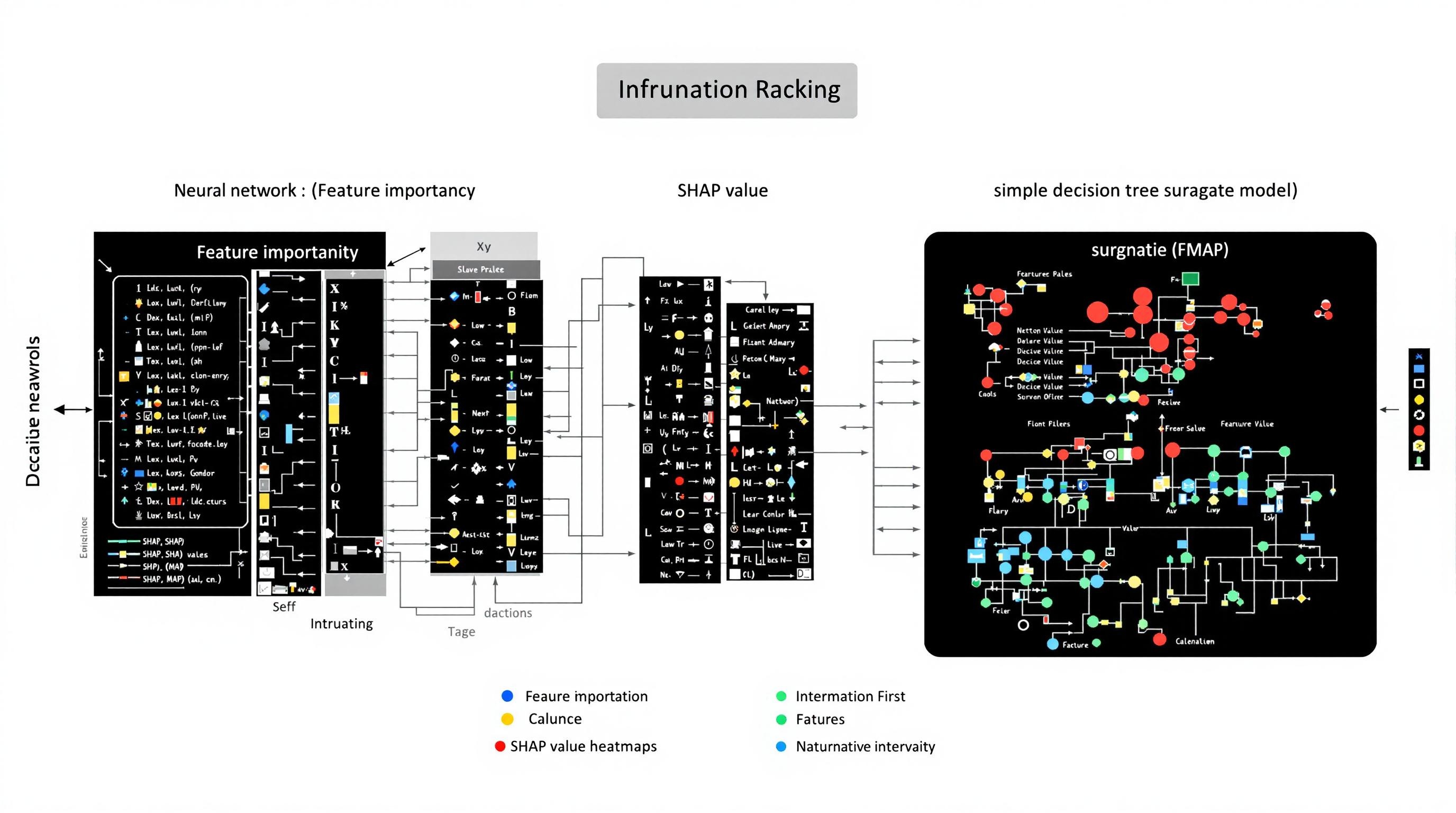
Post-hoc Explanation Techniques
Post-hoc explanation methods apply after model training to interpret already-built black-box models. These techniques include:
- Feature Importance Methods: Techniques like SHAP (SHapley Additive exPlanations), Integrated Gradients, and Shapley values assign importance scores to input features, helping explain how features influence model predictions (IBM).
- Example-based Explanations: These methods explain model decisions through relevant examples from the training data, showing similar cases to help users understand the reasoning.
- Counterfactual Explanations: These identify minimal changes to input features that would alter the model’s prediction, answering “what if” questions about model behavior.
- Surrogate Models: Simple, interpretable models (like decision trees) that approximate the behavior of complex black-box models to provide insights into their decision-making.
These approaches can be further classified as providing either local explanations (focused on individual predictions) or global explanations (aimed at understanding the model’s overall behavior across all instances).
Inherently Interpretable Models
Rather than explaining black-box models after the fact, another approach is to use inherently interpretable models from the start:
- Self-explaining Neural Networks: Specialized neural network architectures designed to provide explanations alongside their predictions.
- Decision Trees and Linear Regression: Traditional machine learning models that offer clear, transparent decision paths or feature weights.
- Generalized Additive Models: These extend linear models while maintaining interpretability by modeling non-linear relationships.
The choice between post-hoc explanations and inherently interpretable models involves balancing predictive power with explainability requirements. While complex models often achieve higher accuracy, interpretable models provide greater transparency in the decision-making process (IBM).
Feature Importance Methods in Detail
SHAP (SHapley Additive exPlanations)
SHAP values, based on game theory’s Shapley values, have emerged as one of the most theoretically sound approaches to feature attribution in machine learning models.
SHAP works by measuring each feature’s contribution to a prediction by calculating the average marginal contribution of that feature across all possible feature combinations. This provides a fair distribution of the prediction among features.
Key strengths of SHAP include:
- Model-agnostic application (works with any machine learning model)
- Consistent local explanations that sum to the actual prediction
- Strong theoretical foundations based on cooperative game theory
However, SHAP calculations can be computationally intensive for complex models and large datasets, which may limit practical applications in some scenarios (IBM).
Integrated Gradients and Gradient-Based Methods
Gradient-based explanation methods are particularly valuable for deep learning models and neural networks, especially in image classification tasks.
Integrated Gradients improves upon basic gradient approaches by considering the path integral of gradients between a baseline input and the actual input. This method with respect to input features helps determine which pixels or features most influenced the model’s decision.
According to research on Explainable Artificial Intelligence, gradient-based methods like Integrated Gradients are particularly effective for explaining deep networks in computer vision applications, where they can highlight regions of an original image that most influenced the classification decision.
Visualization techniques for gradient-based explanations often include heatmaps overlaid on the input data, making them intuitive for human understanding even when the underlying model is complex.
Evaluating the Quality of Explanations
Not all explanations are equally valuable. Evaluating explanation quality involves both quantitative evaluation methods and qualitative assessment:
- Fidelity: How accurately does the explanation represent the actual model’s decision process?
- Consistency: Do similar inputs produce similar explanations?
- Comprehensibility: Can human users understand and apply the explanation effectively?
- Completeness: Does the explanation account for all relevant aspects of the model’s decision?
Common pitfalls in explanation evaluation include focusing too narrowly on technical metrics while neglecting human understanding, or failing to validate that explanations accurately reflect the model’s actual decision boundary (IBM).
Measuring explanation quality often requires interdisciplinary approaches drawing from computer science, cognitive psychology, and the social sciences to ensure explanations serve their intended purpose.
Implementing Explainability in Practice
Integrating explainability methods into existing machine learning workflows requires thoughtful planning and execution:
- Consider explainability from the start: Model training should incorporate explainability considerations early in the development process.
- Choose appropriate methods: Select explainability techniques based on the model type, application domain, and specific stakeholder needs.
- Leverage existing tools: Frameworks like LIME, SHAP, and TensorFlow’s Integrated Gradients provide implementation shortcuts.
- Visualize effectively: Decision boundary visualization and other practical techniques can make explanations more intuitive for users.
Model performance considerations should include explainability alongside traditional metrics like accuracy. In some cases, slightly sacrificing predictive power for significantly improved interpretability may be the optimal trade-off for practical applications (IBM Research).
Industry Applications and Case Studies
Healthcare and Medical Diagnosis

In healthcare, explainable AI is transforming clinical practice by providing transparent decision support that physicians can verify and trust.
Medical diagnosis models using explainability techniques allow doctors to understand which features (symptoms, test results, or patient history) drive AI recommendations, enhancing collaboration between AI systems and healthcare professionals (Palo Alto Networks).
Regulatory considerations specific to healthcare AI, including FDA approval processes for medical AI tools, increasingly emphasize explainability as a requirement for clinical deployment.
According to Palo Alto Networks, “In healthcare applications, explainable models have shown success in helping physicians understand complex diagnostic recommendations while maintaining high accuracy.”
Financial Services and Fraud Detection
Financial institutions deploy explainable models for credit decisions and risk assessment to ensure transparency and regulatory compliance. These explainability methods help justify why specific loan applications were approved or denied (Palo Alto Networks).
In fraud detection, explaining model decisions helps human analysts understand suspicious patterns flagged by AI systems, reducing false positives and building trust in automated detection systems.
Compliance with financial industry standards often requires demonstrating that AI systems make decisions based on relevant, non-discriminatory factors—a requirement that explainability methods directly address.
Future Directions in AI Explainability
Research in explainable artificial intelligence continues to evolve, with several promising directions:
- Interactive Explanations: Systems that allow users to query and explore model behavior in real-time.
- Causal Explanations: Moving beyond correlative explanations to causal relationships in model decision-making.
- System-Level Explanations: Expanding from individual predictions to understanding entire AI systems and their interactions.
- Standardized Evaluation: Development of industry standards for measuring and comparing explanation quality.
Explainability is increasingly recognized as a cornerstone of responsible AI practices, alongside fairness, robustness, and privacy. As AI systems become more integrated into critical infrastructure, the ability to explain their decisions will become even more essential for quality assurance and regulatory compliance (IBM).
To explore tools and services that incorporate AI explainability, visit Jasify’s AI marketplace, where you can find solutions that balance powerful machine learning capabilities with transparent decision-making processes.
Conclusion
AI explainability represents one of the most important challenges in modern artificial intelligence development. As black-box models continue to demonstrate impressive capabilities across domains, the methods discussed for making these models interpretable will play an increasingly crucial role in responsible AI deployment.
From feature importance techniques like SHAP and Integrated Gradients to inherently interpretable machine learning approaches, organizations now have a range of options to address the black box problem. By implementing these methods thoughtfully, developers can create AI systems that not only perform well but also build trust through transparent decision-making processes.
The future of AI lies not just in building more powerful models, but in creating systems whose decisions can be understood, validated, and trusted by the humans who use them. AI explainability methods are the bridge between the remarkable capabilities of modern machine learning and the practical, ethical requirements of real-world applications.
Trending AI Listing on Jasify
- Full AI Marketing System Setup – Use AI Media (One-Time Build) by Jasify Store: This comprehensive solution delivers a fully customized AI-powered growth infrastructure, including AI website design, SEO blog automation, AI video repurposing, email outreach, and more. Ideal for organizations seeking to implement advanced, explainable AI-driven marketing and content systems.
- AI Short-Form Repurposing System (From 2+ Hours of Content to 100+ Posts/Month) by Jasify Store: Transform long-form content into daily short-form posts using AI, ensuring consistent visibility and engagement across platforms. Perfect for brands and creators leveraging AI for content strategy.
- Custom AI Agent Build – Automate Your Business with a Personalized GPT System by Jasify Store: Get a custom-built AI agent tailored to automate key business processes, from outreach to content management, supporting explainable and efficient AI integration.
