

Artificial intelligence agent development represents one of the most dynamic and promising frontiers in modern technology. As AI capabilities continue to expand, the creation of intelligent agents that can perceive, reason, learn, and act with increasing autonomy has become a focal point for innovation across industries. This comprehensive guide explores the fundamentals, architecture, development processes, and future directions of AI agent systems, providing developers and organizations with the knowledge needed to build effective AI solutions.
Understanding AI Agent Fundamentals
AI agents are advanced systems designed to perceive their environment through sensors, process and analyze information, and take actions via actuators to achieve specific goals. Unlike simple programs that execute predetermined instructions, true AI agents exhibit autonomy, adaptability, and the ability to learn from experiences and data.
The evolution of artificial intelligence agents has been remarkable, beginning in the 1950s with rudimentary rule-based systems that were predictable but inflexible. By the 1980s and 1990s, expert systems and early machine learning models enabled more structured decision-making capabilities. The 2010s witnessed transformative breakthroughs in deep learning and neural networks, while the period since 2017 has been defined by large language models (LLMs) that have revolutionized natural language understanding and generation, making agents increasingly conversational and human-like in their reasoning abilities. For more on this evolution, see NFX.
What distinguishes AI agents in the broader artificial intelligence landscape is their combination of four core capabilities:
- Perception: The ability to sense and collect data from their environment
- Reasoning: Analyzing information and making inferences
- Learning: Improving performance based on experience and data
- Action: Executing decisions to achieve goals
Simple agents typically follow predefined rules and operate independently, while complex multi-agent systems involve multiple agents that interact, communicate, and potentially collaborate to solve more sophisticated problems. This distinction is crucial for understanding how to approach AI agent development based on the complexity of the target application. For a deeper dive into agent types and their evolution, refer to Rapid Innovation.
Essential Components of AI Agent Architecture
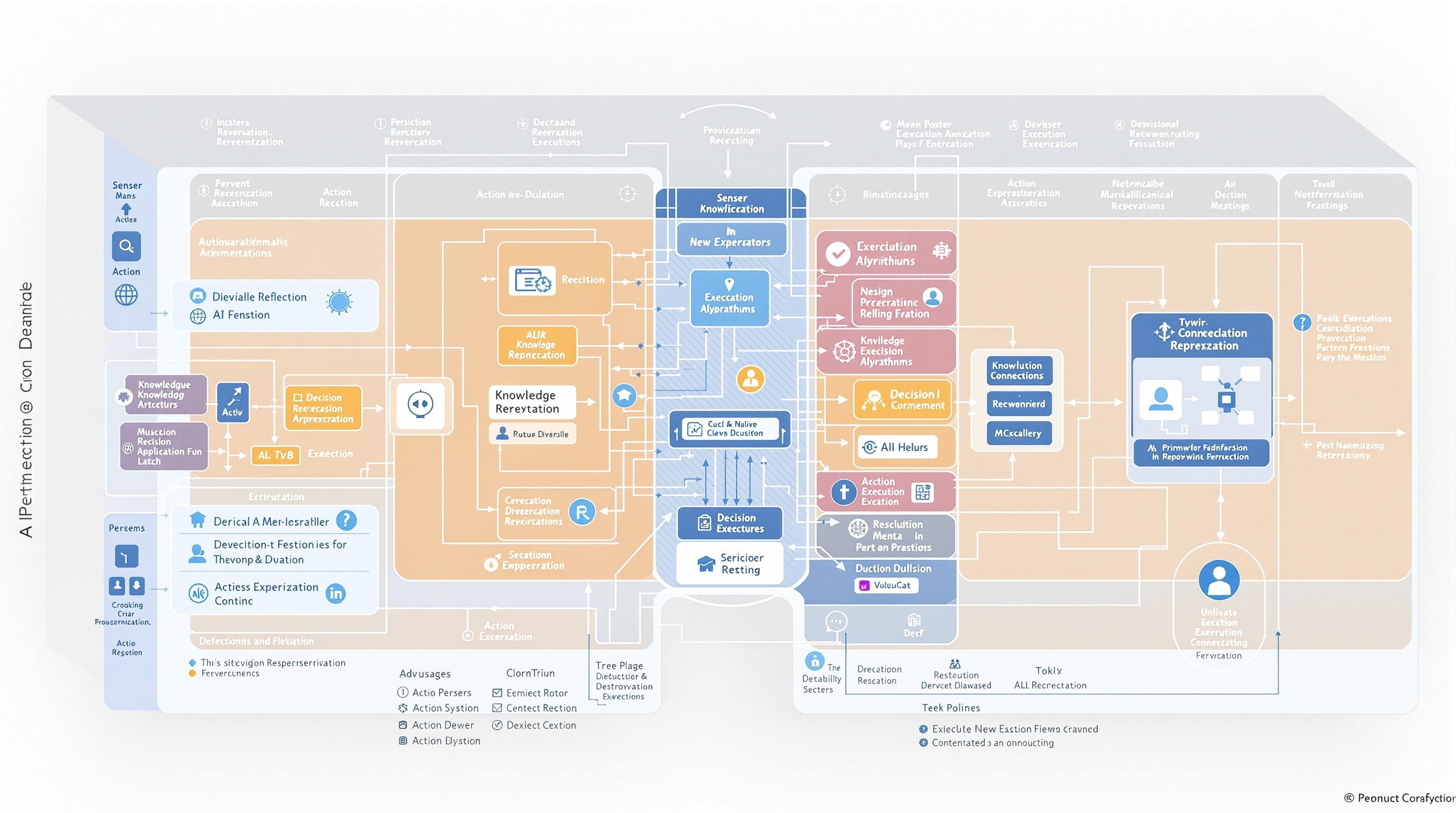
Effective system architecture forms the foundation of successful AI agent development. A well-designed agent architecture typically incorporates several key components:
Sensor systems serve as the agent’s perceptual interface with the environment, collecting data through various means such as text input, image recognition, or audio processing. These systems must be carefully calibrated to gather relevant information while filtering noise.
Knowledge representation frameworks organize and store information in structures that facilitate reasoning and decision-making. These may include ontologies, knowledge graphs, or semantic networks that capture relationships between concepts. According to a World Economic Forum report, effective knowledge representation is essential for agents to make contextually appropriate decisions.
Decision-making algorithms process information and determine actions. These range from simple rule-based systems to complex reinforcement learning algorithms that optimize behavior based on feedback. The choice of algorithm significantly impacts an agent’s performance in different scenarios.
Action execution mechanisms translate decisions into actual behaviors, whether digital (like generating text) or physical (controlling a robot). These must be reliable and precise to ensure the agent’s intentions are accurately implemented.
Feedback loops enable continuous improvement by collecting information about the outcomes of actions and using this data to refine future behavior. This self-correction capability is what allows agents to adapt and evolve over time.
Agent Types and Classification
AI agents can be classified along several dimensions based on their design and capabilities:
Reactive vs. deliberative agents: Reactive agents respond immediately to current inputs without maintaining internal states or planning ahead. In contrast, deliberative agents maintain models of the world and plan sequences of actions to achieve goals. Many modern chatbots combine both approaches, providing immediate responses while maintaining conversation context.
Goal-based and utility-based agents evaluate potential actions based on how they contribute to specific objectives or maximize defined utility functions. These agents excel in domains where clear metrics of success can be established, such as optimization problems or resource allocation.
Learning agents continuously adapt their behavior based on experience. These incorporate machine learning algorithms that allow them to improve over time and handle novel situations. According to Rapid Innovation, learning agents represent the most sophisticated category due to their adaptability.
Specialized agents are designed for specific applications, such as conversational agents (chatbots), recommendation systems that suggest products or content, and analytical agents that process and interpret complex data. Each type requires different design considerations and evaluation metrics. For more on agent classification and architecture, see NFX.
Machine Learning Foundations for AI Agents
Machine learning provides the core technologies that power modern AI agent development. Different learning approaches serve distinct purposes in agent systems:
Supervised learning trains agents using labeled examples, enabling them to classify inputs or predict outcomes based on historical data. This approach works well for agents that need to recognize patterns or make predictions in well-defined domains.
Unsupervised learning discovers patterns in unlabeled data, allowing agents to identify clusters, detect anomalies, or reduce dimensionality. These techniques help agents make sense of complex, unstructured information without explicit guidance.
Reinforcement learning enables agents to learn optimal behavior through trial and error, receiving rewards or penalties based on their actions. This paradigm is particularly valuable for agents that must make sequential decisions in dynamic environments, such as game playing or resource management.
Deep learning architectures, particularly neural networks, have transformed agent capabilities by enabling more sophisticated pattern recognition and decision-making. These networks simulate interconnected neurons that process information in layers, allowing agents to handle complex inputs like images, audio, and natural language. For more on the impact of deep learning and neural networks, see NFX.
Data Requirements and Processing
Effective AI agent development depends critically on data quality and processing:
Training data collection must be comprehensive and representative of the scenarios the agent will encounter. Biased or limited datasets lead to agents that perform poorly in real-world conditions or perpetuate harmful stereotypes.
Feature engineering identifies and extracts the most relevant aspects of raw data for agent perception. This process requires domain knowledge and can significantly impact performance, especially in specialized applications.
Data preprocessing techniques such as normalization, cleaning, and augmentation ensure that input data is consistent and usable. These steps help mitigate issues like missing values, outliers, or format inconsistencies that could compromise agent performance.
Addressing bias in training datasets is essential for developing fair and accurate agents. This requires careful data selection, augmentation, and validation to ensure the agent doesn’t discriminate or make systematically flawed decisions. For more on data and bias handling, see Rapid Innovation.
Developing Single-Agent Systems
Building effective single-agent systems requires a structured development approach:
Design principles for AI agents emphasize modularity, explainability, and robustness. A well-designed agent should have clear interfaces between components, traceable decision processes, and graceful handling of unexpected inputs or failures.
Programming languages and frameworks for agent development include Python (with libraries like TensorFlow and PyTorch), Java (with frameworks like JADE), and specialized tools like Botpress for conversational agents and LangChain for LLM-based systems.
Testing and evaluation methodologies must assess both functional performance (accuracy, efficiency) and user experience (satisfaction, trust). Rigorous testing across diverse scenarios helps identify weaknesses before deployment.
Performance optimization techniques include algorithmic improvements, computational efficiency enhancements, and caching strategies. These become increasingly important as agents scale to handle more users or complex tasks.
Natural Language Processing in Agent Development
Natural language processing (NLP) capabilities are central to many modern AI agents:
Language understanding components analyze user inputs to determine meaning, intent, and contextual nuances. These systems must handle ambiguity, slang, and domain-specific terminology.
Conversational agent design focuses on creating natural, engaging interactions. This includes managing turn-taking, generating appropriate responses, and maintaining coherent conversations over multiple exchanges.
Intent recognition identifies what users are trying to accomplish, while entity extraction identifies specific objects, people, or concepts mentioned in text. These capabilities enable agents to understand and respond to complex requests.
Context management in dialogues allows agents to maintain a coherent understanding of conversation history. This is essential for resolving pronouns, handling follow-up questions, and providing relevant responses over extended interactions. For more on NLP in agents, see NFX.
Building Multi-Agent Systems
Multi-agent systems (MAS) involve multiple AI agents interacting within a shared environment:
Architectural approaches to multi-agent environments include centralized designs (where a master agent coordinates others), decentralized systems (where agents operate independently), and hybrid models. Each approach offers different trade-offs in terms of robustness, efficiency, and complexity.
Communication protocols enable agents to exchange information, coordinate actions, and negotiate solutions. These protocols must be standardized and efficient to support complex interactions.
Coordination strategies govern how agents work together to achieve common goals. These range from simple task allocation to sophisticated collaborative planning algorithms that optimize collective performance.
Game theory applications in multi-agent interactions model strategic decision-making, helping predict and design agent behaviors in competitive or cooperative scenarios. These mathematical frameworks provide valuable insights into equilibrium states and optimal strategies. For more on MAS and coordination, see Rapid Innovation.
Challenges in Multi-Agent Development
Multi-agent systems present unique challenges:
- Ensuring system stability and predictability becomes difficult as agent populations grow and interactions become more complex
- Managing emergent behaviors that arise from agent interactions but weren’t explicitly programmed
- Resolving conflicts between agents with competing goals or resource requirements
- Scaling issues in large agent populations, including communication overhead and coordination complexity
- Balancing autonomy and control to ensure agents have sufficient freedom while maintaining alignment with system objectives
AI Agent Development Tools and Frameworks
Several powerful tools and frameworks facilitate AI agent development:
Botpress offers visual workflow design, multi-channel support, and robust NLP integration, making it ideal for developing conversational agents without extensive coding.
LangChain has emerged as a leading framework for building reasoning, memory-enabled agents that can use tools and follow complex workflows. Its ecosystem includes LangSmith for debugging and LangServe for deployment.
Other notable tools include CrewAI for collaborative agent teams, Microsoft Semantic Kernel for enterprise integration, AutoGen for autonomous agent generation, AutoGPT for goal-directed agents, and RASA for open-source conversational AI.
Cloud computing platforms like AWS, Google Cloud, and Azure provide scalable infrastructure for agent deployment, offering managed services for machine learning, natural language processing, and other AI capabilities that accelerate development. For more on leading frameworks and deployment, see Botpress.
Real-World Applications and Use Cases
AI agents are transforming numerous industries:
Virtual assistants and chatbots handle customer service inquiries, provide technical support, and facilitate information retrieval across sectors. According to industry data, these systems can achieve up to 70% resolution rates for common queries, reducing human workload by 40% in some organizations.
Autonomous vehicles and robotics leverage agent technology for navigation, decision-making, and environmental interaction. These systems must balance safety, efficiency, and adaptability in dynamic real-world settings.
Financial trading agents analyze markets, execute trades, and optimize investment portfolios. Some agent systems have outperformed traditional algorithms by 15-20% in certain market segments by leveraging real-time data analysis and reinforcement learning techniques.
Industrial automation and process control agents monitor equipment, optimize operations, and predict maintenance needs. These applications improve efficiency while reducing downtime and resource consumption. For more on real-world applications, see NFX.
Ethical Considerations in AI Agent Development
Responsible AI agent development requires addressing several ethical dimensions:
Privacy concerns arise when agents collect, store, and process personal data. Developers must implement robust data protection measures and transparent privacy policies to maintain user trust.
Security issues and potential vulnerabilities must be addressed through comprehensive testing, regular updates, and defensive design. Agents that control critical systems or handle sensitive information require particularly stringent security protocols.
Bias in AI decision-making processes can perpetuate or amplify existing societal inequities. Mitigating bias requires diverse training data, algorithmic fairness techniques, and ongoing monitoring of agent behavior.
Transparency and explainability requirements ensure users understand how agents make decisions. This is especially crucial in high-stakes domains like healthcare, finance, and legal applications where trust is essential. For more on ethical frameworks, see Rapid Innovation.
Future Trends in AI Agent Development
The field of AI agent development continues to evolve rapidly:
Integration with Internet of Things (IoT) will enable agents to interact with and control physical devices, creating smarter homes, cities, and industrial environments. This convergence will generate new opportunities for automation and optimization.
Blockchain applications for secure agent interactions offer potential for trustless coordination, secure data sharing, and transparent transaction recording. These technologies could address trust and security concerns in distributed agent systems.
Advancements in cognitive computing will bring more human-like reasoning capabilities to agents, including improved causal reasoning, common sense knowledge, and ethical decision-making. According to NFX, these developments will expand the range of tasks agents can perform autonomously.
Human-computer interaction will evolve toward more natural, intuitive interfaces as agents better understand context, emotions, and social dynamics. This evolution will make AI systems more accessible and useful to non-technical users.
Testing, Evaluation and Optimization
Effective AI agent development requires rigorous testing and continuous improvement:
Performance metrics for agent evaluation should encompass technical measures (accuracy, response time), business outcomes (conversion rates, cost savings), and user experience factors (satisfaction, trust). A balanced assessment provides a complete picture of agent effectiveness.
A/B testing methodologies compare different agent versions in real-world settings to identify optimal designs and behaviors. This empirical approach helps resolve design questions that can’t be answered through theoretical analysis alone.
Continuous improvement processes collect feedback, monitor performance, and iteratively enhance agent capabilities. This ongoing development cycle ensures agents remain effective as user needs and environmental conditions change.
Resource efficiency optimization reduces computational requirements, energy consumption, and operational costs. As AI agents become more prevalent, sustainable development practices will become increasingly important.
The field of AI agent development represents an exciting frontier in artificial intelligence, combining advances in machine learning, natural language processing, and multi-agent systems to create increasingly capable and autonomous software. By understanding the fundamentals, architecture, and development processes outlined in this guide, organizations can harness these technologies to build innovative solutions that transform how we interact with computers and automate complex tasks. To explore AI tools and services that can accelerate your agent development journey, visit Jasify’s AI marketplace.
Trending AI Listings on Jasify
- Custom Logo Design Pack – Perfect for AI agent developers creating new brand identities for their agent systems and services.
- Internship Finder – Helps AI development students and graduates find specialized internships in machine learning and agent development.
- High-Impact SEO Blog – Ideal for AI development companies looking to establish thought leadership through optimized content about their agent technologies.
