

The rapid evolution of artificial intelligence has created a new challenge for enterprises: effectively managing the complex web of AI systems, models, data pipelines, and integrations that power modern business operations. AI orchestration has emerged as the critical solution to this challenge, providing a structured approach to building, deploying, and managing AI workflows at scale. This article explores how enterprises can leverage AI orchestration frameworks to achieve seamless automation and integration across their AI initiatives.
Understanding AI Orchestration Fundamentals
AI orchestration refers to the coordinated management of AI models, systems, and integrations that comprise broader AI workflows or applications. It encompasses the deployment, implementation, integration, and ongoing maintenance of AI components and resources while ensuring they work together harmoniously. Unlike traditional workflow management that handles generic task sequences, AI orchestration specifically addresses complexities unique to AI systems, such as model integration, complex data dependencies, and automated resource allocation. For more on this, see Hatchworks and Nexos.ai.
The market adoption of AI orchestration solutions is accelerating rapidly as enterprises recognize their role in driving operational efficiency, resource optimization, and scalability. According to industry analysts, the rise of large language models (LLMs) and generative AI has created new orchestration demands, with organizations increasingly implementing sophisticated orchestration frameworks to manage complex AI-driven applications like intelligent chatbots and process automation systems. For further reading, refer to BA Insight.
The evolution from manual AI deployment to automated orchestration frameworks represents a significant maturation in how enterprises approach AI implementation. Modern AI orchestration frameworks integrate three essential pillars:
- Automation of repetitive tasks and processes
- Integration across heterogeneous systems and data sources
- Management of the entire AI lifecycle from development to deployment
The Enterprise AI Orchestration Architecture
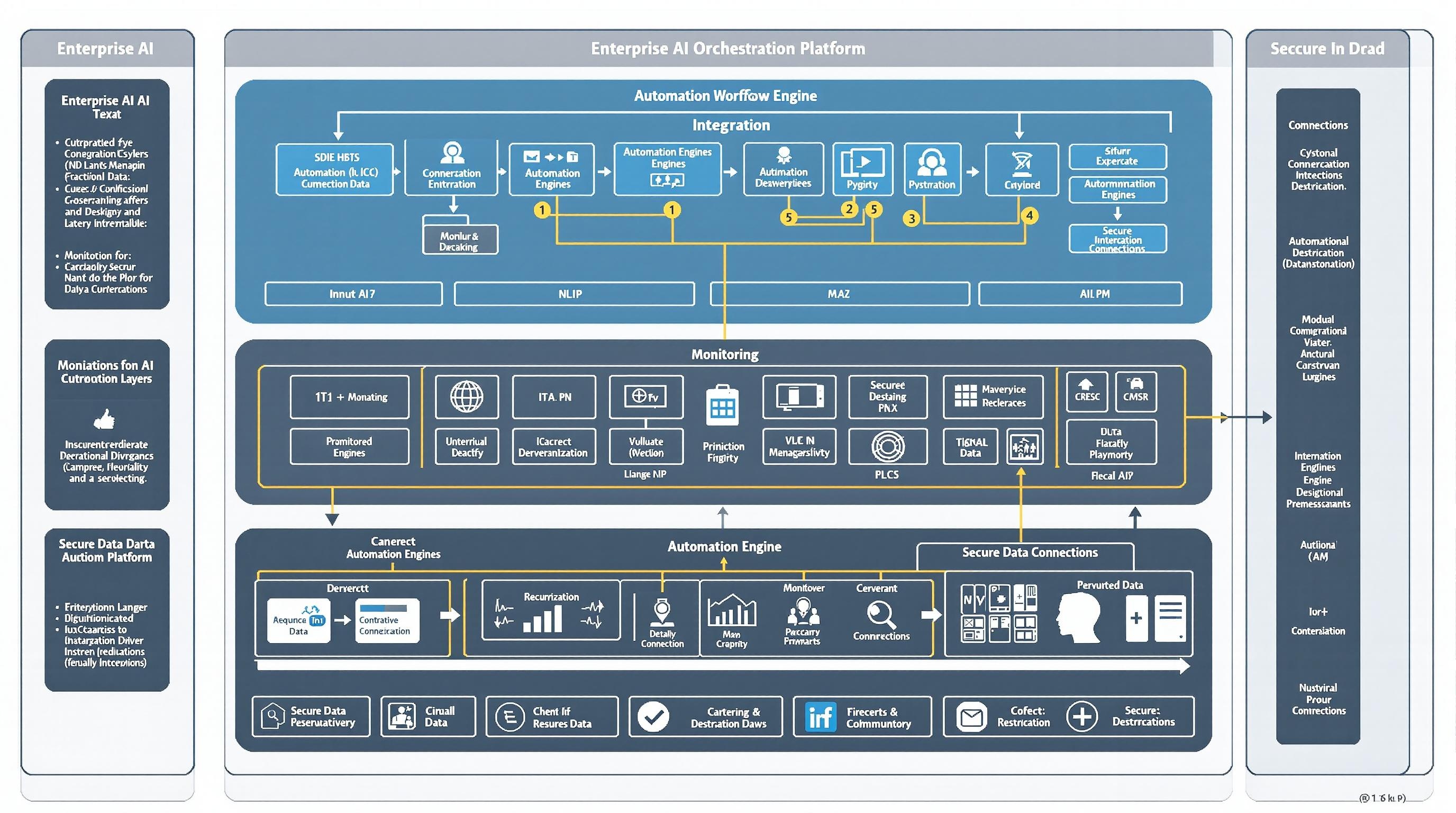
Core Components of AI Orchestration Platforms
Effective AI orchestration platforms comprise several essential components that work together to enable seamless workflow management. At their foundation, these platforms offer robust workflow design and modeling capabilities that allow teams to conceptualize, simulate, and implement AI workflows with modular, reusable elements. This modularity is crucial for maintaining agility as business requirements evolve.
The automation engines and execution environments within orchestration platforms enable automated deployment, task scheduling, resource allocation, and self-healing capabilities. These components detect and correct workflow failures autonomously, ensuring continuity in AI operations even when issues arise. As Hatchworks notes, these automation capabilities significantly reduce manual intervention requirements and accelerate time-to-value for AI initiatives.
Integration layers provide the connectors and APIs necessary to unify diverse AI models, data sources, and infrastructure components. These layers allow for the seamless interoperation of heterogeneous AI systems, breaking down silos that would otherwise limit the effectiveness of enterprise AI. Monitoring and observability frameworks track AI model performance, latency, drift, error rates, and resource consumption in real-time, providing the visibility needed for proactive management.
Governance and compliance management tools enforce security, data privacy, regulatory compliance, audit trails, and ethical AI standards—all critical considerations in enterprise deployments where regulatory requirements and corporate policies must be rigorously maintained.
Deployment Models for Enterprise AI Orchestration
Enterprises have several options for deploying AI orchestration solutions, each with distinct advantages. On-premises orchestration offers greater control over sensitive data and legacy system integration but requires substantial infrastructure investment and ongoing maintenance. Cloud-based orchestration leverages scalable compute resources, elasticity, and managed services, enabling rapid deployment and global accessibility while potentially raising data sovereignty concerns.
Hybrid orchestration strategies combine both approaches, allowing integration of cloud capabilities with existing on-premises systems. This approach accommodates legacy applications and sensitive data environments while still benefiting from cloud scalability. According to Nexos.ai, hybrid approaches are growing in popularity as they provide flexibility while respecting existing IT investments.
Containerization and microservices-based orchestration enhance the modularity and portability of AI components within workflows. Technologies like Kubernetes have become instrumental in facilitating agile deployment and scaling of containerized AI services across distributed environments. Multi-cloud orchestration addresses the challenges of maintaining consistency, data governance, and performance across varied cloud providers—a critical consideration for enterprises seeking to avoid vendor lock-in and optimize costs.
Building Scalable AI Workflows
Workflow Design Principles
Successful AI workflow design begins with modular construction methodologies, creating reusable, decoupled components that enhance maintainability and scalability. This approach allows teams to build complex workflows from well-tested building blocks rather than creating monolithic processes that become difficult to maintain.
The trigger mechanism for workflows represents another important design decision. Event-driven triggers enable responsive workflows that react to data or system events, while scheduled triggers support batch processing and routine tasks. The choice between these approaches depends on the specific use case requirements and desired responsiveness.
Error handling and exception management strategies ensure workflows can recover gracefully or escalate issues without interrupting other operations. These mechanisms are particularly important in production environments where reliability is paramount. Version control and change management track iterations in models and pipelines, enabling rollback capabilities and auditability crucial for compliance and quality assurance.
The integration of machine learning operations (MLOps) best practices, including continuous integration/continuous deployment (CI/CD) pipelines for AI models, ensures workflow reproducibility and faster iteration cycles. As data science teams mature, these DevOps-inspired practices become increasingly central to successful AI orchestration.
Data Orchestration in AI Workflows
Data orchestration forms a critical subset of AI orchestration, focusing on the movement, transformation, and validation of data throughout AI systems. Data ingestion, transformation, and validation pipelines collect, clean, and prepare data from diverse structured and unstructured sources for AI consumption. Managing data dependencies ensures data is available in the correct sequences across workflow stages, preventing bottlenecks and ensuring consistency.
Techniques for handling structured and unstructured data optimize workflow flexibility, enabling systems to process everything from tabular data to natural language text, images, and sensor data. The decision between real-time streaming and batch processing impacts latency and throughput trade-offs, with each approach suited to different use cases.
Data governance integration within orchestration frameworks enforces security policies, data quality standards, and regulatory compliance throughout data lifecycles. As BA Insight emphasizes, this integration is essential for ensuring AI systems operate within established boundaries and maintain compliance with relevant regulations.
Enterprise Integration Patterns for AI Orchestration
API-driven integration approaches form the backbone of AI orchestration by standardizing communication between AI models, data sources, and external systems. Well-designed APIs with clear contracts enable loosely coupled components that can evolve independently while maintaining interoperability.
Event-based integration models enable asynchronous workflow reactions and support loosely coupled systems. This pattern is particularly valuable in complex AI ecosystems where components need to respond to events without direct knowledge of the event source. Message queue and pub/sub patterns facilitate reliable, scalable event distribution and coordination among components in a decoupled manner, enhancing system resilience and scalability.
Service mesh architectures provide observability, traffic control, and security features that simplify managing complex microservices-based AI deployments. These architectures are becoming increasingly common as enterprises adopt distributed systems approaches for their AI initiatives. Integration with existing DevOps and CI/CD pipelines supports continuous testing, deployment, and monitoring of AI workflows, enhancing lifecycle management and accelerating the path from development to production.
Automation Capabilities in Enterprise AI Orchestration
End-to-end workflow automation represents one of the most significant value propositions of AI orchestration. By eliminating manual handoffs and ensuring smooth task progression, orchestration platforms dramatically reduce operational overhead and accelerate time-to-value. Decision automation within AI workflows enables dynamic routing and intelligent task assignment based on AI model outputs and contextual data, creating more responsive and adaptive systems.
Self-healing and adaptive workflow capabilities detect failures or performance degradation and trigger automatic recovery actions without human intervention. This capability is particularly valuable in mission-critical AI applications where downtime must be minimized. Resource provisioning and scaling automation optimizes cost and performance by dynamically adapting to workload demands, ensuring efficient resource utilization across the AI infrastructure.
Automated testing and validation of AI models within workflows maintain model quality, detect drift, and support compliance requirements. These capabilities are essential for maintaining the reliability and accuracy of AI systems over time, particularly in regulated industries where model validation is a formal requirement.
Leading AI Orchestration Tools and Platforms
The market offers a diverse range of commercial orchestration solutions, including platforms like IBM Watson Orchestrate that focus on integrating AI across enterprise systems while providing robust governance and monitoring capabilities. Open-source orchestration frameworks such as Apache Airflow and Kubeflow offer scalable workflow orchestration with strong community support, particularly for machine learning pipelines.
Cloud provider native orchestration services from AWS (Step Functions), Google Cloud (Workflows), and Azure (Logic Apps) provide managed infrastructure tightly integrated with cloud AI tools. These services offer simplified deployment and management for organizations already committed to specific cloud ecosystems.
Specialized orchestration tools for machine learning operations, such as MLflow and TensorFlow Extended (TFX), focus on the lifecycle management of ML models. These tools often integrate with general-purpose orchestration platforms to create comprehensive workflows that span from data preparation to model deployment and monitoring.
When evaluating orchestration technologies, enterprises should consider criteria including platform scalability, integration flexibility, automation depth, security features, ease of use, compliance support, and cost-effectiveness. The optimal choice depends on an organization’s specific requirements, existing technology investments, and long-term AI strategy.
Implementation Strategies for Enterprise AI Orchestration
Organizational Readiness Assessment
Before implementing AI orchestration, organizations must assess their readiness across several dimensions. Required skills and competencies include AI/ML engineering, data engineering, DevOps, and governance compliance expertise. Team structure and collaboration models should integrate data scientists, engineers, and business stakeholders to enhance alignment and ensure orchestration solutions address real business needs.
Governance frameworks must define clear policies for model deployment, data handling, and security to guide orchestration implementation. Technology infrastructure prerequisites include scalable compute, storage, and networking resources with adequate observability capabilities. Change management considerations should address the cultural shifts and training requirements necessary to adopt automated AI workflows successfully.
Phased Implementation Approach
A phased implementation approach minimizes risk and maximizes learning opportunities. Organizations should begin with pilot project identification and scope definition, focusing on specific use cases that can demonstrate value and refine workflows before broader deployment. Scaling from departmental to enterprise-wide orchestration should happen incrementally, adapting designs based on feedback and evolving scaling needs.
Migration strategies for existing AI workflows require careful planning to avoid disruption, often necessitating re-architecting for modularity and automation. Performance benchmarking and optimization should be conducted continuously to identify bottlenecks and improvement opportunities. Continuous improvement methodologies apply lessons learned and user feedback to refine orchestration processes over time, ensuring the solution evolves with the organization’s needs.
Measuring Success: KPIs for AI Orchestration
Effective measurement of AI orchestration success requires a multifaceted approach. Operational efficiency metrics track improvements in throughput, task completion rates, and reduced latency compared to pre-orchestration baselines. Time-to-deployment reductions capture how quickly AI models and workflows reach production, a critical metric for organizations seeking to accelerate innovation cycles.
Resource utilization improvements demonstrate how orchestration optimizes compute, memory, and storage resources across the AI infrastructure. Error rate and reliability measurements track system robustness, with successful orchestration typically reducing failure frequencies and improving mean time to recovery. Cost optimization indicators help quantify the return on investment for orchestration initiatives, while scalability and throughput metrics demonstrate the system’s ability to handle growing workloads effectively.
AI Orchestration Security and Compliance Considerations
Security architecture for AI workflow orchestration must address authentication, authorization, network segmentation, and data encryption to protect sensitive AI assets and data. Authentication and authorization models ensure only authorized users and systems can access orchestration capabilities, while audit trails and activity logging provide the visibility needed for forensic analysis and regulatory compliance.
Regulatory compliance integration ensures orchestration frameworks align with GDPR, HIPAA, industry-specific standards, and internal policies. Data privacy controls embedded within orchestrated workflows prevent unauthorized data access or leaks, particularly important when workflows involve personally identifiable information or other sensitive data. Risk management frameworks help organizations proactively identify and mitigate threats related to AI system misuse or failures, ensuring orchestration enhances rather than compromises security posture.
Future Trends in Enterprise AI Orchestration
The evolution of AI orchestration continues with several emerging trends. Low-code/no-code orchestration platforms are democratizing AI workflow creation, enabling business users to build and modify workflows with minimal coding. This trend aligns with broader movements toward citizen development across the enterprise software landscape.
AI-powered orchestration optimization leverages AI itself to tune workflow performance, resource allocation, and fault recovery dynamically. This meta-application of AI creates self-optimizing orchestration systems that continuously improve their efficiency and effectiveness. Edge computing integration for distributed AI workflows brings processing closer to data sources, enhancing performance for latency-sensitive applications and addressing data sovereignty concerns.
Advancements in distributed systems for AI orchestration will enable more sophisticated federated learning and privacy-preserving AI architectures. The convergence with emerging IT automation paradigms, including AIOps and platform engineering, points toward unified automation frameworks that span AI, infrastructure, and application layers, creating comprehensive digital operation platforms.
As enterprises continue their AI journey, orchestration will become increasingly central to realizing the full potential of artificial intelligence investments. By implementing robust orchestration frameworks and following the principles outlined in this article, organizations can build scalable, efficient, and secure AI workflows that drive meaningful business outcomes.
Are you looking for AI orchestration tools to streamline your workflows? Explore a wide range of AI tools on Jasify, the all-in-one AI marketplace where you can find everything from workflow automation platforms to specialized AI services that can help you implement effective orchestration strategies.
Trending AI Listings on Jasify
- Short-Form Video Clipping Service – Perfect for organizations looking to automate content workflows as part of their AI orchestration strategy.
- Custom Trip Planner – Demonstrates how AI orchestration can be applied to complex planning and logistics scenarios with multiple data dependencies.
- High-Impact SEO Blog – Helps enterprises communicate their AI orchestration strategy through optimized content that ranks in search results.
