


Discover the 7 stages of artificial intelligence from rule-based systems to the theoretical Singularity. Learn where we stand today and how businesses can leverage current AI capabilities for real results.

Discover the real difference between AI vs algorithm with our expert guide. Learn when to use each for your business needs, how they work, and practical examples from automation to ChatGPT.
The world of machine learning has undergone a revolutionary transformation with the emergence of auto ML (automated machine learning). This technology is changing how organizations approach data science by automating complex processes that previously required specialized expertise. In this comprehensive guide, we’ll explore how auto ML is democratizing access to powerful predictive analytics and transforming data-driven decision making across industries.
Auto ML refers to the end-to-end automation of the machine learning process. At its core, auto ML automatically handles everything from data preprocessing to model deployment, significantly reducing the manual effort required to build machine learning solutions.
The journey toward machine learning automation began with traditional ML approaches that demanded extensive manual work. Data scientists spent countless hours on data cleaning, feature engineering, algorithm selection, and hyperparameter tuning. According to IBM, this time-intensive process created bottlenecks in ML development and restricted adoption to organizations with specialized data science teams.
Auto ML solves several critical problems in the traditional data science pipeline:
The efficiency gains from automated model building are substantial. According to Forrester Research, organizations implementing auto ML report reducing model development time from weeks or months to days or even hours. This acceleration of machine learning workflows enables faster time-to-insight and more agile response to business challenges.
Unlike traditional machine learning approaches that require extensive manual intervention, auto ML platforms provide an automated workflow that handles repetitive tasks while allowing data scientists to focus on more strategic aspects of problem-solving. As Zilliz explains, this shift represents a fundamental change in how organizations approach machine learning.
The ROI metrics for organizations implementing auto ML solutions are compelling. Companies adopting auto ML typically report 40-60% reduction in model development time and 30-50% decrease in data science resource requirements, according to Gartner.
Financial services, healthcare, retail, and manufacturing have emerged as early adopters of auto ML technology. In healthcare, for instance, automated machine learning supports predictive models for patient outcomes, while retailers leverage automated data processing for customer segmentation and demand forecasting.
Perhaps most importantly, auto ML removes significant barriers to entry for non-technical stakeholders. Business analysts and domain experts can now build predictive models without deep knowledge of algorithm selection or feature engineering techniques. This democratization allows for wider adoption of data-driven decision making across organizational departments.
Real-world use cases demonstrate auto ML’s practical impact. For example, a manufacturing company implemented an automated anomaly detection system using auto ML that identified equipment failures before they occurred, reducing downtime by 35%. Similarly, financial institutions use automated pattern recognition through auto ML to detect fraudulent transactions with greater accuracy and less human intervention.
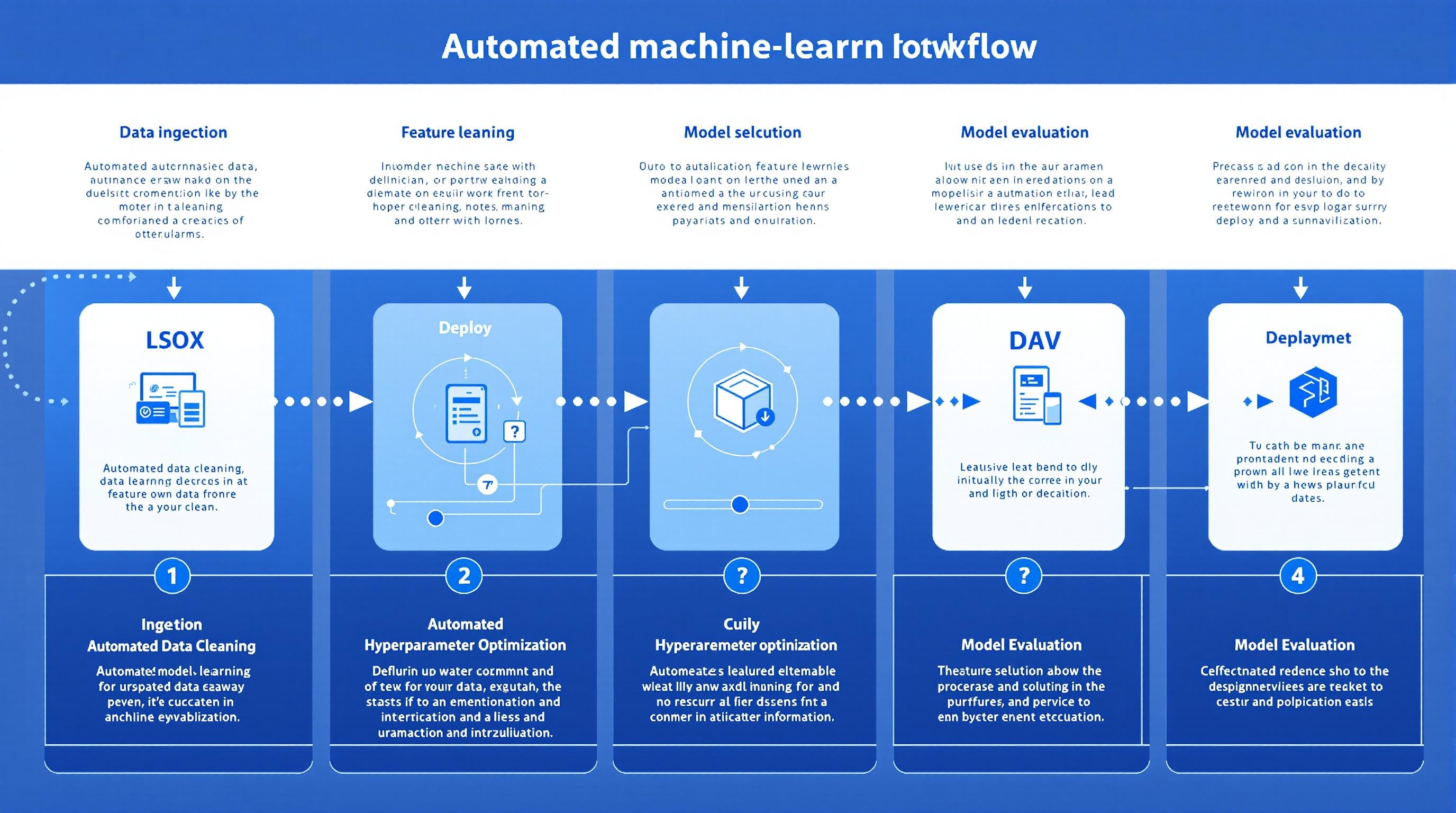
The complete automated workflow in auto ML encompasses several interconnected stages that transform raw data into deployed machine learning models. Understanding this pipeline is essential for organizations looking to implement effective AI automation strategies.
A typical auto ML lifecycle includes:
Automated data cleaning plays a crucial role in ensuring model accuracy. According to GeeksforGeeks, poor data quality remains one of the biggest challenges in machine learning, and auto ML platforms address this through automated outlier detection, missing value imputation, and data validation processes.
Similarly, automated feature engineering significantly impacts model performance. By automatically identifying relevant features and creating new ones through transformation and combination, auto ML systems can discover patterns that might be missed in manual approaches to feature selection.
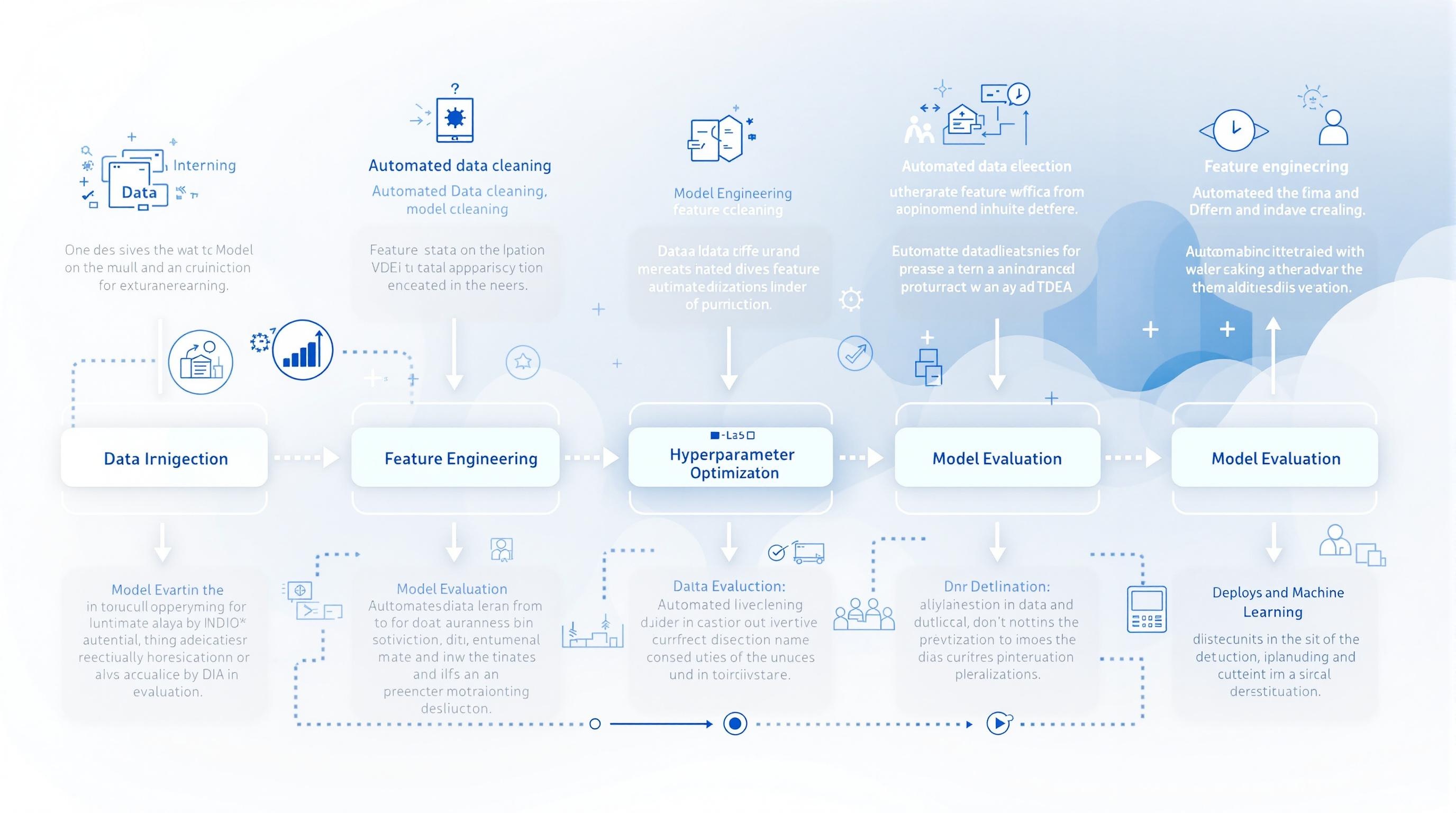
Auto ML platforms employ sophisticated methods for automated data cleaning. When handling missing values, these systems typically use statistical imputation (mean, median, mode), predictive modeling to estimate missing values, or contextual analysis to determine the most appropriate action for each specific case.
For different data types, automated data transformation approaches include normalization for numerical data, encoding for categorical variables, and tokenization for text data. These transformations prepare raw data for model training while preserving its informational content.
Automated outlier detection is another critical component of data preprocessing automation. Auto ML systems employ statistical methods (z-scores, IQR), clustering-based approaches, and machine learning-based outlier detection to identify and handle anomalous data points that could negatively impact model performance.
These automated data preprocessing techniques significantly impact model quality. Research from KDnuggets indicates that proper preprocessing can improve model accuracy by 15-30% compared to using raw data, demonstrating the value of data preprocessing automation in the machine learning workflow.
Auto ML platforms excel at automated feature extraction, automatically generating new features through mathematical transformations, aggregations, and interactions between existing variables. This process often discovers predictive signals that human analysts might overlook.
For reducing dimensionality, techniques for automated feature selection include:
The benefits of automated feature engineering for model performance are substantial. Complex feature transformations handled by auto ML might include polynomial features, logarithmic transformations, periodic decomposition for time-series data, and text-based feature extraction for natural language data.
When comparing manual vs. automated feature engineering outcomes, studies show that automated approaches can match or exceed human performance, particularly on complex datasets with numerous variables. While domain experts may still provide valuable insights, automated feature engineering significantly accelerates the process and often discovers non-intuitive but predictive features.
Automated model selection works by evaluating multiple algorithm types against the prepared dataset. Auto ML platforms typically maintain libraries of common algorithms (random forests, gradient boosting, neural networks, SVMs, etc.) and systematically evaluate each against the data using cross-validation techniques.
For automated hyperparameter optimization, several techniques have emerged:
Grid search exhaustively evaluates all possible parameter combinations within defined ranges, while random search samples combinations randomly, often finding good solutions more efficiently. Bayesian optimization techniques build probabilistic models of the parameter space to intelligently guide the search toward promising regions, significantly reducing the number of evaluations needed.
The time efficiency gains from auto-tuning processes are substantial. Tasks that might take data scientists days or weeks of manual tuning can be completed in hours by auto ML systems, allowing for faster iteration and model deployment.
During the selection process, auto ML evaluates candidate models using various metrics (accuracy, precision, recall, F1 score, AUC, etc.) appropriate to the problem type, automatically selecting the best performing model or ensemble for deployment.
Auto ML platforms leverage automated ensemble methods to combine multiple models, often achieving performance superior to any individual model. These techniques include:
Bagging (bootstrap aggregating) creates diverse models by training on different data subsets, while boosting focuses on sequentially improving performance on difficult examples. Stacking combines models in layers, with higher layers learning to optimize the outputs from lower layers.
Performance gains from automated ensemble creation can be substantial, with improvements of 5-15% over single models commonly reported in practice. This makes automated ensemble methods a key component of competitive auto ML systems.
Implementation considerations for ensemble-based auto ML approaches include computational requirements, potential increases in inference time, and the trade-off between model performance and interpretability. However, modern auto ML platforms are increasingly addressing these challenges through efficient implementations and improved explainability tools.
The auto ML landscape includes both commercial and open-source solutions with varying capabilities and focus areas. Major commercial platforms include Google Cloud AutoML, Microsoft Azure AutoML, IBM Watson AutoAI, DataRobot, and H2O.ai Driverless AI. These platforms offer intuitive interfaces, enterprise integration, and comprehensive support.
When comparing features across different auto ML platforms, important considerations include:
Pricing models vary significantly, from usage-based billing in cloud platforms to enterprise licensing for on-premises deployment. Accessibility considerations include technical expertise requirements, user interface design, and documentation quality.
Integration capabilities with existing data infrastructure are crucial for enterprise adoption. Leading platforms offer connections to common data sources, compatibility with various data formats, and API access for custom integrations with existing ML systems.
Performance benchmarks across different types of ML problems show that while most platforms perform well on standard tasks, specialized platforms may excel in particular domains like time series forecasting, natural language processing, or computer vision.
Popular open-source auto ML frameworks include Auto-Sklearn, TPOT (Tree-based Pipeline Optimization Tool), Auto-Keras, and H2O AutoML. These solutions offer flexibility and transparency, with active development communities contributing improvements.
Implementation requirements for open-source auto ML tools typically include Python programming knowledge, understanding of machine learning concepts, and infrastructure for computation. While more technical than commercial alternatives, they offer greater customization options.
Community support and development activity vary across projects. Auto-Sklearn and H2O AutoML maintain robust communities and regular updates, while other projects may have more specialized focus areas or intermittent development cycles.
Open-source auto ML tools are particularly well-suited for research applications, organizations with existing data science teams, educational purposes, and scenarios requiring customization beyond what commercial platforms offer.
A successful implementation roadmap for auto ML adoption typically includes these phases:
Required infrastructure and technical prerequisites vary by platform but generally include data storage systems, computation resources (CPU/GPU/RAM), networking capabilities, and integration points with existing systems. Cloud-based auto ML platforms may reduce infrastructure requirements but introduce considerations around data transfer and security.
Effective auto ML utilization requires a balanced team structure that combines technical skills (data engineering, ML operations) with domain expertise. While auto ML reduces the need for specialized ML knowledge, successful implementations still benefit from team members who understand the business context and can interpret model outputs.
Change management considerations when transitioning to auto ML workflows include addressing potential resistance from existing data science teams, setting appropriate expectations about automation capabilities, and creating new processes that leverage both human expertise and machine automation.
Key Performance Indicators (KPIs) for measuring auto ML implementation success typically include model performance metrics, time-to-deployment reductions, cost savings, business impact measures, and user adoption rates.
After deployment, auto ML systems employ several techniques for automated model monitoring, including:
Automated validation techniques ensure continued model performance through scheduled retraining, A/B testing of model versions, and backtesting against historical data. These approaches help maintain model accuracy over time as data patterns evolve.
When performance degrades, strategies for automatic model updating include triggering retraining processes, dynamically adjusting model weights, and implementing automated model selection to choose the best performer from a candidate pool.
Automated report generation provides stakeholders with insights into model health and performance through dashboards, scheduled reports, and anomaly alerts. These tools enable efficient oversight of model portfolios without requiring manual checks.
In regulated industries, automated model management must address compliance considerations by maintaining comprehensive audit trails, documentation of model development, validation evidence, and explainability features that allow human reviewers to understand model decisions.
Despite its advantages, auto ML faces several technical limitations. Current systems may struggle with highly specialized domains requiring deep expertise, extremely large datasets that exceed platform capabilities, or novel problem types not well-supported by existing automation approaches.
There are scenarios where traditional ML approaches may outperform auto ML, particularly when:
Explainability challenges represent another significant limitation of automated model building. As DataVersity notes, complex models generated through automation may function as “black boxes,” making it difficult to understand their decision-making processes – a critical requirement in regulated industries or high-stakes applications.
Automated ML model generation may also introduce potential biases if training data contains historical prejudices or unrepresentative samples. Without careful oversight, these biases can be encoded into models and amplified through automation.
To mitigate auto ML limitations, organizations should implement strong governance processes, maintain human oversight of model development, invest in explainability tools, and combine automation with domain expertise for critical applications.
Emerging trends in artificial intelligence automation point toward even more comprehensive automation across the AI development lifecycle. Advances in meta-learning (learning how to learn) are enabling systems that automatically adapt to new domains and problem types with minimal human guidance.
Next-generation automated pattern recognition capabilities are extending beyond traditional tabular data to include unstructured data types like images, audio, video, and text. These advances are making sophisticated AI capabilities accessible to a broader range of organizations.
Progress in automated model interpretation techniques is addressing the “black box” problem by developing tools that automatically generate explanations for model predictions. These tools help stakeholders understand and trust automated decisions, a critical requirement for widespread adoption.
Domain-specific auto ML for NLP, computer vision, and time series analysis is emerging as platforms specialize in particular problem types. These specialized tools offer deeper automation for specific domains while maintaining usability for non-experts.
Perhaps most significantly, auto ML is playing a crucial role in democratizing advanced AI capabilities by reducing technical barriers to entry. This democratization enables organizations of all sizes to implement AI solutions that were previously accessible only to those with specialized data science teams.


Discover the 7 stages of artificial intelligence from rule-based systems to the theoretical Singularity. Learn where we stand today and how businesses can leverage current AI capabilities for real results.
Discover the real difference between AI vs algorithm with our expert guide. Learn when to use each for your business needs, how they work, and practical examples from automation to ChatGPT.
Discover the 7 stages of artificial intelligence from rule-based systems to the theoretical Singularity. Learn where we stand today and how businesses can leverage current AI capabilities for real results.
Discover the real difference between AI vs algorithm with our expert guide. Learn when to use each for your business needs, how they work, and practical examples from automation to ChatGPT.
Discover the 7 stages of artificial intelligence from rule-based systems to the theoretical Singularity. Learn where we stand today and how businesses can leverage current AI capabilities for real results.
Discover the real difference between AI vs algorithm with our expert guide. Learn when to use each for your business needs, how they work, and practical examples from automation to ChatGPT.
Discover the 7 stages of artificial intelligence from rule-based systems to the theoretical Singularity. Learn where we stand today and how businesses can leverage current AI capabilities for real results.
Discover the real difference between AI vs algorithm with our expert guide. Learn when to use each for your business needs, how they work, and practical examples from automation to ChatGPT.
Discover the 7 stages of artificial intelligence from rule-based systems to the theoretical Singularity. Learn where we stand today and how businesses can leverage current AI capabilities for real results.
Discover the real difference between AI vs algorithm with our expert guide. Learn when to use each for your business needs, how they work, and practical examples from automation to ChatGPT.