



Discover the 7 stages of artificial intelligence from rule-based systems to the theoretical Singularity. Learn where we stand today and how businesses can leverage current AI capabilities for real results.

Discover the real difference between AI vs algorithm with our expert guide. Learn when to use each for your business needs, how they work, and practical examples from automation to ChatGPT.
Text classification is a fundamental task in natural language processing (NLP) that involves automatically categorizing text documents into predefined classes or categories. This process enables machines to understand, organize, and extract valuable insights from vast amounts of unstructured textual data. As a core component of information retrieval systems, text classification has become increasingly important in today’s data-driven world.
Document classification serves numerous practical applications across various industries. From sentiment analysis that determines customer attitudes towards products to spam detection that filters unwanted emails, text categorization powers many everyday technologies. Other common applications include:
The process of text classification presents several challenges. Text data is inherently unstructured, high-dimensional, and often contains ambiguities, making it difficult to process compared to numerical data. Additionally, challenges like language variations, context dependencies, and imbalanced datasets further complicate document classification tasks. Despite these obstacles, advancements in machine learning and natural language processing have led to increasingly sophisticated approaches for effective text analysis and categorization.
Machine learning lies at the heart of modern text classification systems. These approaches can be broadly categorized into supervised and unsupervised learning methodologies.
In supervised learning, the most common approach for text categorization, algorithms learn from labeled examples. This process requires a corpus of documents with predetermined categories. For instance, a dataset might contain customer reviews labeled as “positive,” “negative,” or “neutral” for sentiment analysis. The algorithm learns patterns associated with each category, enabling it to classify new, unseen documents.
Proper data management is crucial for supervised learning. The dataset is typically split into:
To assess classification performance, several evaluation metrics are commonly used. Accuracy measures the overall correctness of predictions but can be misleading with imbalanced classes. Precision and recall provide more nuanced insights: precision represents the percentage of correctly identified positive instances among all predicted positives, while recall indicates the percentage of actual positives correctly identified. The F1-score, which combines precision and recall, offers a balanced measure of performance.
Cross-validation techniques like k-fold cross-validation help ensure model robustness by repeatedly training and testing on different data subsets, reducing the risk of overfitting or underfitting. This approach is particularly valuable when working with limited datasets for text mining tasks.
Before applying machine learning algorithms, raw text requires preprocessing to convert unstructured data into a format suitable for analysis. This crucial step significantly impacts classification performance.
Tokenization involves breaking text into smaller units such as words, phrases, or sentences. For example, the sentence “Text classification is important.” would be tokenized into [“Text”, “classification”, “is”, “important”, “.”]. This fundamental step creates the basic units for further processing.
Text normalization standardizes the text to reduce variations that don’t affect meaning. Common normalization techniques include:
These steps ensure consistency in text representation, improving the effectiveness of subsequent processing stages.
Stop words are common words (like “the,” “is,” “and”) that appear frequently in text but typically add little value to classification tasks. Removing these words can reduce noise and computational complexity.
However, the decision to remove stop words depends on the specific task. For some applications, like sentiment analysis, stop words might carry important information. For instance, the phrases “the movie is good” and “the movie is not good” have dramatically different meanings, with the stop word “not” being crucial for accurate classification.
Libraries like NLTK and spaCy offer language-specific stop word lists, but these may need customization based on domain-specific requirements.
Stemming and lemmatization reduce words to their base or root forms, helping to treat variations of the same word as identical. This normalization improves feature consistency in text representation.
Stemming applies simple rules to chop off word endings, often resulting in non-dictionary words. Popular stemming algorithms include Porter and Snowball (Porter2). For example, “running,” “runs,” and “runner” might all be stemmed to “run” or “runn.”
Lemmatization is more sophisticated, using vocabulary and morphological analysis to return the dictionary form of words. For instance, “better” would be lemmatized to “good” and “running” to “run.” While more accurate than stemming, lemmatization is computationally more expensive and requires part-of-speech information.
The choice between these techniques depends on the specific requirements of the text classification task, with lemmatization generally preferred when accuracy is critical and resources allow.
After preprocessing, text data must be converted into numerical features that machine learning algorithms can process. This feature extraction step is crucial for effective text classification.
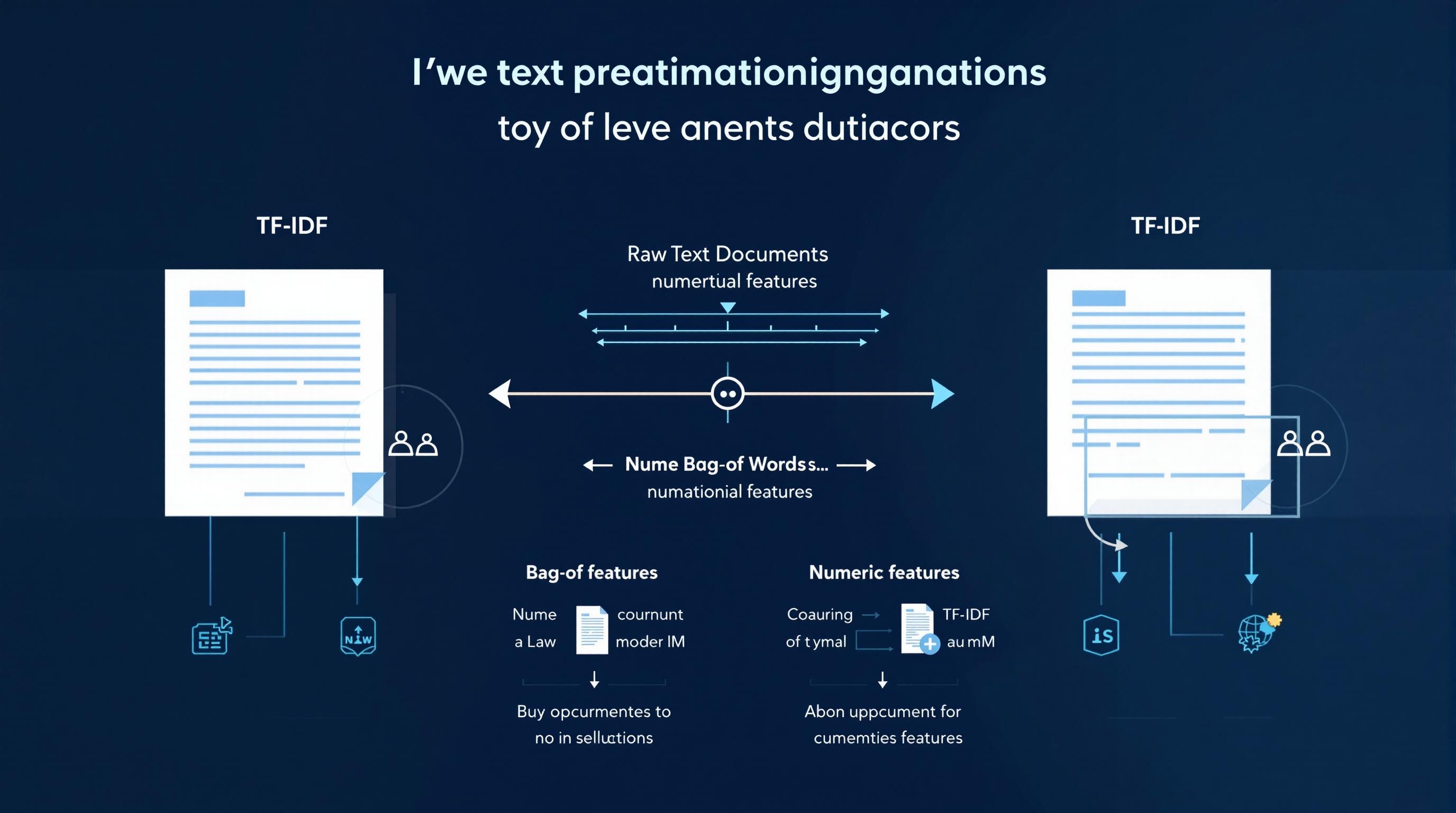
The Bag-of-Words (BOW) model is one of the simplest and most widely used approaches for text representation. It transforms text into fixed-length vectors by counting word occurrences while disregarding grammar and word order.
In this model, each document is represented as a vector where each dimension corresponds to a term in the vocabulary, and the value represents the term’s frequency in the document. For example, for the sentence “I love machine learning because machine learning is fascinating,” the representation might include counts like {“I”: 1, “love”: 1, “machine”: 2, “learning”: 2, “because”: 1, “is”: 1, “fascinating”: 1}.
While BOW is simple to implement using libraries like scikit-learn, it has limitations. It creates sparse, high-dimensional vectors and loses contextual information by ignoring word order. Despite these drawbacks, it remains effective for many text classification tasks, especially with traditional machine learning algorithms.
TF-IDF addresses a key limitation of the simple BOW model by weighting terms based on their importance. This technique combines two metrics:
Mathematically, TF-IDF is calculated as:
TF-IDF(t,d) = TF(t,d) × IDF(t)
Where IDF(t) = log(N/DF(t)), with N being the total number of documents and DF(t) the number of documents containing term t.
This weighting scheme reduces the impact of common terms that provide little discriminative information while emphasizing rare terms that may be more informative for classification. In practice, TF-IDF often outperforms raw frequency counts for document classification tasks.
Beyond basic BOW and TF-IDF, several advanced techniques capture more nuanced aspects of text:
N-grams extend the BOW model by considering sequences of n adjacent words rather than individual terms. For example, bigrams (n=2) would include “machine learning” as a single feature. N-grams capture local context and phrase information, improving classification performance for tasks where word order matters.
Word embeddings like word2vec and GloVe represent words as dense vectors in a continuous vector space, where semantically similar words are positioned closer together. These models capture semantic relationships between words, addressing a major limitation of BOW-based approaches. Word embeddings have revolutionized text feature engineering by providing rich representations that encode meaning and context.
Text feature engineering often combines multiple representation techniques and may include domain-specific features. The right approach depends on the specific classification task, available computational resources, and the characteristics of the text data being analyzed.
Naive Bayes classifiers are probabilistic algorithms based on Bayes’ theorem with an assumption of feature independence. Despite this “naive” assumption rarely holding true for text data (where words are clearly dependent on each other), these classifiers perform surprisingly well for text classification tasks.
There are three main variants used for document classification:
Naive Bayes classifiers offer several advantages for text categorization: they’re computationally efficient, perform well with high-dimensional data, require relatively small training sets, and are less prone to the curse of dimensionality. However, their assumption of feature independence can limit performance for complex language patterns, and they may perform poorly when features are highly correlated.
Support Vector Machines (SVMs) have been among the most effective traditional algorithms for text classification. They work by finding the optimal hyperplane that maximizes the margin between different classes in the feature space.
For text data that isn’t linearly separable, SVMs employ kernel functions to transform the feature space. Common kernels include:
Parameter tuning is crucial for optimal SVM performance. Key parameters include the regularization parameter C (controlling the trade-off between margin maximization and classification error) and kernel-specific parameters. Cross-validation helps identify the best parameter values for a specific document classification task.
SVMs excel with high-dimensional data and are effective even when the number of features exceeds the number of samples, making them particularly well-suited for text analysis problems.
Decision trees create a hierarchical structure where each node represents a feature, each branch a decision rule, and each leaf a class label. For text classification, features might be the presence or absence of specific words or phrases.
While individual decision trees are prone to overfitting, ensemble methods like Random Forests address this limitation by combining multiple trees. Random Forests build many decision trees using random subsets of features and training examples, then aggregate their predictions through voting.
These algorithms offer several advantages for text categorization:
For optimal performance in text mining applications, careful feature selection and tree depth control are essential to prevent overfitting while maintaining predictive power.
Recurrent Neural Networks have revolutionized text classification by effectively modeling sequential data. Unlike traditional methods, RNNs maintain an internal memory that captures information from previously processed words, making them naturally suited for language data.
Standard RNNs struggle with long-range dependencies due to vanishing gradient problems. Advanced architectures address this limitation:
Bidirectional RNNs process text in both forward and backward directions, capturing context from both past and future words. This bidirectional context is particularly valuable for classification tasks where understanding the full context is essential.
Libraries like TensorFlow and Keras make implementing these complex architectures more accessible, facilitating experimentation with different RNN variants for document classification tasks.
Originally designed for image processing, Convolutional Neural Networks (CNNs) have been successfully adapted for text classification. In text applications, CNNs use 1D convolutions that slide over word sequences (rather than 2D convolutions over image pixels).
These models excel at capturing local patterns and n-gram-like features through convolutional filters that identify important word combinations regardless of their position in the text. Multiple filters of varying sizes can detect different types of patterns simultaneously.
The CNN architecture for text typically includes:
CNNs offer computational efficiency compared to RNNs while still capturing local context effectively. They’re particularly well-suited for tasks where local word combinations provide strong classification signals, such as sentiment analysis or topic categorization.
Transformer models represent the current state-of-the-art in text classification. Unlike RNNs, transformers process entire sequences simultaneously rather than sequentially, using attention mechanisms to weigh the importance of different words when representing others.
Pre-trained transformer models like BERT (Bidirectional Encoder Representations from Transformers), GPT (Generative Pre-trained Transformer), and their variants have dramatically advanced the field. These models are first trained on massive general text corpora and then fine-tuned for specific classification tasks, a paradigm known as transfer learning.
The fine-tuning process allows these powerful models to adapt to specific document classification tasks with relatively small amounts of labeled data. This approach has achieved unprecedented performance across numerous benchmarks and real-world applications.
While transformers require significant computational resources, their exceptional performance on complex language understanding tasks makes them the preferred choice when accuracy is paramount and resources permit.
In many real-world text classification scenarios, classes are not evenly distributed. For instance, in spam detection, legitimate emails typically far outnumber spam. This imbalance can bias models toward the majority class, leading to poor performance on minority classes.
Several strategies address this challenge:
For evaluation, metrics beyond simple accuracy become crucial. Precision, recall, F1-score, and area under the ROC curve provide more meaningful insights into model performance across all classes, especially in imbalanced classification scenarios.
Text classifiers often face overfitting due to the high dimensionality of text data. Overfitting occurs when a model performs well on training data but poorly on unseen examples, essentially “memorizing” rather than generalizing.
Regularization techniques help combat overfitting:
Underfitting, where models are too simple to capture underlying patterns, can be addressed by increasing model complexity, adding more features, or reducing regularization strength. The key is finding the right balance between model complexity and generalization ability.
Cross-validation helps detect and address both overfitting and underfitting by evaluating model performance on multiple data subsets, providing a more reliable estimate of how the model will perform on unseen data.
As global communication increases, the ability to classify text across multiple languages becomes increasingly important. Multilingual text classification presents unique challenges beyond those of monolingual classification.
Approaches to multilingual classification include:
Language-specific considerations, such as different preprocessing requirements and varying grammatical structures, must be addressed for optimal performance. Recent advances in multilingual transformers have significantly improved cross-language classification capabilities, enabling effective document categorization across dozens of languages simultaneously.
The scikit-learn library provides comprehensive support for traditional machine learning algorithms and is widely used for text classification tasks. Its consistent API and extensive documentation make it accessible for both beginners and experienced practitioners.
A typical scikit-learn pipeline for text classification includes:
The Pipeline class enables chaining these steps into a single object that can be trained and evaluated as a unit, ensuring consistent data transformation during both training and prediction. This approach simplifies experimentation and helps prevent data leakage between training and testing sets.
For example, a complete text classification pipeline might look like:
from sklearn.feature_extraction.text import TfidfVectorizer

from sklearn.svm import LinearSVC

from sklearn.pipeline import Pipeline
text_clf = Pipeline([
('tfidf', TfidfVectorizer()),
('clf', LinearSVC())
])
Natural Language Toolkit (NLTK) and spaCy are specialized libraries for natural language processing that provide essential tools for text preprocessing and feature engineering.
NLTK offers comprehensive resources for tokenization, stemming, lemmatization, and stop word removal across multiple languages. It also includes several built-in classifiers and evaluation metrics specifically designed for text classification tasks.
spaCy takes a more performance-oriented approach, providing efficient tokenization, part-of-speech tagging, named entity recognition, and dependency parsing. Its pre-trained models capture linguistic features that can significantly enhance classification performance.
Both libraries integrate well with scikit-learn and other machine learning frameworks, allowing practitioners to combine specialized NLP capabilities with powerful classification algorithms. For example, spaCy’s tokenization and lemmatization can feed into a scikit-learn TF-IDF vectorizer, creating a more sophisticated text processing pipeline.
For implementing deep learning approaches to text classification, TensorFlow and its high-level API Keras have become standard tools. These frameworks provide the building blocks for constructing complex neural network architectures.
Key components for text classification include:
Pre-trained word embeddings like GloVe or word2vec can be easily incorporated to improve model performance, especially with limited training data. For transformer-based models, libraries like Hugging Face’s Transformers provide simple interfaces to fine-tune pre-trained models like BERT for specific classification tasks.
TensorFlow’s ecosystem also includes TensorBoard for visualization, TF-Hub for reusable model components, and TFLite for deployment to edge devices, facilitating the entire machine learning workflow from development to production.
As demonstrated in TensorFlow’s tutorial on text classification, building a neural network for sentiment analysis can be accomplished with relatively few lines of code while achieving strong performance.
Sentiment analysis has become a critical application of text classification for businesses seeking to understand customer opinions. This technique automatically categorizes text as positive, negative, or neutral, with some systems detecting more nuanced emotions like frustration, satisfaction, or excitement.
Organizations use sentiment analysis to:
Implementation approaches range from lexicon-based methods that use predefined sentiment dictionaries to sophisticated deep learning models that capture context and nuance. Many companies combine sentiment analysis with other classification tasks, such as intent detection or topic categorization, to gain deeper insights from customer feedback.
According to Embedded Robotics, businesses implementing sentiment analysis have seen up to 30% improvement in customer satisfaction metrics through more timely and targeted responses to negative feedback.
News organizations and content aggregators rely on automated topic categorization to organize vast amounts of content. This application combines supervised classification with unsupervised topic modeling techniques to create sophisticated content organization systems.
In news categorization, hierarchical classification structures often mirror traditional news sections (politics, sports, business, technology) while allowing for more granular sub-categories. For example, a sports article might be further classified into specific sports, teams, or events.
Topic modeling algorithms like Latent Dirichlet Allocation (LDA) complement classification by discovering themes within documents without predefined categories. These techniques help identify emerging topics and trends that might warrant new classification categories.
Performance in news categorization is typically measured using standard metrics like accuracy and F1-score, with special attention to avoiding misclassifications that could undermine reader trust. Major news outlets report classification accuracy exceeding 90% for primary categories, with slightly lower performance for more specialized subcategories.
Email classification, particularly spam filtering, represents one of the most widely deployed text classification applications. Modern spam filters use sophisticated machine learning approaches that continuously adapt to evolving spam tactics.
Feature selection for email classification extends beyond simple word frequencies to include:
The balance between precision and recall is particularly critical in spam detection. False positives (legitimate emails classified as spam) can have serious consequences, while false negatives (spam reaching the inbox) create user frustration. Most systems allow adjustment of this balance through sensitivity settings.
According to Toptal’s NLP tutorial, modern machine learning-based spam filters achieve precision and recall rates above 99%, significantly outperforming rule-based approaches while requiring less manual maintenance.
The field of text classification continues to evolve rapidly, with several emerging trends shaping its future direction:
Zero-shot and few-shot learning approaches aim to classify text into categories not seen during training or with minimal examples. These techniques leverage large pre-trained models and prompt engineering to transfer knowledge across tasks. For example, GPT models can classify text into arbitrary categories by framing the task as text completion, dramatically reducing the need for task-specific labeled data.
Multimodal classification combines text with other data types such as images, audio, or user behavior. This integration creates more comprehensive classification systems that capture information across different modalities. For instance, social media content classification increasingly considers both text and images to better detect misleading content or harmful material.
Explainable AI for text classification addresses the “black box” nature of complex models by providing transparent explanations for classification decisions. Techniques like attention visualization, feature importance analysis, and counterfactual explanations help users understand why a document received a particular classification, building trust and enabling error correction.
As researchers continue to advance the state of the art in natural language processing, text classification systems will become more accurate, require less labeled data, handle more complex language phenomena, and integrate more seamlessly with other AI systems. These developments will expand the range of applications where automated document categorization can provide value.
For those interested in staying current with text classification advances, ProjectPro offers a comprehensive overview of emerging techniques and their practical applications.
As text classification technology continues to mature, the barrier to implementation lowers, making these powerful techniques accessible to organizations of all sizes through platforms like Jasify’s AI tools, which simplify deployment without requiring deep technical expertise.


Discover the 7 stages of artificial intelligence from rule-based systems to the theoretical Singularity. Learn where we stand today and how businesses can leverage current AI capabilities for real results.
Discover the real difference between AI vs algorithm with our expert guide. Learn when to use each for your business needs, how they work, and practical examples from automation to ChatGPT.
Discover the 7 stages of artificial intelligence from rule-based systems to the theoretical Singularity. Learn where we stand today and how businesses can leverage current AI capabilities for real results.
Discover the real difference between AI vs algorithm with our expert guide. Learn when to use each for your business needs, how they work, and practical examples from automation to ChatGPT.
Discover the 7 stages of artificial intelligence from rule-based systems to the theoretical Singularity. Learn where we stand today and how businesses can leverage current AI capabilities for real results.
Discover the real difference between AI vs algorithm with our expert guide. Learn when to use each for your business needs, how they work, and practical examples from automation to ChatGPT.
Discover the 7 stages of artificial intelligence from rule-based systems to the theoretical Singularity. Learn where we stand today and how businesses can leverage current AI capabilities for real results.
Discover the real difference between AI vs algorithm with our expert guide. Learn when to use each for your business needs, how they work, and practical examples from automation to ChatGPT.
Discover the 7 stages of artificial intelligence from rule-based systems to the theoretical Singularity. Learn where we stand today and how businesses can leverage current AI capabilities for real results.
Discover the real difference between AI vs algorithm with our expert guide. Learn when to use each for your business needs, how they work, and practical examples from automation to ChatGPT.